Short answer: Evaluate five things before buying club tennis attire: opacity (stretch white fabric over your hand — if skin shows clearly, skip it), pleat memory (scrunch and release — pleats should spring back), stretch recovery (the waistband should snap back instantly), liner comfort (smooth edges, mid-thigh length), and stitch quality at stress seams. Price is a weak quality signal; construction is a strong one.
There are plenty of style guides for club tennis. This one is different: it is the checklist a garment factory would use to judge whether a tennis skirt, dress or polo is actually well made — translated for buyers. Ten minutes of checking saves a season of disappointment.
The 5-Point In-Store (or Unboxing) Test
1. The opacity test. Stretch a section of fabric — especially white — over your fingers at about 1.5× its relaxed width and hold it to light. If you can clearly see skin or fingers, the garment will turn revealing on court when stretched and sweat-damp. Well-made white tennis pieces use lined panels or denser double knits.
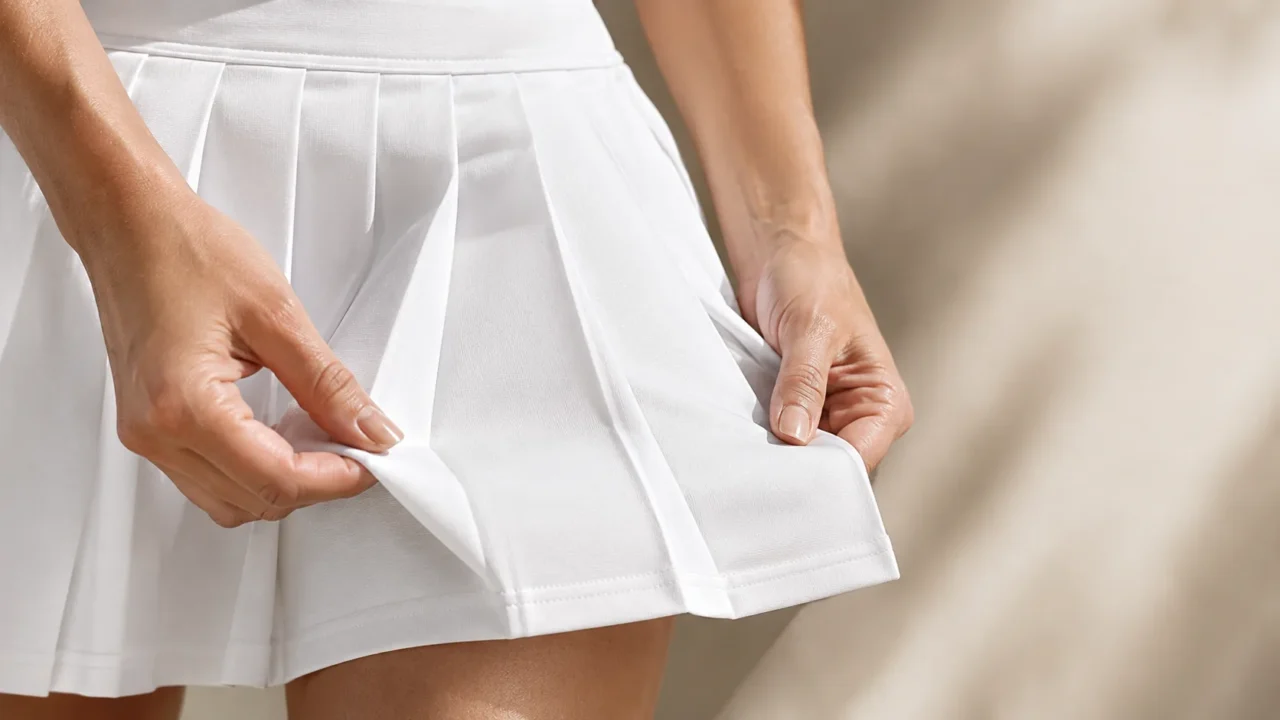
2. The pleat memory test. Crush a pleated section in your fist for five seconds and release. Heat-set pleats on a quality polyester-rich skirt (typically ~180–220 GSM) spring back sharp. Pleats that stay crumpled were pressed, not set — they will collapse after the first wash.
3. The recovery test. Stretch the waistband fully and let go. It should snap back instantly with no slow creep. Fabric or elastic with stretch but poor recovery is why skirts bag at the seat and waistbands fold over mid-match. (High elasticity numbers on a label say nothing about recovery — this hand test does.)
4. The liner check. Built-in shorts should be smooth-faced, sit mid-thigh, and finish with soft, flat elastic edges — no raised seams against the leg. A ball pocket on the liner is a sign the designer actually plays. Liners that are short, loose at the hem or rough-edged ride up and chafe.
5. The seam check. Look inside at the underarm, the skirt waistband join, and the liner attachment. You want flatlock or cleanly overlocked seams with even stitch density and no loose tails. Pull the seam gently sideways — stitches should not gap open.
Fit Checks by Garment
- Skirts and skorts: the waistband should sit flat without folding when you bend; pleats should fall vertically at standstill. Do one full squat and one lateral lunge — the liner must stay put.
- Dresses: raise both arms overhead; the hem should rise less than a hand’s width and the bodice should not pull across the chest. A built-in shelf bra needs to hold without doubling a sports bra unless you prefer one.
- Polos and tanks: collars should sit flat after stretch; sleeve openings shouldn’t gape on a swing. Serve motion test: full overhead reach without the hem escaping your waistband.
Reading the Label Like a Pro
- Fiber blend: polyamide(nylon)-elastane blends feel softer and drape better; polyester-elastane holds pleats and color better outdoors. Both are legitimate — match to the garment’s job.
- Elastane share: roughly 6–12% covers most tennis garments; much higher belongs to compression wear, not club attire.
- Care symbols: “wash cold, no softener, line dry” is normal for performance knits. Fabric softener is the quiet killer of wicking finishes — if you won’t follow that, expect performance to fade.
- UPF rating: for regular outdoor play, UPF-rated fabric is worth seeking out, especially in white where coverage and sun protection both depend on fabric density.
When “Expensive” Isn’t “Better”
Premium price often pays for brand and print, not construction. The five-point test above costs nothing and routinely disqualifies expensive pieces while passing mid-priced ones. Conversely, suspiciously cheap tennis sets usually fail two tests at once — opacity and recovery — because both are fabric-cost problems.
For Brands: Turning This Checklist Into a Spec Sheet
Every test above maps to a factory specification: fabric GSM and lining plan, heat-setting parameters for pleats, elastic recovery percentage, liner pattern and edge finish, and stitch density at stress seams. If you are developing a club tennis line, put these into your tech pack — and confirm your manufacturer tests them before bulk, not after returns.
That is how we run activewear production at YOUMEGA, a private-label manufacturer in Xiamen, China: paired fabric and liner sourcing, heat-set pleating, recovery-tested elastics, and AQL 2.5 final inspection, with OEKO-TEX Standard 100, BSCI, REACH and CPSIA compliance — the same checklist applies whether the style is a yoga set or a country-club skort. Stock styles with your logo from 100 sets (mixed colors and sizes allowed); full custom development at 300–500 pcs per style per color; stock samples in about 7 days, custom in 12–15.
Preguntas frecuentes
How can I tell if a white tennis skirt is see-through before buying?
Stretch the fabric over your fingers at moderate tension and hold it to light. Clear skin show-through at the stretch means it will be revealing on court. Lined or double-layer construction passes this test.
What makes tennis skirt pleats stay sharp?
Heat-set pleating on polyester-rich fabric at sufficient weight (roughly 180–220 GSM). Crush-and-release in your hand — permanent pleats spring back.
How much should good country club tennis attire cost?
Construction matters more than price tier. Use the five-point test; mid-priced garments frequently outperform premium-priced fashion pieces on opacity, recovery and seams.
What’s the ideal fabric blend for tennis dresses?
Polyamide-elastane for soft drape and feel, polyester-elastane for pleat retention and outdoor colorfastness — typically with around 6–12% elastane either way.
Why do some skirts bag out at the seat after a few wears?
Poor elastic and fabric recovery — the fabric stretches but doesn’t snap back. The instant-snap waistband test catches this before you buy.