MOQ Theater: Why Some Factories Quote 100 But Won’t Actually Run 100
“MOQ desde 100 pcs” on a factory’s Alibaba listing is often a marketing claim, not a production reality. Many Chinese activewear factories with real profitable thresholds of 500-1,000 pcs use low advertised MOQs to win first contact, then price 100-pc orders to lose — surcharges, premiums, and lead-time penalties that quietly make small orders unprofitable for the buyer. The pricing curve and three sourcing questions reveal which factories actually run 100 pcs and which are running MOQ theater.
Walk through any Chinese activewear factory’s Alibaba listing and you’ll see "MOQ desde 100 pcs" or even "MOQ desde 50 pcs" advertised. For growing brands, that number is the difference between launching and not launching. Then you send an inquiry, and somehow the quote that comes back tells a different story.
Setup fee. Fabric MOQ surcharge. "Custom color premium." "We can do 100 pcs but lead time is 60 days." Suddenly your 100-pc order costs as much as a 500-pc order would at a different factory.
This isn’t always a scam. Sometimes it’s the factory’s honest cost structure showing through. But often it’s something more deliberate: MOQ theater — advertising a low MOQ to win the inquiry, then making 100-pc orders unprofitable to discourage them in favor of larger orders.
How MOQ theater works
Three forms are most common:
1. Fabric MOQ surcharge. Many fabric mills require a minimum purchase per color — typically 100-500 kg. For 100 pcs of leggings, the fabric needed might be 30 kg, well under the mill’s MOQ. The factory pays for 100 kg, uses 30, and tries to recover the unused 70 kg cost either by selling it to other clients or by passing it to you as a "small-order surcharge." A factory that genuinely supports 100-pc MOQ has fabric in their own stock to absorb this. A factory that doesn’t will quietly charge you for the difference.
2. Inflated per-unit price below their real threshold. A factory’s true profitable MOQ might be 500 pcs. They’ll quote 100 pcs at $18/pc and 500 pcs at $12/pc. The 100-pc quote isn’t reflecting real cost — it’s reflecting "if you really want this, here’s the price that makes it not worth our time." Most buyers see the math and order 500 instead. Which is exactly the point.
3. Lead time as deterrent. "We can do 100 pcs, but lead time is 45 days." Translation: your order will sit in queue behind larger orders until there’s a gap to slot it in. Sometimes that gap is real. Often it’s a soft "no" without saying no.
Why factories do this
It’s not malicious. Running a 100-pc order takes nearly the same setup time as running a 500-pc order — pattern grading, fabric prep, machine setup, sample approval, QC. The labor cost difference is small. The margin on 100 pcs is thin. Many factories built their capacity around 500+ pc orders and genuinely struggle to fit smaller ones profitably.
The dishonest part isn’t the cost structure. It’s advertising "MOQ 100" when the factory’s real, profitable MOQ is 500. They’re selling the access, not the production.
What "genuine MOQ 100" actually looks like (factory economics)
A factory that genuinely runs 100-pc orders profitably has built their operation around small batches. Their economics look different from the start:
- Fabric stock model: They keep 15-25 fabric SKUs in their own warehouse (typical weights: 220 / 240 / 260 / 280 GSM, in 6-10 core colors each). When a 100-pc order comes in, no fabric mill surcharge applies because they’re cutting from existing stock.
- Machine setup cost amortized differently: A sewing line setup for a new style takes 2-4 hours regardless of order size. Big factories spread that cost across 500-1,000 pcs. Small-batch factories spread it across 100-300 pcs, which means their per-piece overhead is genuinely higher — but they’ve priced that in, so they’re not surprising you with a surcharge.
- Operator skill match: Their sewing operators are cross-trained on multiple styles instead of specialized to one style. This is slower per piece on long runs but dramatically faster on short runs (no relearning time when switching styles).
- QC scaled to batch: They run 100% inspection on 100-pc orders (because it’s only 100 pieces) instead of AQL sampling. This actually catches more defects on small runs than big factories catch on 1,000-pc runs.
The economic reality: a factory genuinely good at 100-pc production charges 20-30% more per piece than a factory genuinely good at 5,000-pc production. That premium is honest — it reflects the real operational difference. MOQ theater is when a factory charges that premium while pretending they’re running like a small-batch operation.
Three questions that reveal MOQ theater
When you receive a quote for a low-MOQ order, ask these three:
1. "Is fabric in your stock or do you need to source it for this order?" If the answer is "we’ll source it for your order," and your order is small, expect surcharges. If the answer is "we have this fabric in stock," your 100-pc order is likely to run smoothly without hidden costs.
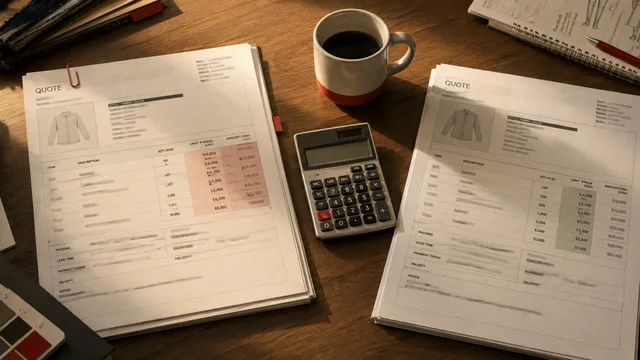
2. "What’s the per-unit price at 100 pcs, 300 pcs, 500 pcs, and 1,000 pcs?" Honest factories will give you a smooth curve — maybe $14 / $12 / $11 / $10. MOQ theater shows up as a cliff — $18 / $11 / $10.50 / $10. The cliff means 100 pcs is being priced to discourage, not to break even.
3. "How many 100-pc orders did you run last month?" A factory genuinely running small orders does this routinely and will give you a number ("about 8 orders under 200 pcs last month"). A factory doing MOQ theater will dodge or say something vague like "we run all sizes" — the answer that doesn’t answer.
Why MOQ theater shows up at the sample stage first
If you don’t catch MOQ theater in the quote, it shows up next at the sample stage. Watch for these signals before you’ve committed to bulk:
- Sample lead time is 25+ days for a basic style. A factory running small orders routinely makes samples in 7-12 days because their sampling team is fast and their fabric is in stock. Long sample lead time means your sample is going to the back of the queue behind their bigger clients.
- Sample fee is non-refundable even on bulk. Real small-batch factories refund sample fees on bulk orders because that’s how they convert paid samples to paid orders. Non-refundable sample fees signal that the factory isn’t set up to convert your 100-pc order into a relationship.
- Sample is sent without any technical questions. A factory that intends to actually run your 100 pcs will ask about your target customer’s body proportions, your retail price point, your washing instructions, and whether you want any size grading adjustments. A factory running MOQ theater just makes a generic sample.
- Sales rep mentions "higher quantities" in 3 of the first 5 emails. This is the soft sell toward your 500-pc order at the expense of your actual 100-pc plan. Pay attention to whether the rep is solving your problem or trying to change your problem.
Real-MOQ-100 vs MOQ theater: 10 signals side by side
| Signal | Genuine MOQ 100 factory | MOQ theater factory |
|---|---|---|
| Pricing curve (100 / 300 / 500 / 1000) | Smooth: $14 / $12 / $11 / $10 | Cliff: $18 / $11 / $10.50 / $10 |
| Fabric source for small orders | In-house stock, 15-25 SKUs | Sourced per order, with surcharge |
| Tiempo de muestra | 7-12 days | 20-35 days |
| Sample fee policy | Refundable on bulk over 100-200 pcs | Non-refundable or refundable only on 500+ pcs |
| Bulk lead time at 100 pcs | 18-25 days | 40-60 days (or “TBD”) |
| Setup fee transparency | Listed on quote, $0-200 typical | Hidden in unit price or “to be confirmed” |
| 100-pc order frequency last month | Specific number (e.g., 8 orders) | Vague (“we run all sizes”) |
| Sales rep behavior | Engages with 100-pc plan as-is | Steers conversation toward 500+ pcs |
| Factory size | Typically 80-200 workers | Typically 300+ workers |
| Production location | Sews in-house | May subcontract small orders to a workshop |
When MOQ theater is OK
Not every cliff in pricing means a factory is dishonest. Factories specializing in seamless knitting, sublimation print, or proprietary fabrics legitimately can’t produce profitably below 300-500 pcs because their machinery is optimized for runs. Those factories will tell you so upfront when asked. The honest version is: "Our minimum is really 300 pcs for this product. We list 100 to be available for samples and small repeats." That’s a workable signal — you know exactly what you’re working with.
This honest version is also what to listen for if you’re doing seamless or sublimation-printed swimwear — both have legitimate technical reasons for higher minimums. A factory that says "300 pcs minimum on seamless, 100 pcs on cut-and-sew" is being honest about machine economics, not running theater.
What this means for growing brands
If you’re placing 100-pc orders, find factories whose real MOQ is at or below 100 pcs — not factories whose advertised MOQ is 100 but whose real economics need 500. The smaller, mid-sized factories that do 100 pcs as their bread-and-butter will often quote you a flat per-unit price across small and medium runs. They won’t have a 50% premium for small orders because small orders are their business.
The factory that can quote you $12/pc at 100 pcs without hidden charges is the factory you want — not the one that quotes $18 at 100 and $11 at 500 hoping you’ll pick the 500.
If you’re considering mixing styles to hit a higher MOQ at one factory (e.g., 50 leggings + 30 sports bras + 20 tops = 100 total), be aware that mixed MOQ orders have their own hidden costs — separate setup, separate fabric handling, separate QC. The economics are different from a single-style 100-pc order.
Frequently asked questions
What’s the real minimum order quantity for activewear in 2026?
Genuine MOQ for cut-and-sew activewear with custom logo (not full custom design) starts at 50-100 pcs per style at small-batch factories. Full custom OEM with custom fabric typically starts at 300-500 pcs. Seamless construction has a hard floor around 200-300 pcs because of machine setup. Sublimation-printed styles need 100m of fabric per print, which equates to roughly 100-150 pcs per design. Anyone advertising lower than these numbers without explaining how they hit those economics is usually running MOQ theater.
Why don’t big factories just stop advertising low MOQs?
Because the low MOQ wins them the first email. Once they have your contact, they can either upsell you to a larger order or pass you to a subcontractor. The cost of advertising a misleading MOQ is essentially zero. The cost of losing the inquiry to a competitor with a real low MOQ is real. So they advertise low and price high. The buyer absorbs the cost of the mismatch.
Is it worth paying the surcharge to work with a big factory at 100 pcs?
Sometimes. If you need a specific certification (OEKO-TEX, GRS, BSCI) that only a large audited factory can provide for your retail channel, the surcharge may be justified. If you’re sourcing for general retail or DTC and certifications aren’t a hard requirement, a mid-sized factory delivers better value at small order sizes.
How do I know if a factory’s 100-pc lead time is real or stalling?
Ask for a specific production calendar: "What week does cutting start? What week does sewing finish? What week does QC happen?" A factory genuinely running 100-pc orders will give you specific dates. A factory stalling will give you vague ranges or "subject to material arrival." The specificity test almost always works.
Can I negotiate down the surcharge on a 100-pc order at a big factory?
Yes, partially. Most big factories will reduce a stated "small-order surcharge" by 30-50% if you commit to a follow-up order or a multi-style sample agreement. They won’t eliminate it — the underlying economics are real — but the negotiated surcharge often lands close to what a mid-sized factory would charge without the surcharge framing. Whether that’s worth the negotiation effort depends on how much you value their certifications or capacity for future scale.
This article was written by the manufacturing team at YOUMEGA, an activewear OEM/ODM factory in Xiamen, China. We run 100-pc orders as our standard floor — fabric stock, in-house sewing, smooth pricing curve, no surcharge theater. If you want to see what a real small-batch quote looks like, Contactar with your style references and quantities.