The Hidden Cost of "Mixed MOQ" Orders Across Multiple Styles
Mixed MOQ typically costs 10–20% more per unit than a single-style order of the same total quantity. That premium is not a markup — it is real factory setup time being passed through to the buyer. Understanding where it comes from is the difference between using mixed MOQ as a launch tool and treating it as a hidden tax.
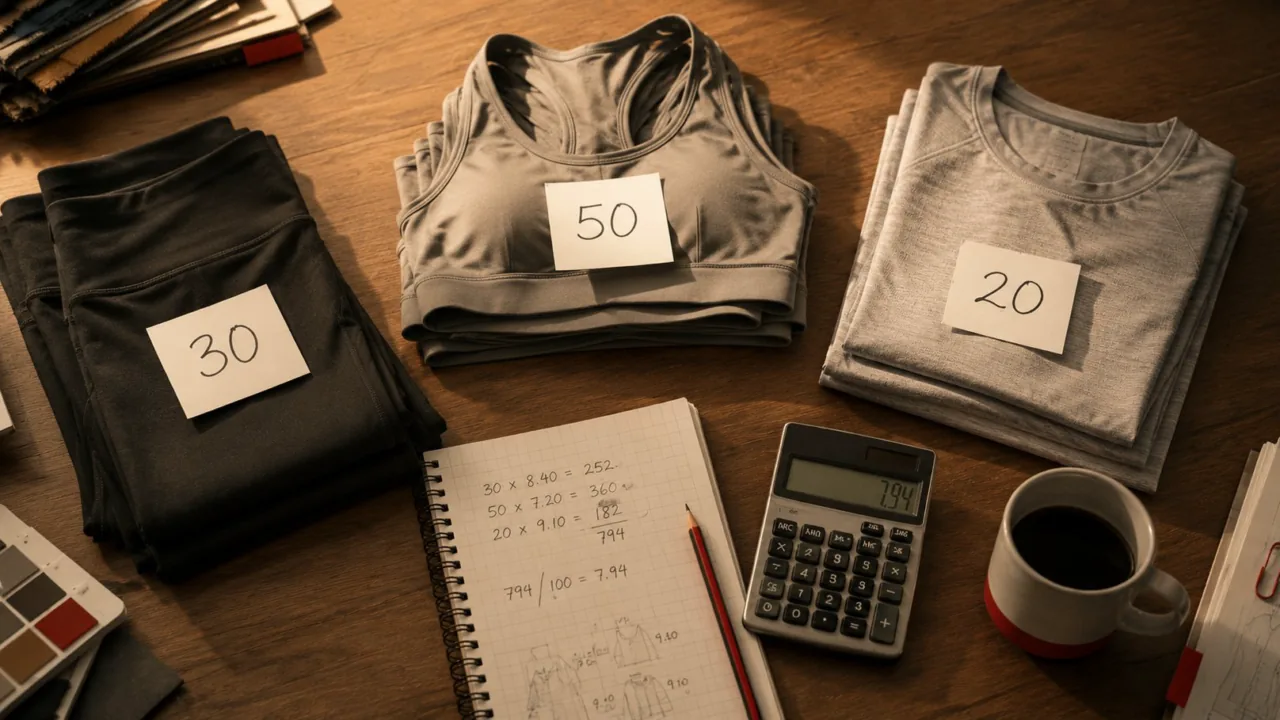
If your activewear brand is small or just launching, the words "mixed MOQ welcome" feel like permission. You can order 30 pcs of a sports bra, 50 pcs of a legging, and 20 pcs of a top — total 100 pcs, MOQ met, launch happens.
This is a real option at many mid-sized factories (ours included). It’s not a marketing trick. But it has hidden costs that change the per-unit economics in ways most buyers don’t see until the quote comes back.
Understanding the math saves you 10-20% per unit and helps you decide when mixed MOQ is worth it versus when consolidating into single-style orders gives you a better launch.
What mixed MOQ actually costs the factory
Every style change in production has fixed costs. Even when total piece count is 100, splitting that across 3 styles triples the setup work:
Pattern grading. Each style needs its tech pack reviewed, patterns digitized, and graded to 5-6 sizes. Time: ~2 hours per style. For 100 pcs of one style: 2 hours. For 100 pcs across 3 styles: 6 hours.
Fabric setup. Each style may use different fabric or different colorways. Cutting 30 pcs of legging fabric, then 50 pcs of bra fabric, then 20 pcs of top fabric requires three fabric layouts on the cutting table, three pattern markers, and three cutting machine passes. Time: ~1.5 hours per fabric setup. Three setups: 4.5 hours.
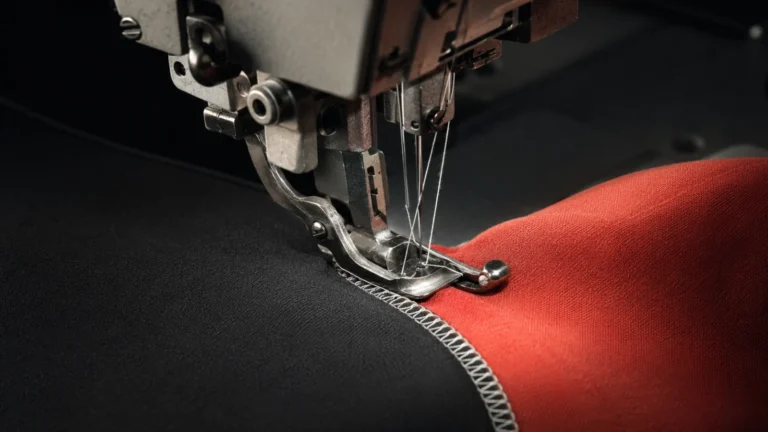
Machine changeover. Sewing different styles uses different stitch types, different machine attachments, and different operator skill sets. Switching a sewing line from legging to bra production takes 1-2 hours of setup time per changeover. Three changeovers: 3-6 hours of lost production time.
QC adjustment. Each style needs a separate sample approval and inspection protocol. Three styles means three inspection rounds, three packing specifications, three labeling templates.
Total fixed setup time for 3 styles at 100 pcs split: 15-20 hours. Total fixed setup time for 1 style at 100 pcs: 4-6 hours.
That difference — 11-14 hours of extra factory time — has to come from somewhere.
Setup time, side by side
| Production step | 100 pcs / 1 style | 100 pcs / 3 styles | Extra time |
|---|---|---|---|
| Pattern grading | ~2 hours | ~6 hours | +4 hours |
| Fabric layout & cutting setup | ~1.5 hours | ~4.5 hours | +3 hours |
| Sewing line changeover | 0 hours | 3–6 hours | +3–6 hours |
| QC + packing setup | ~1 hour | ~3 hours | +2 hours |
| Total fixed setup | 4–6 hours | 15–20 hours | +11–14 hours |
How factories absorb the cost
Option 1: Per-unit price increases. Honest factories will quote a "split surcharge" of $1-3 per unit on mixed MOQ orders. A single-style 100-pc order quotes at $12/pc. The mixed-MOQ version quotes at $14-15/pc. The math reflects the real setup time.
Option 2: Longer lead times. Some factories absorb cost in time instead of money. Single-style: 18 days production. Mixed across 3 styles: 28-30 days because the order has to slot in around other work whenever the cutting/sewing line has gaps.
Option 3: Quality drift. Cheaper or larger factories try to absorb cost by sewing faster, skipping QC steps, or assigning B-grade operators. You won’t see this in the quote — you’ll see it in your goods.
The first two are honest. The third is the one to watch for.
The math at three order sizes
Imagine you’re a new brand launching with three SKUs. Here’s how the same order plays out two ways:
Scenario A: Single-style consolidated order
- Round 1: 100 pcs of Style A (high-waist legging), order date Jan 1, ship date Feb 1
- Round 2: 100 pcs of Style B (sports bra), order date Mar 1, ship date Apr 1
- Round 3: 100 pcs of Style C (training top), order date May 1, ship date Jun 1
- Per-unit price: $12/pc across the board
- Total: $3,600 for 300 pcs, 6 months timeline, 3 separate launches
Scenario B: Mixed MOQ all at once
- 30 pcs of Style A + 50 pcs of Style B + 20 pcs of Style C, order date Jan 1, ship date Mar 1
- Per-unit price: $14/pc (mixed surcharge)
- Total: $1,400 for 100 pcs, 2 month timeline, 1 launch
Mixed MOQ saves $0 on per-unit cost but saves you 4 months of timeline. Single-style saves you $2/pc but spreads launch across 6 months.
Which is better depends on what you’re optimizing for:
- Speed to market → Mixed MOQ wins
- Per-unit margin → Single-style wins
- Inventory risk → Mixed MOQ wins (you sell through 100 mixed before reordering)
- Sample variety in your store → Mixed MOQ wins
- Brand depth → Single-style wins (you have 100 of one style instead of 30 of three)
When mixed MOQ is the right call
Three scenarios make mixed MOQ worth the per-unit premium:
Scenario 1: First launch, learning what sells. You don’t know which of your three SKUs will be bestseller. Buying 30/50/20 lets you see real customer response before committing to 500-pc reorders.
Scenario 2: Capsule collection or seasonal drop. You want a coordinated set of products for an Instagram launch or seasonal Pinterest campaign. Mixed MOQ gets you variety at launch without 1,500 total pieces sitting in inventory.
Scenario 3: Sample-to-bulk validation. Some buyers use 100-pc mixed MOQ as an extended sample — see how all three styles sell in their store, then order single-style reorders of the bestsellers at 500+ pcs to get the better per-unit pricing.
When single-style is better
Three scenarios where single-style 100-pc orders make more sense:
Scenario 1: You already know your bestseller. If your audience consistently buys leggings and one specific style, 100 pcs of just that style at $12/pc is better margin than 30 mixed at $14/pc.
Scenario 2: Repeat orders. Once you have data showing what sells, single-style orders avoid paying the mixed surcharge for variety you don’t need.
Scenario 3: Multiple colors of the same style. Some factories let you mix colors within a single style at no surcharge (because it’s one pattern, one fabric, one stitch type — just different dye lots). 50 pcs black + 30 pcs navy + 20 pcs grey of the same legging is usually $12/pc, not $14/pc. Ask before assuming.
Decision matrix: when mixed MOQ pays off
| Your situation | Better choice | Why |
|---|---|---|
| First-ever launch, 3+ SKUs untested | Mixed MOQ | Cheaper learning, faster market data |
| Reorder of proven bestseller | Single-style | Skip surcharge, better margin |
| Seasonal capsule for one campaign | Mixed MOQ | Coordinated drop, less inventory risk |
| Same style in 3 colors | Single-style multi-color | Usually no surcharge — one pattern, one fabric |
| Budget locked, max units needed | Single-style | 10–20% more pieces for the same spend |
| Tight launch deadline (under 60 days) | Mixed MOQ | One production window instead of three |
Factory size changes the surcharge
The factories that make mixed MOQ work without painful surcharges are usually mid-sized: 50–200 sewing operators, simpler product mix, and machines that change over quickly. Large factories (500+ operators) built around 1,000-pc orders treat 100-pc mixed runs as a disruption and price accordingly. Very small workshops can be flexible but often struggle with QC consistency across three different styles. If your target order is in the 100–300 pc range and you plan to mix styles regularly, the mid-sized factory tier is almost always the right match.
What to ask your factory
Three questions before committing to mixed MOQ:
1. "What’s the per-unit price for 100 pcs single-style versus 100 pcs mixed across 3 styles?" The gap tells you what the factory’s real cost is. A $0.50 gap means they’re absorbing most of the cost. A $3 gap means they’re passing it all to you. Both are honest — but you know what you’re paying.
2. "Do mixed colors within a single style count as ‘mixed’?" Often no. Mixed colors usually don’t trigger the surcharge because the pattern and fabric are the same. Ask.
3. "What’s the lead time for mixed MOQ versus single-style?" If lead time is 50% longer for mixed MOQ, the factory is queue-managing the cost. Make sure your launch date can absorb that.
The real trade-off
Mixed MOQ isn’t a buyer-friendly favor. It’s an option. Used well, it cuts your time-to-market and inventory risk. Used badly, it costs you 15-20% per unit without benefit.
The factories that make mixed MOQ genuinely work for small buyers are the ones who built their operations around 100-pc orders from day one — usually mid-sized factories with simpler product mix, faster machine changeovers, and operators trained to work across styles. The factories where mixed MOQ feels expensive are usually the ones built around 500-pc orders trying to accommodate you.
When you are evaluating quotes from multiple suppliers, this difference rarely shows up on the spec sheet. Our 10-point quote comparison checklist covers the other places it hides.
Want a clear single-style vs mixed-MOQ quote on your project?
Send us your reference images, target quantity per style and target launch date. We’ll reply within 24 hours with both options priced side by side — so you can choose based on the real trade-off, not guesswork. MOQ desde 100 sets, mixed colors and sizes allowed.
Frequently asked questions
What is a typical mixed-MOQ split surcharge?
Most honest factories charge $1–3 per unit extra on mixed-MOQ orders compared with a single-style order of the same total quantity. On a $12/pc base, this is roughly a 10–20% premium and reflects 11–14 hours of additional pattern grading, fabric setup, sewing changeover, and QC time.
Do multiple colors of the same style count as “mixed”?
Usually no. Mixed colors within one style share the same pattern, fabric base and stitch type, so the cutting and sewing setup is identical. Most factories quote 50 black + 30 navy + 20 grey of the same legging at the single-style price, not the mixed-MOQ price. Always confirm in writing before the deposit.
Why is mixed-MOQ lead time often longer?
Some factories absorb the setup cost in time rather than money. Single-style 100 pcs might ship in 18 days; mixed-MOQ 100 pcs across 3 styles might take 28–30 days because the order has to slot in around larger production runs whenever the cutting and sewing lines have gaps.
When should I switch from mixed-MOQ to single-style reorders?
Once you have 60–90 days of sell-through data and one or two clear bestsellers, reorder those bestsellers as single-style runs at 300–500 pcs. You’ll capture the 10–20% per-unit savings and concentrate inventory where demand is proven. Keep mixed-MOQ for new style trials, not for repeat business.
Is mixed MOQ realistic for ocean shipping (LCL/FCL)?
Yes for LCL (less-than-container-load), which is the standard for orders under 200–300 kg. A typical 100-pc mixed-MOQ activewear order weighs 25–40 kg total and ships as LCL without issue. FCL only starts making sense at orders around 500+ pcs of cut-and-sew or 800+ pcs of seamless.
What factory size handles mixed MOQ best?
Mid-sized factories with 50–200 sewing operators tend to handle 100-pc mixed-MOQ orders best — their machine changeovers are faster and they price the surcharge realistically. Very large factories (500+ operators) usually charge more because mixed-MOQ disrupts their workflow. Very small workshops are flexible but often inconsistent on QC across multiple styles.