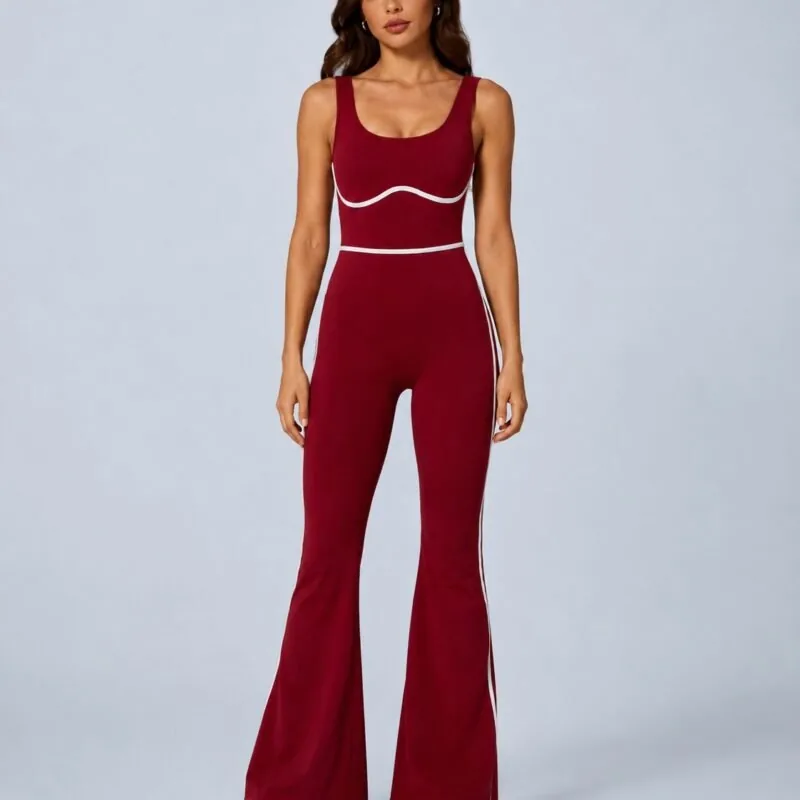
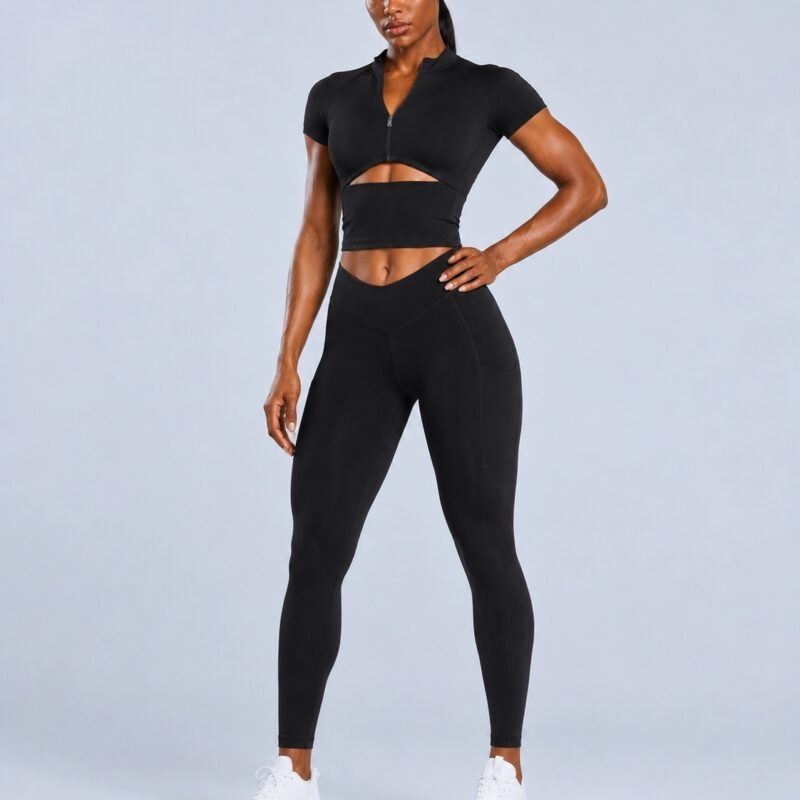
For most commercial private label leggings, the right starting point is 230–250 GSM nylon-spandex. That single range covers the majority of yoga, training and studio orders we ship — but it is not the right answer for every brand, and choosing the wrong legging fabric Gramaje is one of the most common reasons a first private label run feels off-brand.
At YOUMEGA we run legging fabrics from 220 up to 320 g/m² — 280–320 g/m² for compression and squat-proof styles.
For private label activewear, fabric weight is measured in GSM (grams per square meter, ISO 3801). It affects how the garment feels in hand, how much compression it gives, how opaque it looks in motion, and how much the final product will cost. For a growing brand, choosing the right GSM for leggings is not just a technical detail — it is part of product positioning.
What does GSM actually change?
Higher GSM does not automatically mean better leggings. It means heavier fabric. In some products that helps. In others, it creates unnecessary cost or makes the garment feel too warm.
Fabric weight influences five things most buyers care about:
- Opacity during bending and stretching
- Compression and support
- Drape and softness
- Heat retention and seasonal comfort
- Fabric cost and shipping weight
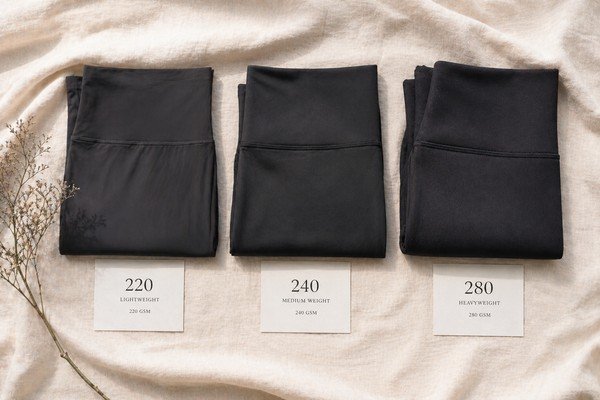
Quick comparison: 220 vs 240 vs 280 GSM
| GSM Range | Ideal para | Hand feel | Cost tier |
|---|---|---|---|
| 220 | Studio, lounge, warm climate | Light, soft, flexible | Entry |
| 240 | General gym, yoga, training | Substantial but not heavy | Mid (commercial sweet spot) |
| 280 | Sculpting, high compression, cool weather | Dense, structured, premium | Premium |
220 GSM: light, flexible, lower-cost entry point
A fabric around 220 GSM is usually chosen for lighter training leggings, studio wear, or brands trying to keep pricing aggressive. It can work well when the yarn quality is good and the fit is correct, but it leaves less room for error. If the pattern is too tight, or if the legging is worn in lighter colors, buyers may start to worry about transparency.
This weight is often useful for brands that want a softer, lighter legging feel, warm-climate collections, entry price points, or less compressive products. The tradeoff is that light fabrics depend more on good pattern engineering and careful color selection — black 220 GSM is far more forgiving than mocha or light grey at the same weight.
240 GSM: the commercial sweet spot
For many private label brands, 230 to 250 GSM is the most practical range for leggings. It balances softness, stretch, opacity and commercial cost. This is why many buyers start in this zone for leggings meant for general gym, yoga and studio wear. It feels substantial without becoming too heavy. It also gives better confidence when customers ask whether the product is squat proof.
If a buyer does not have a strong technical preference yet, this is often the safest place to begin. Most of the leggings in our product catalog sit in this GSM range for exactly this reason.
To see these weights on real products, the live catalogue lists the fabric and composition on every style.
280 GSM: more compression, stronger hold, higher cost
At 270 to 280 GSM and above, the legging usually starts to feel denser and more supportive. That can be a good thing for training leggings, sculpting fits, or premium-feel collections. But heavier fabric is not always the answer. If the brand aesthetic is soft, minimal and everyday, a very dense legging may feel too stiff. It also raises cost and can slow drying time after washing — a 280 GSM legging typically takes 20–30% longer to air-dry than a 220 GSM one.
Use this fabric weight range when the product goal is stronger compression, more structure, cooler-weather wear, or a premium support feel.
How GSM is measured — and the ±5% tolerance you should expect
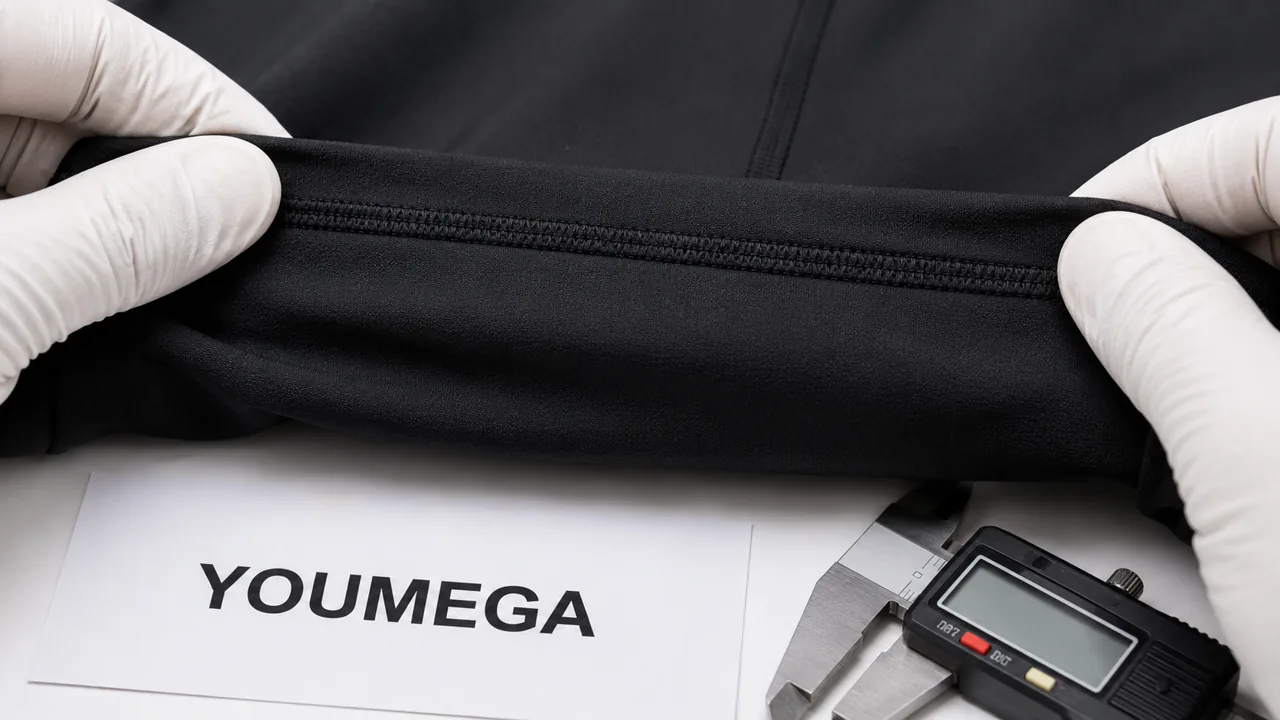
One detail rarely covered in supplier conversations: GSM on a spec sheet is a target, not a guarantee. Knitted fabrics naturally vary across rolls. The standard test method (ISO 3801) takes the weight of a cut swatch of known area and converts it to g/m². A well-controlled mill will deliver fabric within roughly ±5% of the nominal GSM. That means a “240 GSM” legging fabric may arrive anywhere from 228 to 252 GSM and still pass spec.
To connect nominal weight with dimensional behavior, use shrinkage and torque testing.
This matters in two situations. First, when buyers compare two suppliers, a quoted “240 GSM” from one factory and “250 GSM” from another are often the same fabric within tolerance. Second, when a buyer reorders six months later and the fabric feels slightly different — that is usually normal lot variation, not a quality drop. Ask suppliers to share the actual test report from each bulk lot if this matters to your brand.
Weight alone does not guarantee opacity
A common sourcing mistake is assuming that higher GSM always solves transparency in leggings. In reality, opacity is affected by multiple factors: yarn type, knitting density, color, stretch ratio, pattern grading, and how the garment fits on the body.
That is why swatch testing and wear testing matter more than the number on the spec sheet. We always recommend buyers approve a real fabric swatch — not just a GSM target — before committing to bulk. (This is part of our standard sample development process.)
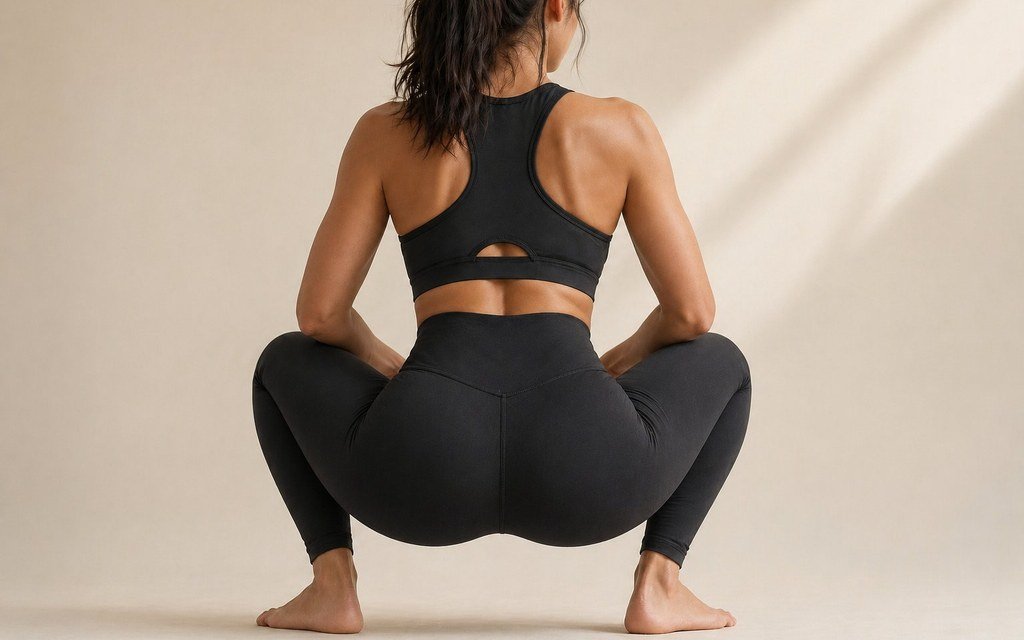
Nylon-spandex vs polyester-spandex at the same GSM
Another point buyers often miss: two fabrics with the same fabric weight can still feel very different. A nylon-spandex blend at 240 GSM usually feels smoother, softer and more premium. A polyester-spandex fabric at the same weight may feel drier or more performance-oriented depending on construction.
Same weight, different fabric: a 240 GSM side-by-side
| Attribute | Nylon-spandex 240 GSM | Polyester-spandex 240 GSM |
|---|---|---|
| Hand feel | Smooth, soft, slight cool touch | Drier, more matte, sportier |
| Visual finish | Subtle sheen, premium | Flatter, more athletic |
| Moisture management | Good, slower to dry | Excellent, faster wicking |
| Color depth (after dye) | Richer, deeper saturation | Slightly flatter, more uniform |
| Prueba de pilling | Higher | Lower if low-quality yarn used |
| Typical FOB cost | Higher (≈15–25%) | Lower |
| Best fit for | Premium yoga, lifestyle, studio | Training, running, value tiers |
That is why GSM should never be judged in isolation. Fabric weight is one part of the decision, not the whole decision. Yarn family, knit type (warp-knit vs circular vs seamless) and finishing process matter just as much.
Choosing GSM by use case — a quick decision matrix
Most buyers find it easier to start from the intended use rather than from a number. The matrix below maps the most common scenarios we see in B2B inquiries.
For the recovery check after repeated extension, consult stretch-recovery bench testing.
| Intended use | Suggested GSM | Preferred blend | Key risk to test for |
|---|---|---|---|
| Hot yoga / warm-climate studio | 200–220 | Nylon-spandex, jacquard knit | Sweat-through opacity |
| Daily yoga / lifestyle | 230–250 | Nylon-spandex, smooth knit | Squat-test opacity in light colors |
| HIIT / functional training | 240–270 | Nylon-spandex or poly-spandex | Recovery after repeated stretch |
| Running / outdoor | 200–230 | Polyester-spandex, wicking finish | Chafing at seams |
| Sculpting / shapewear-style | 270–320 | Nylon-spandex with high elastane | Underband digging at XL+ sizes |
| Winter / cool-weather training | 260–300 | Brushed-back nylon-spandex | Drying time, machine-wash recovery |
Seasonal and regional considerations
Climate matters more than most spec sheets acknowledge. A brand selling to Middle East or Southeast Asia rarely needs anything heavier than 230 GSM. A brand selling to Northern Europe or Canada often benefits from a 260–280 GSM core legging plus a brushed inner-face winter style. If your collection ships globally, splitting the line into a lighter “core” weight (around 230) and a heavier “winter” weight (around 270) usually serves the market better than forcing one GSM to cover both.
How to choose the right GSM for your brand
A simple way to decide:
- If the goal is lower cost and light comfort, start around 220 GSM.
- If the goal is mainstream commercial leggings, start around 230 to 250 GSM.
- If the goal is stronger support and denser hand feel, test 270 to 280 GSM.
The best approach is to compare swatches side by side, not just choose from a number on a spreadsheet. If you are not sure where to begin, start with two or three GSM options in different weights and compare them in real wear tests before locking your first bulk order. When you are evaluating supplier replies, our guide to comparing activewear supplier quotes covers what a complete fabric specification should look like.
If you want to narrow that swatch request before you brief us, the GSM Selector turns product type, training use and colour plan into a practical starting band.
Final thought
Legging fabric weight is one of the fastest ways to align product feel with brand position. A premium brand, a studio brand and a price-sensitive startup may all need different answers. The right question is not “what GSM is best?” The right question is: what fabric weight fits the product promise you want to sell?
Not sure which GSM fits your leggings collection?
Send us your reference image and target market. We’ll reply within 24 hours with two or three fabric swatches in different GSM weights — and ship samples so you can wear-test before committing to bulk. MOQ desde 100 sets, mixed colors and sizes allowed.
For choices that sit outside GSM alone, continue with why leggings lose their stretch, maternity activewear grading, and stock fabric vs custom knitting.
Frequently asked questions
What is the best GSM for yoga leggings?
Most commercial yoga leggings use a fabric weight between 230 and 250 GSM. This range balances softness, stretch and opacity without feeling too heavy or too thin. It also keeps cost and lead time reasonable for first-time brands.
Are 280 GSM leggings always squat proof?
Not automatically. Opacity depends on yarn type, knit density, color, and pattern fit, not just on GSM alone. A well-engineered 240 GSM nylon-spandex can outperform a poorly engineered 280 GSM fabric. Always wear-test a real swatch.
What is the difference between nylon spandex and polyester spandex at the same GSM?
At the same fabric weight, nylon-spandex usually feels softer, smoother and more premium, with deeper dyed colors and roughly 15–25% higher fabric cost. Polyester-spandex tends to feel drier, dries faster after washing, and works better for running and high-sweat training. Both can be excellent — the choice depends on brand position.
What GSM should a new activewear brand start with?
If unsure, start in the 230 to 250 GSM range. It is the most commercially proven weight for general training, yoga and studio use, and works for most price points. You can always add a heavier or lighter style in your second collection.
How accurate is the GSM number on a fabric spec sheet?
Industry tolerance for knitted activewear fabrics is approximately ±5% from the nominal GSM (tested per ISO 3801). A “240 GSM” fabric may legitimately arrive at 228–252 GSM. Ask your supplier for the lot-level test report if your QC protocol requires it.
Does a brushed or peach-skin finish change the effective GSM?
Slightly. Brushing pulls fibres to the surface, which can add 5–15 GSM to the same base fabric and changes the hand feel significantly. If you are comparing a brushed sample to an unbrushed one, ask for both the base GSM and the finished GSM.
What GSM do premium yoga brands typically use?
Most well-known premium yoga leggings sit in the 230–280 GSM range, with the “buttery soft” feel category usually around 240–260 GSM in nylon-spandex with a tight circular knit. The exact spec varies by collection — the same brand often runs lighter summer styles and heavier compression styles.
Can I order leggings in multiple GSM weights at low MOQ?
Yes. Stock styles with custom logo start at 100 sets, mixed colors and sizes allowed. Full custom OEM development with a specific GSM target requires 300–500 pcs per style per color.
Buyer FAQ
Which GSM is best for private label leggings?
Most private label leggings work best between 240 and 280 GSM. Choose around 240 GSM for softer everyday yoga wear, and 260-280 GSM when opacity, compression and premium hand feel matter more.
Does heavier GSM always mean better leggings?
No. Higher GSM can improve coverage and compression, but it can also feel warmer, cost more and reduce drape. Fit, yarn, knit structure and elastane recovery matter as much as weight.
What should I send YOUMEGA for a fabric quote?
Send your target use case, reference product, preferred compression level, color plan, order quantity and whether you need stock fabric or custom development. A reference sample is the fastest way to match hand feel.