Why "Free Sampling" From Chinese Factories Costs You More Than Paid Samples
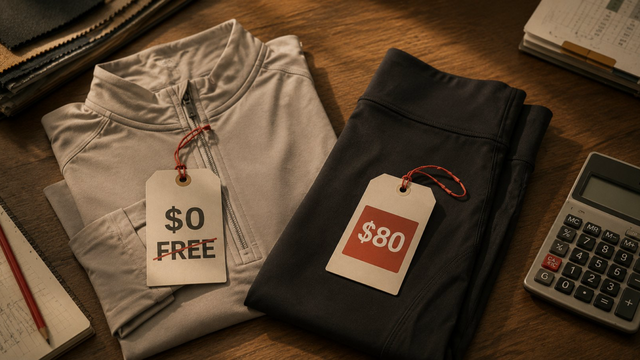
Free sampling from Chinese activewear factories almost never means free — the cost is either priced into your bulk quote (typically 2-3% silently added), absorbed through lower-grade sample work, or recovered through reduced sales attention. Paid samples at $50-150 usually deliver better factory match, better bulk representativeness, and refund eligibility on bulk orders.
Search any Alibaba activewear listing and you’ll see "Free Sample!" in bold above the product. For first-time buyers, that line is compelling. Sample cost is real money — $80 to $150 per piece, multiplied across 3-5 factories you’re considering, adds up fast.
But "free" almost never means free. It means the cost is somewhere else. And in activewear sourcing, that "somewhere else" usually hurts your project more than the $80 would have.
Here’s how free sampling actually works, and why paid sampling at $50-150 per piece often gets you a better factory match.
What "free sample" really means
There are three economics behind free sampling, and you can tell which one a factory is running by what they ask for next:
Economic 1: Cost priced into your bulk quote
Your bulk quote is $12/pc at 500 units = $6,000 total. The factory’s true cost is $11/pc. They make $1/pc margin. They send you 3 free samples that cost them $200 to produce. They recoup the $200 by either (a) shipping the sampling cost across your bulk margin (now their margin is $0.60/pc), or (b) padding the bulk quote slightly to absorb it.
Result for you: You think you got free samples. You actually paid for them through bulk. Bulk price is 2-3% higher than it would have been if you paid sample fees upfront.
Economic 2: Lower-grade sample to qualify your seriousness
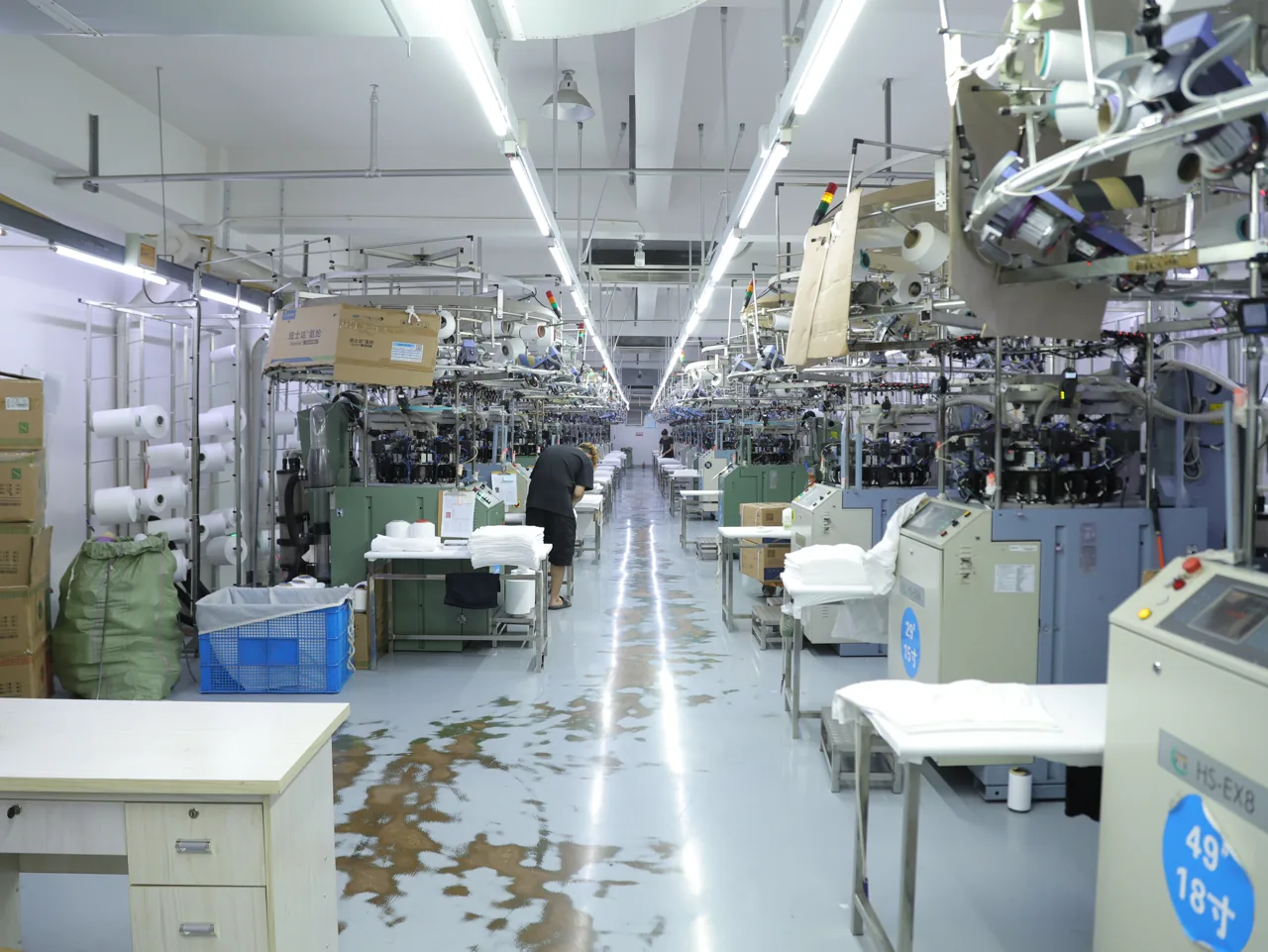
This is sneakier. The factory’s free sample is genuinely free — but it’s not made by the same operators, same machines, or same fabric stock that your bulk will use. The free sample is made on the cheapest possible production line, often a leftover fabric from a previous client, using "B-grade" operators (less experienced, faster, paid less per piece).
If you approve and order bulk, you’ll get bulk made on production lines, with proper fabric, by A-grade operators. The bulk will be different — sometimes better, sometimes worse — than what you approved.
Result for you: You approved a sample that wasn’t representative of what you’ll receive. Your bulk decision was based on the wrong data. This is the single largest source of sample vs bulk drift complaints in activewear OEM.
Economic 3: Qualifying serious buyers
Some factories use sample fees as a filter. Buyers who pay $80 for a sample tend to follow through with bulk orders 40-60% of the time. Buyers who get free samples tend to follow through 5-15% of the time. So free-sample factories are processing 10x more samples to win the same number of bulk orders.
The factory’s sales team is overwhelmed by sample requests. Their quote turnaround slows. Their attention is diluted. By the time you place your bulk order, you’re competing for production capacity against 9 other buyers who got the same free sample treatment.
Result for you: You got the free sample, but you’re not a priority client.
When paid samples are a better deal
Pay $50-150 per sample to a factory that takes samples seriously, and three things happen:
Before comparing sample fees, distinguish proto, fit, size-set and PP samples.
You get production-line representation. Paid sample fees usually fund a sample made on the actual machines, with the actual operators, using the actual fabric stock that your bulk would use. The sample tells you what bulk will look like — not what the factory’s marketing department can put together.
You get sales team attention. The factory’s sales team treats paid sample buyers as committed. Your quotes come back faster (typically within 48 hours instead of 5-7 days). Your fabric inquiries get specific answers. Your questions go to engineers, not just sales.
You get refundable sample fees on bulk orders. Most reputable factories refund the sample fee (sometimes 50%, sometimes 100%) when you place a bulk order over a certain threshold. So the $80 sample fee is actually a deposit, not a cost.
When free samples are fine
Free fabric swatches: always fine. These cost the factory pennies (typically under $0.50 in materials) and tell you a lot about fabric quality. Request them aggressively — 5-10 swatches per factory.
Free small fabric panels (12cm x 12cm with logo applied): also fine. These show you the factory can apply your logo without distortion.
Free finished garment samples: be skeptical. If the factory offers, ask: "Will this sample be made on production machines with bulk-grade fabric, or on a separate sample line?" Their answer tells you which economics they’re running.
The math at 5 factories
You’re considering 5 factories for your activewear launch.
- All free samples scenario: $0 in sample fees. 5 finished samples that may or may not represent bulk quality. Bulk quotes 2-3% higher across the board (silently). Your launch decision: based on 5 unrepresentative samples.
- All paid samples scenario: $400-600 in sample fees (refundable on bulk at 3-4 of 5 factories). 5 finished samples that genuinely represent bulk quality. Bulk quotes 2-3% lower than the free-sample scenario. Your launch decision: based on 5 accurate samples.
On a $20,000 bulk order, that 2-3% difference is $400-600. Right back to the sample fees you "saved." Plus you made a better factory decision because your data was real.
Sample policy red flags: what each signal really means
The way a factory talks about samples in the first email tells you most of what you need to know. Use this matrix to map their behavior to the underlying economics:
| Signal in first email | Likely factory type | What it tells you |
|---|---|---|
| "Free samples, ship today" (no questions asked) | Volume-chase factory | You’re one of 50 weekly free-sample requests. Sample is cheap and unrepresentative. |
| "Free sample after you confirm fabric, color, logo, size" | Mid-tier factory hedging | Free sample is real but bulk price is padded 2-3% to recover sample cost. |
| "$80 sample, refundable on orders over 300 pcs" | Professional mid-sized factory | Sample is production-representative. Sales team will prioritize you. |
| "$150-200 sample, non-refundable, 10-15 day lead time" | Premium / niche factory | Sample is hand-finished by the head sampler. Worth it if quality is your differentiator. |
| "We don’t do samples" or "You need to visit us first" | Big factory in MOQ theater mode | Real MOQ is much higher than advertised. They’re filtering you out. |
How to negotiate sample fees on bulk orders
If you’re going to pay sample fees, get them refunded. Most factories will agree to one of these structures if you ask before approving the sample:
- 50% refund at first bulk order over 300 pcs. Common default for new buyer relationships.
- 100% refund at first bulk order over 500 pcs. The standard for established mid-sized factories. Ask for this — most will agree.
- 100% refund credited toward second bulk order. Some factories prefer this because it locks in repeat business. Acceptable if you’re planning multiple drops.
- Sample fee converted into design credit. Less common, but useful if you’re developing multiple styles. The $80 sample fee becomes $80 toward pattern grading on your next style.
Put the refund structure in writing in the same email where you confirm the sample order. A simple line — "Confirming sample fee of $80 is fully refundable on first bulk order of 500+ pcs" — protects you. Factories that resist putting this in writing are usually the ones with the worst sample-to-bulk drift.
The exception: factories that genuinely don’t charge
A small number of factories — usually small or mid-sized ones building their book of business — genuinely don’t charge for samples. They lose money on every sample. They make it up by converting at higher rates because they invest deeply in each sample.
You can tell these factories from the Alibaba "free sample!" crowd by the questions they ask before sending a sample. If they ask 5-10 questions about your brand, target customer, fabric preferences, color requirements, and launch timeline before they sample, they’re investing real time. The sample they send will represent their best work. They’re free-sampling you because they want to win you specifically.
If they sample without asking questions, the sample is cheap and unrepresentative, and you’re one of 50 buyers they’re sampling that week.
What to do this week
If you’re sampling 5 factories right now:
- Audit each factory’s sample policy. Are they charging? How much? Refundable on bulk?
- For the free-sample factories, ask: "Will this sample be representative of bulk production?" Get an answer in writing.
- For the paid-sample factories, ask: "Is the sample fee refundable on bulk, and at what order size?"
- Compare bulk quotes after sampling — be alert to whether free-sample factories quoted higher per-unit prices.
You’ll find that 2 of your 5 factories are running clean, transparent sampling economics. Those are usually the 2 you want to work with.
Frequently asked questions
How much should an activewear sample actually cost?
For private-label work with logo and basic customization, $50-100 per piece is standard at mid-sized factories. Full-custom OEM samples with pattern development from a tech pack run $100-200 per piece. Samples under $30 usually indicate the factory is cutting corners somewhere — either lower-grade fabric, faster sewing, or both. Samples over $250 are typical only for technical or proprietary fabric development.
Are sample fees refundable on bulk orders?
Often yes, but not by default — you have to ask. Most mid-sized factories will refund 50-100% of the sample fee when you place a bulk order above a certain threshold (usually 300-500 pcs). Get this in writing in the same email where you confirm the sample order. Don’t assume.
How many factories should I sample before placing a bulk order?
3 to 5 factories is the sweet spot. Fewer than 3 and you don’t have enough comparison data. More than 5 and you spread your attention too thin, sample fees become significant, and you’ll struggle to remember which factory’s sample was which. At 4 factories, total sample investment is typically $200-400 if paid — recoverable as refunds on the winning factory’s bulk order.
Should I expect the same factory to send samples for multiple styles for free?
For repeat buyers, yes — most factories absorb sample cost on follow-up styles once a buyer relationship is established. For first-time buyers asking for samples of 4-5 different styles, expect to pay for each. Factories that send unlimited free samples to first-time buyers are typically running the volume-chase economics described above.
What’s the difference between a sample and a pre-production sample (PPS)?
A sample (sometimes called a development sample or proto) is made before you place bulk. It uses approximated specs and is meant to confirm overall design direction. A pre-production sample (PPS) is made after you’ve placed the bulk order, using actual bulk fabric on bulk production machines, before mass cutting begins. PPS is your last quality checkpoint before bulk cutting and is typically free or included in your bulk quote. Always request a PPS — many factories skip this step unless asked.
This article was written by the manufacturing team at YOUMEGA, an activewear OEM/ODM factory in Xiamen, China. We work with brands on sampling structures that actually represent bulk — and we’ll tell you the honest economics behind the sample fee, refund structure, and how the sample is going to be made. Contactar if you want to talk through your sampling plan.