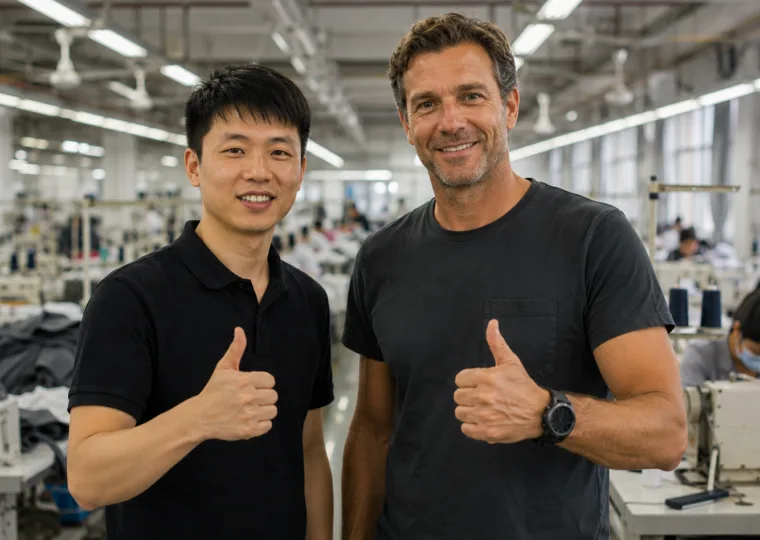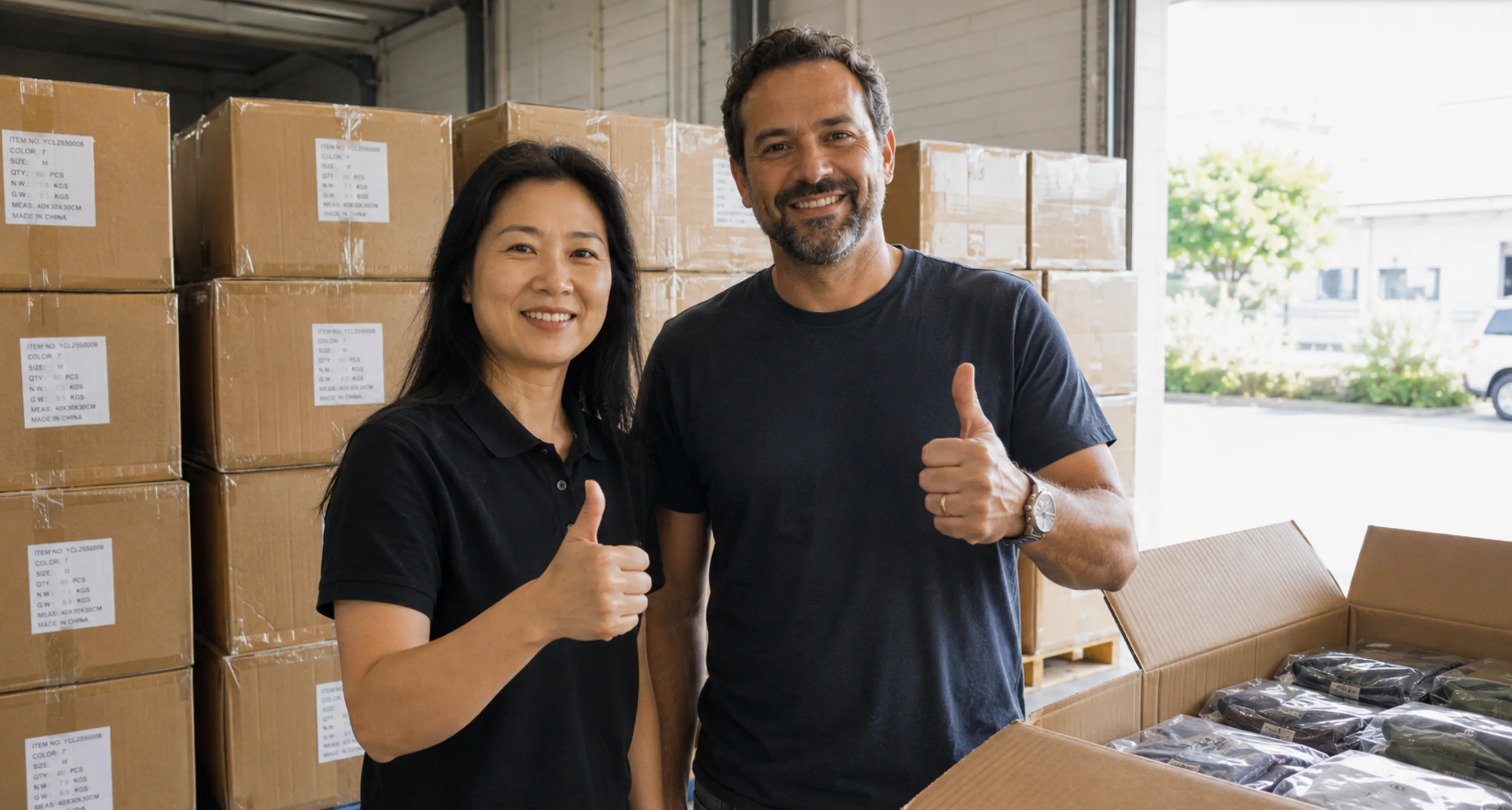
One hundred sets. One product. One season’s worth of doubt.
Tomasz and his co-founder placed their first order with us two years ago. It was 100 sets across a single legging style — a test order, by any factory’s definition, and small enough that several manufacturers they had contacted before us had simply not replied. The brand they were building from Warsaw had a clear positioning and a defined customer, but at the moment of that first order it had no proven sell-through, no retail relationships, no margin to absorb a quality mistake, and no operational reason for any factory to give the project meaningful attention.
We took the order at standard terms because the factory we have built does not have a separate process for small orders. The lab-dip happened the same way it would on a 5,000-set program. The fit sample went through the same pattern review. The 100-unit production run was inspected to the same AQL 2.5 standard as the bulk runs in adjacent slots on the calendar. The shipment landed in Warsaw three weeks after production wrapped.
That first run sold through. The second order doubled. The third doubled again. By the time the fourth season rolled around, the conversation had shifted from “can we afford another test order” to “how do we plan the production calendar around our growth trajectory.”
The product did not change. The infrastructure underneath the product did.
The transition from a 100-set test run to an 8,000-set seasonal program is not a single decision. It is a series of small infrastructure changes that have to happen quietly, in the background, without disrupting what is already working. The fabric specification stays locked. The pattern blocks stay locked. The color standards stay locked. What changes is the production planning, the QC sample size, the export documentation cadence, and the volume of communication between the brand and the factory at any given moment in the cycle.
For Tomasz’s brand, this transition happened across roughly six seasons. We added more styles to the active SKU set as the brand expanded its range. We moved from single-color production runs to multi-color batched runs as the palette grew. We introduced a rolling lab-dip review process so new colorways could be qualified during off-peak periods rather than blocking the start of bulk production. None of these changes were announced as major project milestones. They happened as the order sizes required them to happen.
The product quality at 8,000 sets is identical to the product quality at 100. That consistency is the partnership.
Across two years of expanding orders, the cumulative defect rate on the brand’s production runs has not increased. The garment that ships today, at 80 times the volume of the first order, performs the same way the first 100 did. This is the test most manufacturing partnerships actually fail. The first orders ship cleanly because they are small enough for the factory to pay close attention to them. The scaled orders develop drift — slight color variation, slight fit inconsistency, slight QC relaxation — because the factory’s attention is diluted across a much larger production calendar.
The partnership held because the production discipline that worked at 100 sets was already the discipline we use at 5,000 sets. Scaling up did not require us to change the process. It only required us to apply more of it. For Tomasz’s brand, the commercial result is that the customer who bought from them in season one and the customer who buys from them in season eight receive a garment that performs the same way. That consistency is the brand’s competitive moat in the Polish market. We are part of how it stays a moat.
The dinner table where the real planning happens.
Every six months, Tomasz and his team fly to Xiamen for what they call “the planning week” — three days walking the production floor, two days reviewing the next collection. On the last night, the team shares dinner together. It is where deadline pressures, fabric sourcing changes, and shipping windows get talked through without an agenda. Two years of dinners. Two years of growth. The orders get planned in the meeting rooms. The relationship gets built at the table.