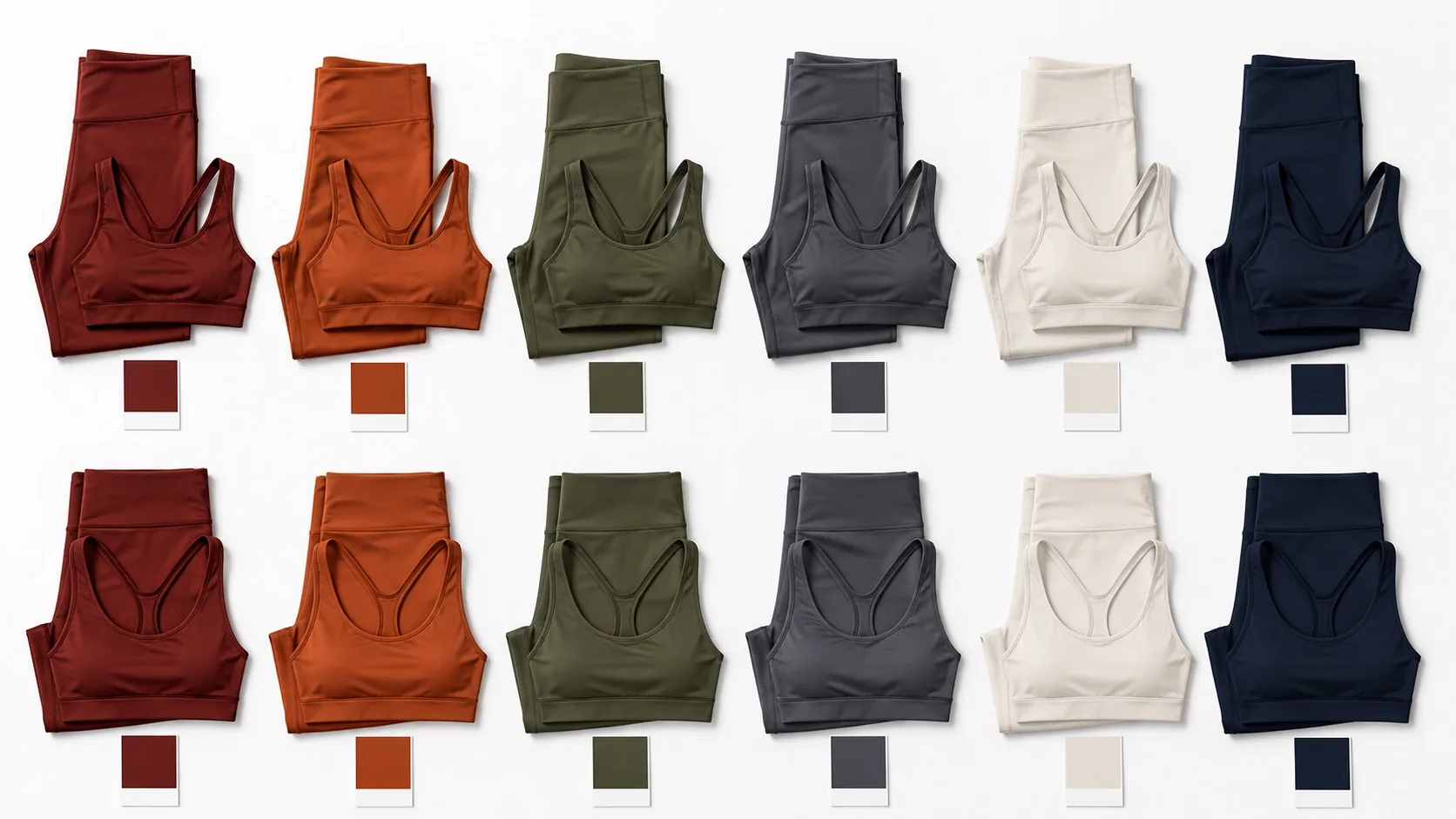
Most rebrands ship the first drop clean. The drift starts on batch two.
Grazi Marotti Sportswear already had proven styles, but their rebrand introduced a new color system across leggings, bras and training tops. The Italy-based brand needed twelve styles re-produced without changing fit, while keeping six custom Pantone colors consistent across first production and repeat orders. Grazi Marotti Sportswear’s positioning depended on color discipline — the new palette was the visible signal of the rebrand, and any color drift between the first drop and subsequent reorders would visibly fracture the relaunch.
The technical risk was specifically on the reorders, not the first production. First-run color matching, given enough lab-dip cycles and budget, is a solved problem. Color consistency across multiple production runs, across different fabric lots, sometimes across different fabric mills — that is where most Pantone-driven rebrands quietly drift, and where most factories quietly let it happen because the drift is small enough on each individual run to be defensible.
Physical swatches, not Pantone codes. Recipes, not specifications.
We rebuilt the project around controlled lab-dip rounds, pre-production shade bands, and SKU-level approval checkpoints. Fabric, trim, logo and packaging references were locked before bulk cutting. Every reorder was tied back, through documented records, to the original approved Pantone and lab-dip — not to a written specification of the color, but to the physical sample swatch and the dyeing recipe used to produce it. This is a different methodology than most factories use. The standard industry approach is to specify the Pantone code in the production document and trust the dyehouse to hit it. Our approach is to specify the actual approved fabric swatch and require every reorder dye-bath to be matched back against that physical reference under controlled lighting.
The cost of this methodology is process overhead during production planning. The benefit is that color drift across reorders is structurally prevented rather than caught after the fact. For Grazi Marotti Sportswear, whose rebrand depended on color consistency as a visible market signal, the trade was obvious.
The system became the proof. Every reorder runs on it now.
The relaunch shipped with twelve re-produced styles, six approved custom Pantone colors, and an average of two lab-dip rounds per color before bulk approval. The first production drop totaled 3,500 pieces across the SKU range. The reorder approval system built for this rebrand is now in active use on every subsequent production run — repeat orders are matched back to the original approved standards rather than re-quoted against the Pantone code in isolation. Two seasons after the rebrand launch, Grazi Marotti Sportswear has not experienced a color dispute on a repeat order. That outcome is the system working as designed.
The commercial result of this consistency is that Grazi Marotti Sportswear’s retail partners and direct customers experience the new palette as a stable, repeatable visual identity rather than as a launch palette that drifts over time. For a rebrand whose entire premise was the new color system, that stability is what makes the rebrand actually take hold in the market.
Color drift across reorders is invisible until it isn’t. By then it is too late to fix the brand.
The activewear category has a quiet color-consistency problem that most brands only notice after they have been in the market for two or three years. The first production run lands cleanly. The first reorder is close enough. The second reorder is a little off but explainable. By the fourth reorder, the brand’s customers are receiving garments in a “color” that is meaningfully different from the website photography and the original launch — and the brand has no clean way to recover, because every previous batch has been deemed “acceptable” at the time of inspection.
The methodology that prevents this is process discipline at the factory level, not stricter Pantone codes on the customer’s tech pack. The customer cannot enforce color consistency from outside the dyehouse. The factory either operates a documented reorder approval system tied back to the physical approved standards, or it does not. If you are planning a rebrand built around a custom color palette — or if you have already launched one and are seeing drift across your reorders — the only durable fix is at the manufacturing process level. That is the system we built for this project, and it is the system every Pantone-led brand we work with now runs on by default.