For activewear quality control, AQL 2.5 (per ISO 2859-1 / ANSI Z1.4) is the standard inspection level — meaning a random sample of 80 units from a 1,000-piece lot, with strict thresholds on major defects and limited tolerance for minor ones. Knowing how this works in practice is what separates buyers who get clean shipments from buyers who get surprises.
Quality control is one of those phrases every supplier uses. Fewer buyers understand what it means in practice. AQL — the most common standard in garment QC — sounds technical, but the underlying logic is simple, and every activewear buyer should understand it before placing a first bulk order.
What is AQL?
AQL stands for Acceptable Quality Limit. It is a sampling-based inspection standard used to assess whether a production batch passes or fails based on the number and severity of defects found. The system is defined by the international ANSI/ASQ Z1.4 standard (and the equivalent ISO 2859-1) and is the most widely used QC method in apparel manufacturing.
For buyers, the important point is simple: QC is not just someone glancing at the garments before packing. It should follow a defined inspection logic.
How AQL sampling actually works
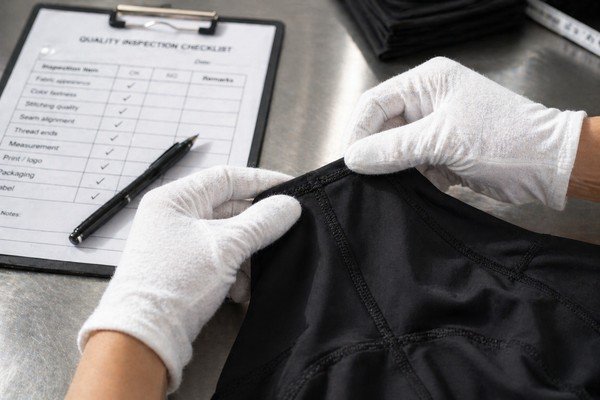
Instead of inspecting every single garment (which would be slow and expensive), AQL uses a statistical sample. For an order of 1,000 pieces, an inspector typically checks 80 random units. The number of defects found determines whether the batch passes.
The most common standard for mid-quality garments is AQL 2.5 — which is what we use at YOUMEGA for all activewear orders. It allows a small number of minor defects but is strict on major defects. For premium brands, AQL 1.5 is sometimes used.
For the underlying inspection framework, see the official ISO 2859-1 catalogue entry and QIMA's product-inspection overview.
AQL sample size table
Sample size scales with lot size — but not linearly. A 5,000-piece order doesn’t need 5x the sample of a 1,000-piece order, because statistical confidence grows with the square root of sample size. Standard General Inspection Level II numbers:
| Lot size | Sample size | AQL 2.5 Accept / Reject |
|---|---|---|
| 91–150 | 20 | 1 / 2 |
| 151–280 | 32 | 2 / 3 |
| 281–500 | 50 | 3 / 4 |
| 501–1,200 | 80 | 5 / 6 |
| 1,201–3,200 | 125 | 7 / 8 |
| 3,201–10,000 | 200 | 10 / 11 |
| 10,001–35,000 | 315 | 14 / 15 |
Reading the table: for a 1,000-pc order at AQL 2.5, the inspector pulls 80 random units. If 5 or fewer major defects are found, the lot passes. If 6 or more are found, the lot fails and must be sorted or reworked before shipment.
Major vs minor defects
AQL inspections classify defects into three categories:
- Critical defects — safety issues like broken needles, sharp components. Zero tolerance.
- Major defects — visible problems that affect saleability: stains, holes, wrong color, broken stitching, wrong size labeling.
- Minor defects — small cosmetic issues that don’t affect function: tiny loose threads, very slight color variation.
AQL 2.5 typically allows a few minor defects but very few major ones in any sample.
AQL 1.5 vs 2.5 vs 4.0: how thresholds compare
The AQL number is the percentage of defects that would still be considered acceptable in the long-run average — a lower number means stricter inspection. For a 1,000-pc lot with an 80-unit sample:
| AQL level | Major accept / reject | Minor accept / reject | Typical use |
|---|---|---|---|
| AQL 1.0 | 2 / 3 | 5 / 6 | Premium luxury brands; medical textiles |
| AQL 1.5 | 3 / 4 | 7 / 8 | Premium activewear and athleisure |
| AQL 2.5 | 5 / 6 | 10 / 11 | Standard mid-market activewear (YOUMEGA default) |
| AQL 4.0 | 7 / 8 | 14 / 15 | Value/promotional apparel |
| AQL 6.5 | 10 / 11 | 21 / 22 | Disposable or single-use textiles |
Most activewear buyers should not go below AQL 2.5. Going to AQL 1.5 can be worth the added cost for premium positioning, but going to AQL 4.0 to save cost usually results in returns and refund requests that wipe out the savings.
What defects matter most in activewear?
For activewear specifically, common inspection points include:
- Fabric damage or contamination
- Stitching problems (especially on stretch seams)
- Logo misplacement or poor adhesion
- Size measurement tolerance issues
- Color inconsistency between pieces
- Packaging mistakes
A buyer may care more about one of these than another depending on the product category. For example, opacity testing matters more for leggings — see our fabric weight guide.
The activewear-specific QC checklist
Generic garment QC misses things that matter for stretch sportswear. Our standard activewear QC checklist covers:
To frame dimensional acceptance, consult how inspection judges measurement tolerances.
- Stretch test: Stretch the fabric to 30–40% extension and check for seam puckering, thread breakage, or logo cracking.
- Recovery test: After stretching, the fabric should return to within 2% of original dimensions within 30 seconds. Slow recovery indicates spandex degradation.
- Opacity test (leggings): Bend test with the legging stretched over a hand or knee — fabric should not become see-through under 30% stretch. Critical for light colors and lower-GSM fabrics.
- Logo adhesion (wash test): 5-cycle wash test at 40°C; heat transfer and silicone logos should show no lifting, cracking, or color shift.
- Measurement tolerance: Verify against tech pack with ±0.5–1.0cm tolerance on body measurements, ±0.5cm on inseam/length.
- Color consistency: Compare across the lot under D65 daylight; flag any DE > 2.0 variance between units.
- Care label accuracy: Verify fiber content matches actual fabric composition (legal requirement in most markets).
- Packaging integrity: Polybag sealing, hangtag attachment, barcode legibility.
Why QC matters more in stretch garments
Activewear is not like loose woven apparel. It stretches on the body, which means seam quality, logo flexibility, fabric recovery and opacity all matter more. A garment that looks acceptable lying flat on a table may show problems once worn. That is why activewear QC should include stretch testing, not just visual inspection.
For the stretch checks behind this inspection step, use stretch-recovery bench testing.
When QC happens: three inspection types
Bulk inspection at the end of production (Final Random Inspection, or FRI) is the most common — but it’s not the only QC stage that matters:
- Pre-Production Sample inspection (PPS): Before bulk fabric is cut, the supplier produces a small sample run to confirm pattern, color, fit and logo are all correct. This is the cheapest place to catch problems.
- During-Production inspection (DUPRO): Inspection during the production run, usually when 20–30% of units are complete. Catches systemic issues early enough to fix before the whole lot is finished.
- Final Random Inspection (FRI): Standard AQL inspection after 100% of production is complete and 80% is packed. Decides pass/fail for shipment.
For first-time orders, we recommend DUPRO inspection in addition to FRI — the small added time cost catches problems while they’re still cheap to fix. Returning a failed FRI lot for rework costs 10–20x what catching the same issue at DUPRO would have cost.
What buyers should ask before bulk shipment
Ask your supplier:
- What inspection standard is used? (AQL 2.5 is standard)
- What points are checked during QC?
- How are size measurements verified?
- How are logo issues handled?
- Can defects be sorted before shipment?
- Can you provide QC photos and video before I pay the balance?
These questions move the conversation from generic promises to actual process. At YOUMEGA we provide bulk inspection photos and video on request before shipment.
How to write QC requirements for your supplier
If you want a specific QC standard, write it into your PO — don’t leave it to assumption. A simple QC clause that works:
“All goods to be inspected at AQL 2.5 (ISO 2859-1, General Inspection Level II) for major defects, AQL 4.0 for minor defects. Inspection report with photos to be provided before balance payment. Stretch test and opacity test required on all stretch garments. Logo wash test (5 cycles, 40°C) required on first PO.”
This level of specificity tells the supplier exactly what to do and gives you a clear standard to hold them to if something goes wrong.
Use the activewear manufacturing glossary to decode inspection terms, then compare the approved sample with bulk using the sample-versus-bulk checklist.
Final thought
Good QC is not only about catching defects. It is about reducing surprise for the buyer. If the supplier has a clear inspection standard and communicates quality issues before shipment, repeat orders become easier and trust builds faster. AQL 2.5 with proper stretch testing, opacity testing and pre-shipment photo documentation is the right baseline for almost every private-label activewear order — and it costs the supplier almost nothing to actually do.
Want our team to review your project?
Send us your reference image, target quantity and timeline. We reply within 24 hours on weekdays — in English, Spanish or Chinese — with fabric options, MOQ, sample lead time and a transparent price breakdown. MOQ from 100 sets, mixed colors and sizes allowed.
To extend the inspection brief beyond AQL, use why leggings lose their stretch and shrinkage and torque testing as focused checkpoints.
Frequently asked questions
What is AQL 2.5 in garment manufacturing?
AQL 2.5 is the most common Acceptable Quality Limit standard used for mid-tier apparel. It allows a small number of minor cosmetic defects in a random sample but is strict on major defects like stains, broken stitching or wrong sizes. For a 1,000-pc lot at AQL 2.5, an 80-unit sample is checked; up to 5 major defects pass, 6 or more fail. YOUMEGA uses AQL 2.5 for all activewear orders.
Can I request a stricter QC standard than AQL 2.5?
Yes. AQL 1.5 is stricter and sometimes used for premium brands, but it adds cost (more inspector time, higher rework rate) and may slow down inspection by 30–50%. For most activewear buyers, AQL 2.5 with proper measurement and stretch testing is sufficient.
What’s the difference between PPS, DUPRO and FRI inspection?
PPS (Pre-Production Sample) inspection happens before bulk cutting and checks pattern, fit and logo are right. DUPRO (During Production) happens at 20–30% completion and catches systemic issues early. FRI (Final Random Inspection) is the standard AQL check after production is complete. First-time orders benefit most from doing all three; reorders typically only need FRI.
How do you opacity-test leggings during QC?
The standard test stretches the legging fabric over a hand or knee at 30% extension under bright lighting; the inspector checks whether skin or contrast color shows through. For light-colored leggings or lower-GSM fabrics, this is one of the most important QC steps and the most common cause of customer returns when skipped.
Will I receive QC photos before shipment?
At YOUMEGA, yes — we provide bulk inspection photos and video on request before shipment, so you can verify quality before paying the balance. Not all suppliers do this. Ask before placing an order.
What happens if QC finds defects in my order?
Defective pieces are sorted out and replaced or repaired before shipment. If the defect rate is unusually high (above AQL 2.5 thresholds), we hold the shipment and notify you with photos so you can decide how to proceed. We don’t ship known defects without telling you first.
Do I need to hire a third-party inspector?
Not necessarily. Many buyers use third-party inspection (SGS, QIMA, Bureau Veritas) for added assurance, especially on first orders. Cost is typically $250–400 per inspection day. After trust is established with a supplier, in-house QC photos are usually sufficient.
Buyer FAQ
What does AQL mean for activewear orders?
AQL is a sampling inspection method that defines how many pieces are checked and how many defects are acceptable before shipment. For activewear, AQL 2.5 is a common buyer baseline.
Which defects matter most in activewear QC?
Key defects include open seams, skipped stitches, uneven compression, color mismatch, logo peeling, measurement tolerance issues, fabric holes, stains and poor waistband recovery.
How can buyers reduce QC problems before bulk shipment?
Approve a clear pre-production sample, confirm measurement tolerances, lock fabric and logo standards, and request inline checks before final inspection instead of waiting until packing is complete.