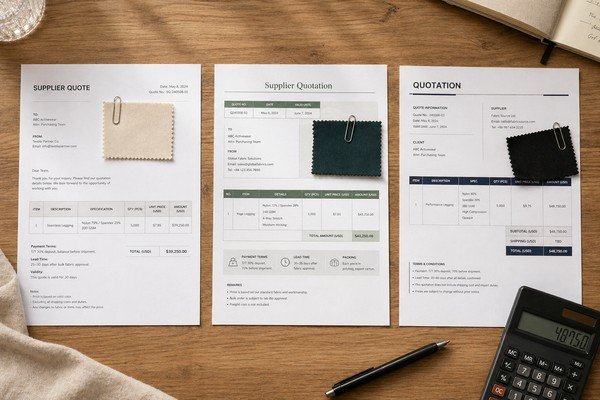
Compare two quotes for the same garment, not just two unit prices. If one quote is per set and includes logo application, while the other is per piece and excludes branding, neither number tells you which offer costs less. Ask both suppliers to price the same specification and state every exclusion.
Many buyers say they want the best price. What they usually mean is that they want the best value without discovering hidden problems later. That is why comparing activewear supplier quotes by unit price alone is one of the fastest ways to choose the wrong supplier.
This guide walks through what to actually compare when activewear suppliers send you quotes — and how to spot the red flags that don’t show up in the price line.
Unit price is only one part of the quote
A lower unit price can hide a higher total risk. Before comparing suppliers, line up the following details side by side:
- MOQ and whether colors or sizes can be mixed
- Fabric composition and fabric weight
- Sample fee and whether it is refundable
- Number of free revisions
- Lead time for sample and bulk
- Logo method included or excluded
- Packaging included or excluded
- Incoterm used in the quote
- Payment terms
- Who handles customs and export paperwork
A quote that looks higher at first may actually include things the cheaper supplier left out. We break down all of these in our how it works page so buyers can see what a complete quote looks like.
The 10-point quote comparison checklist
Send the same ten lines to both suppliers. Mark a blank line “not quoted”, not zero. If a supplier changes the fabric or quantity to meet a target price, ask for a separate option so you can still compare the original specification.
| # | Line item | What to look for | Common omission |
|---|---|---|---|
| 1 | Unit price (USD) | Per piece or per set, clearly stated | Unit not specified |
| 2 | MOQ structure | Per style / per color / per set, mixable or not | “100 pcs” with no breakdown |
| 3 | Fabric spec | Composition % + GSM + knit type | “High quality” with no numbers |
| 4 | Sample fee | Amount + refundable yes/no + free revisions | Refund policy missing |
| 5 | Logo method | Printed / embroidered / heat-transfer / silicone, included? | Logo treated as a vague extra |
| 6 | Packaging | Polybag, hangtag, retail box — included or extra | Polybag only, no labels mentioned |
| 7 | Sample lead time | Days from the agreed sample start to dispatch | “Soon” / “ASAP” |
| 8 | Bulk lead time | Start event, factory dispatch date and separate shipping time | No start event or end point |
| 9 | Incoterm | EXW / FOB / CIF / DDP clearly named | Incoterm not stated, just “ex-factory” |
| 10 | Payment terms | Deposit % + balance trigger | “100% before shipping” with no QC step |
MOQ language can be misleading
One supplier may say “MOQ 300 pcs” and another says “MOQ 100 sets.” Those numbers do not mean the same thing. Buyers need to ask:
- Is that MOQ per style?
- Per color?
- Per set?
- Can sizes be mixed?
- Is logo work included?
This matters especially for first collections, where brands want to test multiple colors without overcommitting. Mixed MOQ also carries its own pricing logic — see our breakdown of the hidden cost of mixed-MOQ orders across multiple styles before assuming the lowest mixed-MOQ quote is the best deal.
Check whether fabric specs are real or vague
“High quality fabric” is not a spec. A useful quote should tell you something measurable: nylon/spandex or polyester/spandex, approximate GSM, brushed or non-brushed, seamless or cut-and-sew, recycled or standard option.
If one supplier gives real fabric specs and another only gives marketing words, the more detailed quote is usually easier to trust. (Not sure what GSM means? See our fabric weight guide.)
Sample policy reveals how the supplier actually works
The sample stage shows whether the supplier is set up for development or only for bulk repetition. Ask:
- How long does a stock style sample take?
- How long does a full custom sample take?
- Are revisions charged?
- Is the sample fee refundable against bulk?
At YOUMEGA, adjustments to the original sample are free; a substantial redesign needs a new charge. The sample fee is returned on stock orders over 200 sets or custom orders over 600 sets. Ask each supplier to state its own conditions in writing. Do not assume it uses the same units or threshold.
Lead time should be realistic, not just attractive
Ask what starts the clock: approval of the brief, material readiness, or confirmation of the order. At YOUMEGA, stock styles with your logo take 20–25 days from confirmed order to factory dispatch; fully custom bulk takes 30–35 days. Shipping is additional. Compare promises with the same end point.
Incoterms: a short cheatsheet
The same per-piece price can mean wildly different totals depending on the incoterm. The four you will see most often in activewear quotes:
Cross-check the named term in the official ICC Incoterms 2020 reference, then use the Trade.gov import tariffs and fees overview when mapping costs outside the supplier quote.
| Incoterm | Who pays for what | Best for |
|---|---|---|
| EXW (Ex Works) | Buyer arranges everything from factory door — pickup, export, freight, import, last-mile | Buyers with their own freight forwarder |
| FOB (Free On Board) | Specify the named port of shipment and which freight and import costs are outside the quote. | Sea or inland waterway shipment |
| CIF (Cost, Insurance, Freight) | Supplier pays freight + insurance to destination port; buyer handles import duty + last-mile | Buyers who want predictable shipping cost but local clearance |
| DDP (Delivered Duty Paid) | Specify the named destination and confirm import clearance, duties, taxes and any unloading costs in writing. | Where the seller can meet the agreed import obligations |
A per-piece quote to a named port and a per-piece quote to your warehouse cover different work. Ask for the same named place and delivery basis, or list the costs excluded by each offer.
For the next comparison step, use the DDP hidden-cost checklist, the payment-terms guide, and the first-order calculator.
Which payment milestone releases the balance?
Ask both suppliers to state the deposit, balance trigger, inspection point and documents in the quotation. A percentage alone does not establish whether the order is protected. Check what happens if the goods differ from the approved sample.
Factory, trading company, or sourcing agent — they price differently
With a direct factory, ask who makes and inspects the order. With a trading company or sourcing agent, also ask who appoints the factory, who owns the inspection and which coordination services are included. Compare the written scope; the business model alone does not establish the markup.
Red flag decoder
| What you see in the quote | What it often means | What to do |
|---|---|---|
| “Best price, contact us” with no breakdown | No standardized cost structure | Ask for line-item quote |
| Sample fee differs between quotes | The work included may differ | Ask whether pattern work, revisions and a return of the fee are included |
| A short bulk schedule without a start date | The milestone is unclear | Ask for the approval, dispatch and transit dates separately |
| Full payment before production | The timing of inspection and payment matters | Agree the inspection point, documentation and remedies before ordering |
| An important question remains unanswered | The quote is incomplete | Ask for the missing specification before comparing totals |
| No mention of QC stage | Inspection scope is not specified | Insist on AQL inspection clause |
| Different unit (set vs pc) across quote lines | Quote not normalized internally | Ask supplier to re-issue |
Communication quality is part of product quality
In activewear sourcing, communication is part of product quality. A supplier that answers clearly, explains tradeoffs, and flags problems early often saves buyers more money than a cheaper supplier that goes quiet during production. This matters even more for first-time founders and buyers working without a full technical team.
Final thought
The best quote is the one that gives you the clearest path from inquiry to repeat order. When comparing activewear suppliers, look at structure, detail and honesty — not just price. A factory that can answer the 10-point checklist completely on the first reply is signalling something important: that they run their operations the same way they run their quotes.
Want our team to review your project?
Send the style reference, logo artwork, colour and size breakdown, and target quantity. We can identify the production route before quoting the work.
Frequently asked questions
What’s a fair sample fee for activewear?
Ask what the fee covers: stock branding, pattern development or a redesign. YOUMEGA returns the sample fee on stock orders over 200 sets or custom orders over 600 sets; obtain the conditions for the specific order.
Should I always choose the cheapest activewear supplier?
Not on unit price alone. Ask both suppliers to separate branding, packaging and quality control from the garment price and identify exclusions.
How do I know if a factory’s MOQ is real?
Ask whether MOQ is per style, per color, per size, or per set. A factory saying ‘100 sets, mixed colors and sizes allowed’ offers far more flexibility than ‘300 pcs minimum per color.’ For first collections, mixed-MOQ flexibility matters more than the headline number.
What should be included in a complete activewear quote?
A complete quote should list: product code, fabric composition and GSM, MOQ, unit price, sample fee, lead time for sample and bulk, logo method, packaging included or extra, payment terms, and incoterm. If any of these are missing, ask before deciding.
How long should I wait for a quote reply?
Agree a reply date and ask for a list of missing inputs. A late reply is a reason to clarify the schedule, not proof that a factory cannot deliver.
What’s the difference between FOB, EXW and DDP?
Ask for the named place or port and the agreed Incoterms rule. Confirm who arranges freight, export and import clearance, and which charges are excluded. Do not apply a fixed percentage to convert one offer into another.
Are 30%/70% payment terms safe for a first order?
A deposit percentage alone does not make a first order safe. Confirm the payee, agreed milestones, inspection rights, balance trigger and procedure for a failed inspection before ordering.
What’s the difference between a factory, a trading company, and a sourcing agent?
A factory quotes for production. A trading company or sourcing agent may coordinate several suppliers. Ask who executes the work and who is responsible for quality, shipment and claims; compare the services offered rather than assuming a fixed markup.
Buyer FAQ
Why are activewear supplier quotes hard to compare?
Quotes often include different fabric grades, MOQ rules, sample policies, packaging scope, logo methods and shipping terms. A lower unit price may exclude costs that appear later.
What should buyers compare besides unit price?
Compare fabric composition, GSM, MOQ per color, sample fee, revision policy, lead time, QC standard, packaging, payment terms and incoterms. Ask each factory to quote the same assumptions.
When should a buyer reject a quote?
Reject a quote when the supplier cannot confirm fabric specs, avoids sample-to-bulk controls, gives vague MOQ language or refuses to explain what is included in the price.