How to Spec and Produce a Private Label Swim Line: A Factory Guide to Swimwear OEM
The single decision that determines whether a private label swim line holds up after the first season is fabric composition and lining weight — not colorway, not hardware, not even cut. Brands that start with a trend idea and choose fabric last end up with samples that turn transparent in the water, straps that stretch out after eight pool sessions, or a one-piece that loses its shape under UV exposure before the summer ends. By the time those problems surface in sampling, you have already spent money on patterns and trim.
This guide explains how YOUMEGA approaches swimwear OEM and private label production from the ground up: what to specify, what to decide early, and how each construction choice affects cost, lead time, and final quality. If you are evaluating swimwear manufacturing for the first time and want to understand how it differs from activewear at the sourcing level, read our separate article Private label swimwear sourcing: how it differs from activewear first, then come back here for the production detail.
Fabric Is the First Spec, Not the Last
Swimwear fabric lives in a different environment from activewear fabric. It faces chlorine, saltwater, UV radiation, and the mechanical stress of being stretched wet. A four-way stretch knit that performs well in a gym legging will not necessarily perform well in a bikini bottom worn in a lap pool three times a week.
YOUMEGA produces swimwear in two primary fabric families: nylon (polyamide) / elastane and polyester / elastane. Both are four-way stretch knits cut and sewn in our Xiamen production facility. Each has a distinct performance profile, and choosing between them should happen before patterns are drafted.
Nylon/elastane has a softer hand-feel, recovers shape quickly when wet, and historically dominates the premium swimwear market. Its weakness is cost — nylon yarn is more expensive than polyester — and it is more sensitive to sunscreen degradation over time if not treated. Buyers who prioritize feel-against-skin and recovery after stretching typically choose nylon blends.
Polyester/elastane is inherently more resistant to chlorine degradation than untreated nylon. Polyester holds color better under prolonged UV exposure and is generally more durable in heavy-use environments like resort pools or training swimwear. It is also lower in unit cost. The tradeoff is hand-feel: polyester blends feel slightly firmer and less luxurious than nylon at equivalent weight.
Buyers can also specify chlorine-resistant fabric or UPF-rated fabric as a construction requirement; we source and work with mills that supply these options. Whether a specific UPF value or chlorine-resistance rating is right for your line depends on your end use and the certifications your retail channel requires — this is a conversation to have during the tech-pack stage, not after bulk production.
For brands building with a sustainability angle, ECONYL (recycled nylon regenerated from ocean waste and pre-consumer nylon waste) and rPET (recycled polyester from post-consumer plastic) are available on request. Both perform comparably to their virgin-fiber equivalents in stretch and recovery; the key practical difference is that recycled fiber programs typically carry higher MOQs at the mill level and require longer fabric sourcing lead times, which we factor into project scheduling.
Swim Fabric Comparison
| Property | Nylon / Elastane | Polyester / Elastane | ECONYL (Recycled Nylon) |
|---|---|---|---|
| Hand-feel | Soft, silky | Firm, structured | Comparable to nylon |
| Chlorine resistance | Moderate (treatment required for high resistance) | Good inherently | Comparable to nylon |
| UV / color retention | Good | Very good | Good |
| Shape recovery (wet) | Excellent | Good | Excellent |
| Cost relative | Higher | Lower | Higher (mill minimums apply) |
| Sustainability positioning | Standard | Standard | Recycled / ocean-bound |
| Quick-dry | Fast | Slightly slower | Fast |
The right fabric is the one that matches your end-use environment and price tier. We will make a recommendation during quoting based on the product type you submit — but the final call is yours to confirm before patterns are cut.
Lining and Cup Construction Define the Product, Not Just the Feel
Lining is where swimwear differs most sharply from most activewear categories, and it is the spec decision that most new brands underestimate.
Swimwear fabric — regardless of how opaque it appears on a dry swatch — can become translucent when wet. A bikini bottom or one-piece that looks fully opaque in a fitting room will behave differently standing up from a pool. This is not a defect; it is a physics property of thin stretch knit. The solution is deliberate lining specification.
Standard at YOUMEGA: full front lining on all swimwear pieces. A front-lining panel — typically a 50–100 gsm nylon or polyester liner fabric — is sewn into the front of one-piece suits, bikini bottoms, and bikini tops as default. This resolves the opacity problem and adds a modest layer of structure.
Beyond standard, three lining decisions remain:
Full lining vs. front-only lining. Full lining (front and back panels) is common in one-piece competition or training swimwear and in any style where the outer fabric is very lightweight. It adds weight and cost but maximises opacity, structure, and durability. For fashion swimwear in mid-weight fabric, front-only lining is typically sufficient.
Removable bust cups vs. sewn-in cups. Bust cups are specified in bikini tops, one-piece suits, and tankinis. Removable cups sit inside an internal pocket sewn at the bust and can be taken out by the consumer for washing or personal preference. Sewn-in cups (foam or molded) are more structured and stay in place permanently; they are better for performance or higher-support styles and add more bulk to packaging. Removable cups with internal pockets are more common in fashion and resort wear and easier to produce at lower MOQs. The choice affects pattern, cost, and the cup itself — moulded bra cups are a separate trim sourced from specialist suppliers and need to be confirmed early.
Lining fabric specification. Liner fabric should be tested wet. A liner that holds opacity dry but goes translucent wet defeats the purpose. We use dedicated liner fabric — not repurposed outer fabric — and include wet-opacity checks in the pre-production approval process.
Lining and Cup Options
| Option | Best For | Trade-offs |
|---|---|---|
| Front lining only | Fashion bikinis, mid-weight one-pieces | Standard; lower cost; adequate for most styles |
| Full lining | Competition, training, lightweight fabrics | Higher cost; more structure; adds weight |
| Removable cups (pocket) | Fashion tops, resort wear | Consumer flexibility; easier MOQ; less structured |
| Sewn-in foam cups | Performance, fuller coverage | Fixed structure; higher cost; size-graded cups required |
| Moulded bra cups | Premium support styles | Specialist sourcing; longer lead; highest support |
| No cups | Bandeau, bralette, minimal styles | Simplest construction; confirm opacity with lining |
Elastic and Finishing Are Where Swimwear Construction Gets Technical
Swimwear elastic is not the same product as activewear waistband elastic. Garment-quality rubber-core swim elastic is specified for continuous contact with chlorine and saltwater; standard elastic will degrade, lose recovery, and cause wavy seams within a season. This is a spec point that matters to QC but rarely appears in a buyer’s first brief — which is why we flag it during tech-pack development.
Swimwear finishing involves several edge treatments that do not exist in most activewear:
Leg openings. Elasticated leg openings on bikini bottoms and one-piece suits carry consistent tension around a curved seam. The elastic must be applied at the correct tension ratio; too tight and the leg opening puckers, too loose and it gaps. This is a skill that comes from producing swimwear specifically, not from activewear experience alone.
Neckline and armhole finishing. Necklines on one-pieces and the top edge of bikini tops are commonly finished with fold-over elastic (FOE), a self-fabric trim, or a narrow bound edge. Each gives a different aesthetic and a different stretch behavior. FOE is the most common choice in fashion swimwear; self-fabric binding is cleaner for premium styles.
Strap and back construction. Adjustable straps on bikini tops and one-piece suits require hardware — rings and sliders — that must be chlorine-resistant. Cheap metal hardware corrodes fast in salt and pool water; we specify coated or plastic hardware as standard for swimwear. Fully bonded or taped back seams are sometimes specified for competition or training styles.
Hygiene liner sticker. Every bikini bottom and one-piece in packaging includes a hygiene liner sticker (protective adhesive strip) as required for retail. This is part of our standard packaging spec for swimwear.
One-Piece vs. Bikini: Construction Complexity Differs
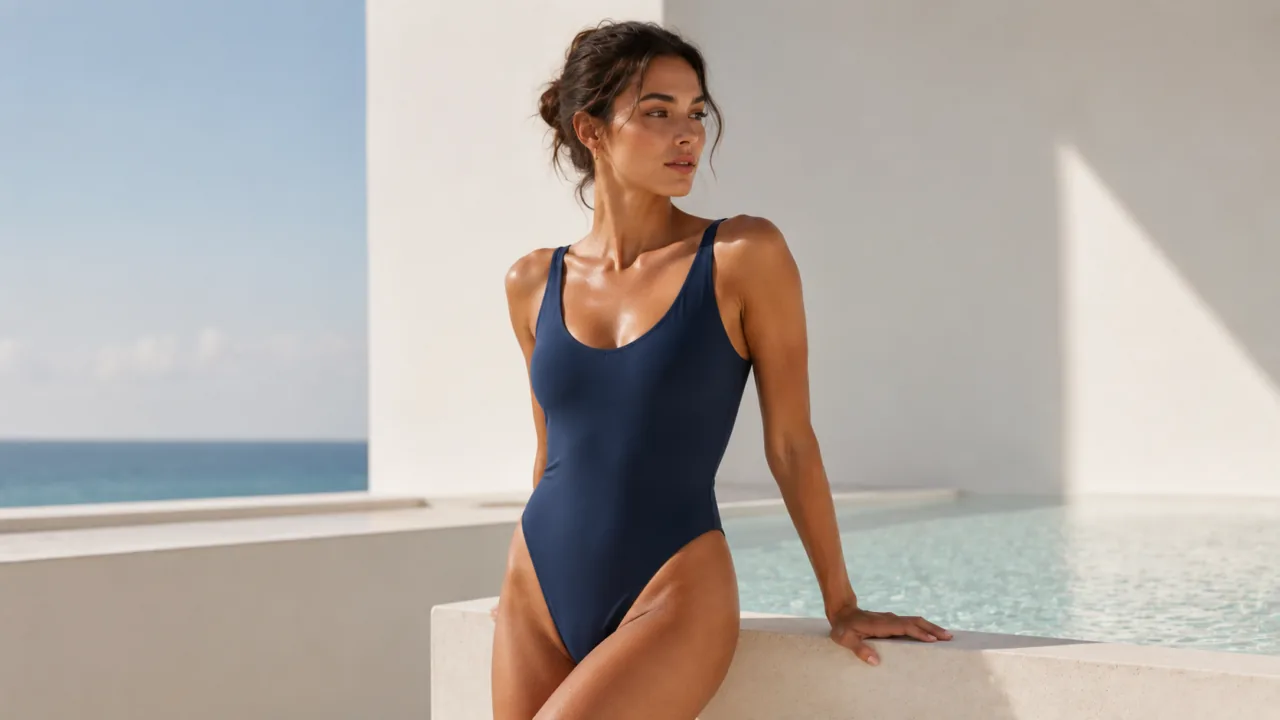
One-piece suits and bikini sets are both cut-and-sew swimwear, but they are not equivalent in construction complexity. Brands planning a mixed range should understand the difference at the spec stage because it affects sampling time, pattern cost, and unit price.
| Feature | One-Piece Swimsuit | Bikini / Two-Piece Set |
|---|---|---|
| Pattern pieces | More complex (single body, often 6–10 panels) | Two simpler garments per set |
| Lining | Full or front; more liner fabric | Front cup lining; brief lining |
| Elastic points | Leg openings, neckline, back, straps | Top edge, leg openings, straps, side ties |
| Cup integration | Integral to garment | Separate in top |
| Sizing complexity | Graded across bust AND hip simultaneously | Top and bottom can be sold separately |
| Average sewing time | Longer | Shorter per piece; two pieces per set |
| Minimum effective assortment | 1 style | 1 top + 1 bottom (can sell as set) |
Cover-ups — kaftans, sarongs, beach dresses — are also within YOUMEGA’s production scope and are simpler cut-and-sew constructions. They are typically produced alongside a swim range rather than as a standalone category.
For context on where swimwear sits in the broader cut-and-sew manufacturing landscape, our article on seamless vs. cut-and-sew activewear is worth reading. All YOUMEGA swimwear is cut-and-sew; the seamless production we run in Yiwu on Santoni machines is specific to our activewear knit categories.
MOQ Structure for Swimwear OEM
MOQ for swimwear at YOUMEGA follows the same logic as our activewear minimums, structured by how much custom work each order requires. Our full MOQ breakdown is covered in the guide MOQ for activewear: what’s realistic in 2026, but here is how it applies specifically to swimwear.
Stock style with your label: from 100 sets per style. This tier covers styles from our existing swimwear pattern library with standard trims — you apply your own woven labels, printed labels, and packaging. 100 sets means 100 of each garment in a set (e.g., 100 tops + 100 bottoms for a bikini style).
Full OEM/ODM with custom pattern or fabric: 300–500 pieces per style per color. If you bring your own tech pack or ask us to develop a pattern from your reference, or if you want a fabric construction that differs from our standard programs, the minimum steps up to this range to justify pattern development and fabric minimums.
Custom Pantone color dyeing: 300-500 pieces per style per color. Matching a specific Pantone reference requires a dye lot at minimum fabric quantity. Below 500 pieces, dyeing a custom color is typically not economically viable at the mill level. For Pantone color strategy more broadly, see our article on Pantone color matching for activewear.
Brands testing a new swim category for the first time often start at the 100-set tier — one or two stock styles with their own label — and move to full OEM once they have sell-through data. This is a sensible approach. Testing does not require a large commitment; it requires a realistic understanding that even the entry tier involves real development time and sampling investment.
How Long Does Swimwear Development Actually Take?
This depends on what you are building. There is no single answer, but there is a range we can commit to based on project type.
Stock style + your logo: approximately 30–35 days from pre-production sample sign-off to bulk shipment. Sampling typically runs 10–14 days. Total project time from first inquiry to shipment is usually 45–55 days assuming prompt feedback at each stage.
Full OEM (custom pattern, standard fabric): bulk production is approximately 40–50 days. Custom pattern development and sampling adds 15–20 days to the front end. Allow 60–75 days total from project start to shipment, plus time for you to review and approve samples.
Full ODM (YOUMEGA develops pattern and fabric): bulk production runs approximately 45–55 days. The design and development phase is longer. For accurate project timelines at ODM level, review our services page or contact us directly with your brief.
The most common cause of delay is not production — it is feedback latency. Brands that take two weeks to review a sample and respond with consolidated comments will extend their timeline by two weeks. We produce and hold; the critical path is usually on the brand side. Booking a production slot before sampling is complete is possible and reduces wait time if you are working to a seasonal deadline.
Customization Available Across the Swim Line
Swimwear OEM at YOUMEGA is not limited to cut-and-sew construction. The following customization options are available and are part of what we specify during tech-pack development:
- Labels: woven labels, printed labels, heat-transfer labels, care labels — all custom to your brand
- Hangtags: custom printed hangtags with your branding and sizing information
- Hygiene liner sticker: included as standard on all bikini bottoms and one-pieces
- Decoration: heat transfer print, silicone 3D print, sublimation print, embroidery — applied to outer fabric panels
- Pantone color matching: available at 300-500 pcs/color minimum dye lot
- Packaging: poly bags, branded retail packaging, folded vs. rolled presentation, barcodes, country-of-origin labels
- OEM and ODM: we work from your tech pack (OEM) or develop the full design, pattern, and specification from your brief (ODM)
For branding applied to garments — label placement, silicone logo size and position, care instruction content — we provide a brand-detail form during the pre-production stage. Getting these details confirmed early prevents a second sampling round purely for label corrections, which is a common and avoidable delay.
All YOUMEGA products are manufactured under OEKO-TEX Standard 100 and BSCI audit compliance, with REACH and CPSIA conformity. We hold our own export license and ship FOB, CIF, EXW, or DDP to buyers across 50+ countries.
Frequently Asked Questions
Which swim fabric should I choose — nylon/elastane or polyester/elastane?
For fashion and resort swimwear where hand-feel is important, nylon/elastane is the more common choice. For training or high-use swimwear where chlorine resistance and color retention under UV are the priority, polyester/elastane is a stronger option. If sustainability positioning matters to your brand, ECONYL (recycled nylon) or rPET are available on request. We will recommend based on your use case during quoting.
Do I need front lining or full lining? What is standard?
Full front lining is standard on all YOUMEGA swimwear. Full lining (both panels) is available as an upgrade for one-piece suits or lightweight fabrics. The practical reason is wet-opacity: front lining is sufficient for most fashion swimwear in mid-weight fabric, but the right call depends on the specific fabric and style you choose.
Should bust cups be removable or sewn in?
Removable cups in an internal pocket are the default for fashion bikini tops and one-pieces — they give the consumer flexibility and are simpler to produce. Sewn-in foam cups or moulded bra cups are specified when the style requires more structure or support. Moulded cups require specialist sourcing and should be flagged at the brief stage.
How is swimwear elastic and finishing different from activewear?
Swimwear uses rubber-core elastic rated for chlorine and saltwater exposure. Hardware on straps and adjusters is coated or plastic to resist corrosion. Leg opening elastic application requires specific tension ratios for a clean finish. These are standard to swimwear production but are not the same as activewear finishing — it is one reason why working with a factory that actively produces swimwear matters.
What are YOUMEGA’s MOQs for swimwear?
Stock style with your label starts from 100 sets per style. Full OEM or ODM with a custom pattern or fabric is 300–500 pieces per style per color. Custom Pantone dyeing requires the same 300-500 pieces per style per color. We do not offer uncommitted minimums — every order is a confirmed production run.
Can I use recycled or sustainable swim fabric?
Yes. ECONYL (recycled nylon from ocean and pre-consumer waste) and rPET (recycled polyester) are both available on request. Both perform comparably to virgin-fiber equivalents. Expect slightly longer fabric sourcing lead times and higher minimums at the mill level; we will factor these into your project timeline during quoting.
What customization is available for my swim line?
Custom woven and printed labels, hangtags, hygiene liner stickers, branded packaging, Pantone-matched colorways, heat transfer and silicone 3D prints, sublimation, and embroidery are all available. OEM (your tech pack) and ODM (we develop from your brief) are both supported. We manage full export documentation and ship to 50+ countries under our own export license.
How does swimwear production differ from activewear?
The key differences are in fabric environment, lining requirements, elastic specification, and hardware. Activewear is designed for perspiration and movement; swimwear is designed for water, chlorine, UV, and wet-stretch stress. The construction processes overlap — both are cut-and-sew — but the materials science and finishing details are distinct. For a full comparison from a sourcing perspective, read our guide Private label swimwear sourcing: how it differs from activewear.
Have a swimwear question? We reply in 24 hours.
Next step for your activewear project
— YOUMEGA Editorial Team
YOUMEGA (Xiamen Mega Garment Co., Ltd.) is a private label and OEM/ODM activewear manufacturer in Xiamen, China, specializing in low-MOQ runs for emerging and growing brands.