How We Test Stretch and Recovery at the QC Bench (And How to Read the Numbers)
Every fabric supplier says “four-way stretch, great recovery.” At the QC bench those words become two numbers — and the numbers are what your reorder can be held to. This is the operational version of the stretch story: how the test actually runs, what good values look like for activewear, and how to write them into your standard so “great recovery” stops being a matter of opinion. (Why recovery dies over a garment’s life is the elastane chemistry story — this article is about measuring it while it’s alive.)
The bench test, step by step
The principle is unglamorous and repeatable:
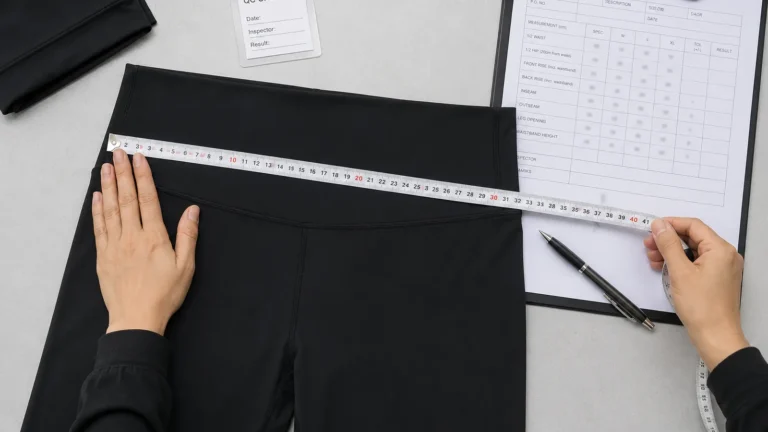
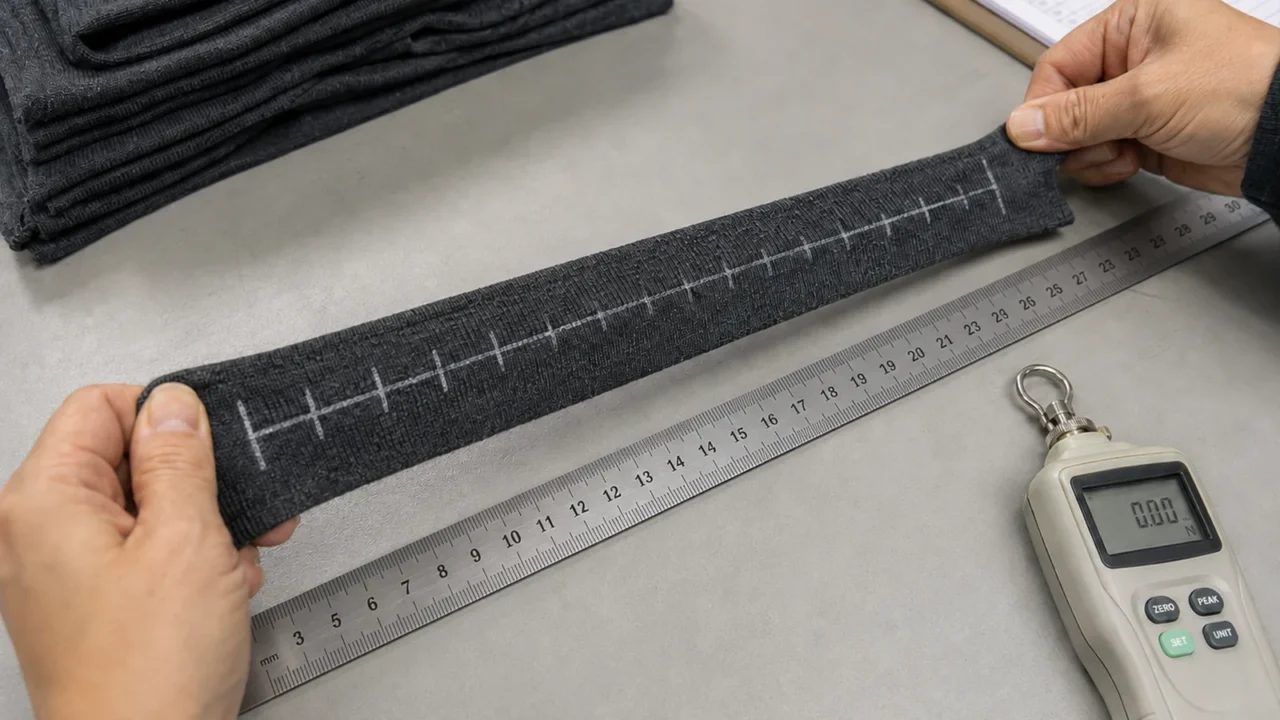
- Mark a gauge length on the relaxed fabric — say, 100 mm between two marks, in the direction being tested.
- Stretch to a defined condition — either to a specified force (using a simple gauge) or to a specified elongation, held for a set time.
- Measure stretched length → elongation % (how far it goes).
- Release, rest for a defined interval, re-measure → the gap between original and rested length is unrecovered growth; recovery % is how much of the stretch came back.
- Repeat in the other direction — length and width behave differently in knits, always.
Lab-grade versions of this run on calibrated instruments through accredited labs (we arrange them when a program’s spec requires it); the bench version runs on every approval and every bulk lot, because a test you run often beats a perfect test you run once.
Reading the two numbers like a buyer
Elongation is the marketing number — how stretchy it feels. Recovery is the product-lifespan number — whether the waistband snaps back at wash one and wash thirty. The failure pattern we see constantly in submitted “equivalent” fabrics: elongation matches the reference, recovery quietly doesn’t. The garment fits identically in the fitting room and grows a size by month two.
Rules of thumb for premium activewear knits:
- Elongation: enough for the movement, not a bragging contest — a compression legging and a flow-yoga legging should test differently
- Recovery: the high nineties, measured after rest, per direction — and consistent between lots, which matters more than any single spectacular value
- Growth after repeated cycling: small and stable — one stretch proves little; the tenth stretch tells the truth
Writing it into your standard (the part most brands skip)
A stretch spec that can settle a dispute has four parts: gauge length and direction, the stretch condition (force or elongation, hold time), the rest interval before re-measure, and the pass window per direction. Put those on the spec sheet next to GSM and composition, test the approved lot, record the values on the sealed sample documentation — and every future bulk lot has an objective referee. At final inspection we check garments against the sealed standard at AQL 2.5; fabric-level stretch verification per lot is what makes that garment check mean something.
One honest caveat: bench values are comparative tools, not universal physics — protocols differ between labs and suppliers. Which is exactly why the spec must state its own protocol. A number without its method is an adjective wearing a costume.
FAQ
What’s the difference between two-way and four-way stretch? Direction count: four-way stretches and recovers both lengthwise and widthwise — the activewear default. The test above, run in both directions, is how the claim gets verified rather than assumed.
What recovery percentage should I demand? High-nineties after rest for premium knits — but demand consistency to the approved lot above any single number. A stable 96% beats an occasional 99%.
Can I run this test myself on samples? Yes — ruler, marks, a means of consistent stretch, and patience. Your bench numbers won’t match a lab’s absolutely, but they’ll expose lot-to-lot drift immediately.
Do you provide lab reports? When the program requires them — accredited third-party testing to your protocol, quoted per project, on production fabric rather than a drawer swatch.
Want your reference garment’s actual stretch and recovery profile? Send it over — we’ll test it, report the numbers with the method, and quote fabric that can hit them again. Reply within 24 hours on weekdays.