Short answer: Nylon (in Spanish also nailon or nilón) is a synthetic fiber in the polyamide family. On European Union labels it appears as “polyamide” or “nylon,” and in the United States as “nylon.” In leggings and sports bras it is usually blended with elastane, and the label states the percentage by weight of each fiber.
Updated in October 2026. Definitions taken from European and U.S. regulations, from the Diccionario de la lengua española and from reference sources cited at the end.
Nylon, nailon, nilón or polyamide: are they the same?
Yes, in everyday use they are the same fiber. The Royal Spanish Academy’s Diccionario de la lengua española lists “nailon,” from the registered name Nylon®, as a “synthetic polyamide from which elastic and very strong filaments are made, used in the manufacture of various fabrics.” “Nilón” appears as a synonym.
“Polyamide” is the name of the chemical family: the same dictionary defines it as a “polymer characterized by the presence of multiple amide groups, such as nailon.” That is why on a technical data sheet you may see “polyamide,” “PA,” “nylon” or “nailon” referring to the same yarn.
What the label says: polyamide in Europe, nylon in the United States
In the European Union, Regulation (EU) No 1007/2011 sets the fiber names that may appear on the label. Its Annex I includes “polyamide or nylon” and defines it this way: “fiber formed from synthetic linear macromolecules having in the chain recurring amide linkages, at least 85% of which are linked to aliphatic or cycloaliphatic units.”
The same regulation requires stating “the name and percentage by weight of all fibers” in descending order. A label such as “polyamide 80%, elastane 20%” means that, by weight, four fifths of the garment is polyamide.
In the United States, the FTC textile labeling rule (16 CFR 303.7) uses the name “nylon” for the fiber whose substance is a long-chain synthetic polyamide in which fewer than 85% of the amide linkages are attached directly to two aromatic rings. Aromatic polyamides form another group with its own name: aramid, which the European regulation lists in the next entry.
What type of fiber is nylon?
It is a synthetic fiber: it is made from a polymer and spun into filaments. Encyclopaedia Britannica explains that polyamides are obtained from a dicarboxylic acid and a diamine, or from an amino acid or its lactam (such as ε-caprolactam), and that by varying the acid and the amine you can get hard, tough materials or soft, rubbery ones.
For clothing, what matters is the result in the fabric: the yarn is woven or knitted, and the feel, opacity and recovery depend on the knit structure, the fabric weight and the finish, not only on the name of the fiber.
Nylon 6 and nylon 6,6
These are the two most common polyamides. According to Britannica, the most common nylon is made from adipic acid and hexamethylenediamine, two compounds with six carbon atoms each: hence the name “nylon 6,6.” When the raw material is caprolactam, the result is “nylon 6,” so called because its basic unit has six carbon atoms.
On a garment label the two appear the same, as “polyamide” or “nylon.” If your product depends on a specific type, ask the supplier to state it in the fabric’s technical data sheet, and don’t infer it from the label.
Where nylon comes from
The American Chemical Society, which recognizes the development of nylon as a historic chemical landmark, reports that on February 28, 1935, Wallace Carothers’ team at DuPont synthesized “fiber 66” from adipic acid and hexamethylenediamine, so called because each component had six carbon atoms. DuPont announced nylon on October 27, 1938; by then it was already being used in small amounts in toothbrush bristles. The first stockings were sold in March 1939 to company employees in Wilmington, and the plant began producing on December 15, 1939.
Why is it used in activewear?
From the start it was described as a strong, elastic fiber: the dictionary speaks of “elastic and very strong filaments,” and the American Chemical Society reports that fiber 66, once cold-drawn, was strong and elastic, was unaffected by water and most solvents, and had a high melting point.
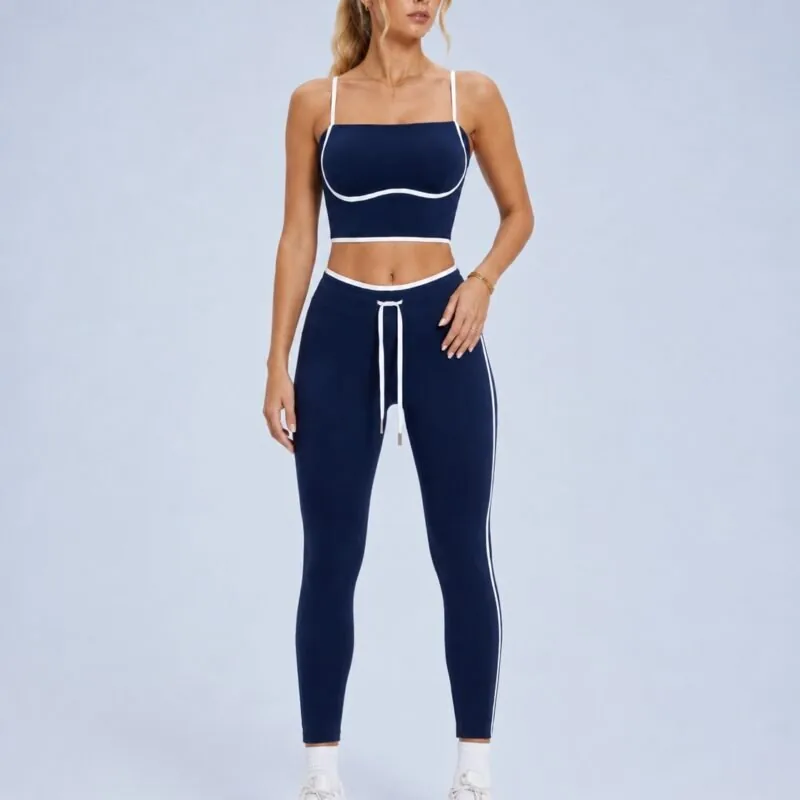
In leggings and sports bras, polyamide is usually combined with elastane so that the fabric stretches and recovers. To understand what each fiber contributes, read what Lycra (elastane or spandex) is.
Nylon or polyester?
Both fibers are blended with elastane and used in leggings, tops and sports bras. Neither is better in every case: it depends on the feel you want, the coloring method, how the garment will be used and the price of the particular specification. For example, sublimation printing is designed for polyester; we explain it in sublimation printing. There is a table of criteria in best fabric for leggings, and in what polyester is you will find the other fiber explained.
Recycled nylon
Recycled polyamide also exists. ECONYL®, a brand of the Italian company Aquafil, says it introduced its regeneration system in 2011. The system collects fishing nets, old carpets and discarded fabric scraps and turns them into nylon that, according to the brand, offers the same quality and performance as standard nylon.
If a supplier offers you recycled polyamide, ask for the certificate that backs that recycled content and the document that links it to your lot; we explain this in GRS scope certificate and transaction certificate. The recycled options are compared in recycled fabrics for activewear.
Caring for nylon garments
Heat, certain cleaning products and some washing habits affect polyamide and the elastane that goes with it. What damages these garments, and how to avoid it, is covered in what damages polyester and nylon activewear. Always follow the garment’s care label.
What we check at the factory
When a technical data sheet says “nylon,” confirm the exact composition as a percentage, the fabric weight and the finish for each style, and agree before production which stretch, recovery and shrinkage tests will be done, who does them and which tolerances are accepted. For custom colors, the lab dip is approved against the Pantone reference before the lot is dyed.
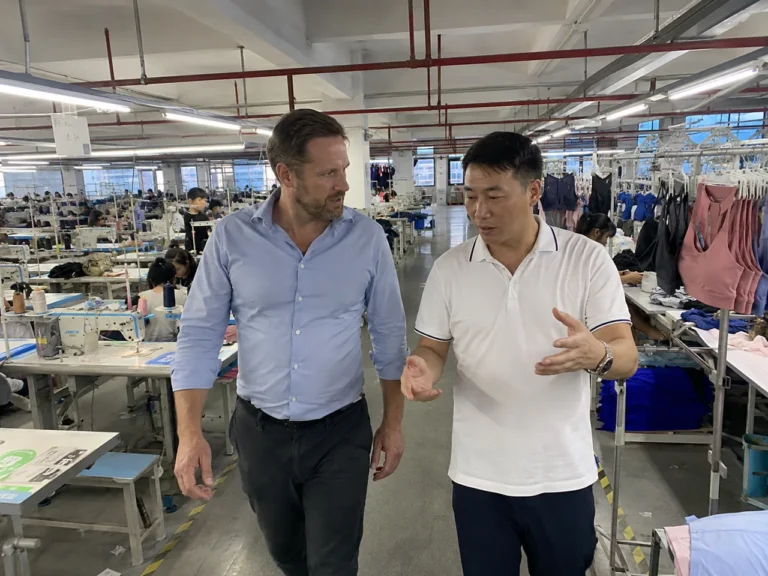
At YOUMEGA, cut-and-sew is done at our Xiamen headquarters and seamless styles in Yiwu. Stock styles with your logo start from 100 sets with mixed colors and sizes; custom dyeing and full development start at 300–500 pieces per style per color. The finished garment goes through our quality control to AQL 2.5.
FAQ
Is nylon natural or synthetic?
It is synthetic. The dictionary defines it as a “synthetic polyamide” and the European regulation defines it as a fiber of “synthetic linear macromolecules.” It does not come from plants or animals: it is made from a polymer that is then spun into filaments to make fabrics.
What is the difference between nylon and polyamide?
No practical difference in a garment: “polyamide” is the name of the chemical family and the one usually seen on European labels, while “nylon” (or “nailon” in Spanish) is the common name of the fiber. Aromatic polyamides, such as aramid, have their own name and are not labeled as nylon.
Are nylon and Lycra the same thing?
No. Nylon is a polyamide; Lycra is the common name for elastane fiber, and LYCRA® is a brand. In leggings and swimsuits it is common to see them together on the label: the elastane provides the stretch. The label states the percentage by weight of each fiber.
What does “polyamide 80% elastane 20%” mean?
That, by weight, 80% of the garment’s fibers are polyamide and 20% are elastane. Regulation (EU) No 1007/2011 requires stating the percentage by weight of all fibers in descending order. The figure does not tell you the knit type, the fabric weight or the finish: that information is in the technical data sheet.
Which is used more, nylon 6 or 6,6?
According to Encyclopaedia Britannica, the most common nylon is 6,6, made from adipic acid and hexamethylenediamine. Nylon 6 is obtained from caprolactam. On the garment label both appear as polyamide, so if the type matters for your product, ask for it to be stated in the fabric’s technical data sheet.
What is recycled nylon?
It is polyamide made from waste instead of new raw material. For example, ECONYL®, from Aquafil, says it has been regenerating fishing nets, carpets and fabric scraps since 2011. If a fabric is sold as recycled, ask for the certificate that backs the recycled content and the document that links it to your lot.
Preparing a line with polyamide fabric? Send us your reference or technical data sheet and we will reply with fabric options, minimums and sample lead times.
Sources
- Real Academia Española, Diccionario de la lengua española, “nailon” (in Spanish): https://dle.rae.es/nailon
- Real Academia Española, Diccionario de la lengua española, “nilón” (in Spanish): https://dle.rae.es/nil%C3%B3n
- Real Academia Española, Diccionario de la lengua española, “poliamida” (in Spanish): https://dle.rae.es/poliamida
- Regulation (EU) No 1007/2011, Article 9 and Annex I (No 30, polyamide or nylon; No 31, aramid), Spanish version: https://eur-lex.europa.eu/legal-content/ES/TXT/HTML/?uri=CELEX:32011R1007
- U.S. Federal Trade Commission, 16 CFR 303.7, generic names for fibers: https://www.law.cornell.edu/cfr/text/16/303.7
- Encyclopaedia Britannica, “Nylon”: https://www.britannica.com/science/nylon
- American Chemical Society, Wallace Carothers and the Development of Nylon: https://www.acs.org/education/whatischemistry/landmarks/carotherspolymers.html
- ECONYL®, Who We Are: https://www.econyl.com/pages/who-we-are