What Is Polyester? What It's Made Of, How It's Made and Whether It's a Good Fabric
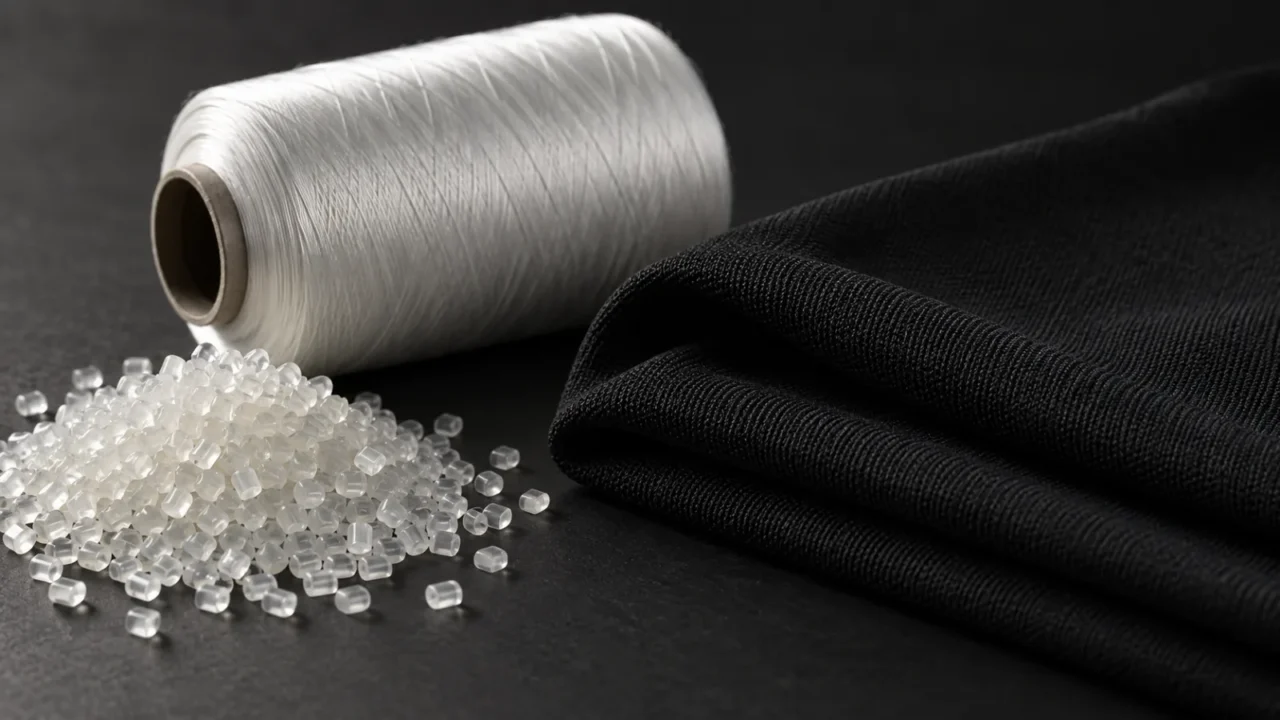
Short answer: Polyester is a synthetic fibre; clothing polyester is commonly PET (polyethylene terephthalate). PET can be made from petrochemical or recycled feedstock, spun into filaments and knitted or woven into fabric. Textile Exchange reported polyester at 59% of global fibre production in 2024. The fibre name alone does not establish a garment's drying rate, stretch, pilling or suitability for leggings.
What polyester is: a fibre, not a type of fabric
Polyester is a fibre — the raw material spun into yarn — not a way of making cloth. So the honest answer to "what type of fabric is polyester?" is: a synthetic fibre that can be knitted or woven into almost any fabric, from mesh to fleece.
Chemically, it is a plastic. EU labelling law defines the polyester fibre name using a specified terephthalate-ester chain. US textile rules define their generic polyester name separately; do not assume the legal wording or every included polymer is identical across markets. Clothing polyester is commonly PET, while other textile polyester types exist. In Spanish the fibre is poliéster.
Why polyester is called a polymer
A polymer is a very long molecule made of many small units joined in a chain; poly means many. In polyester the links are esters, the bond formed when an acid reacts with an alcohol. To make PET, terephthalic acid (or dimethyl terephthalate) is reacted with ethylene glycol, an alcohol with two reactive ends, and heated until the units join into long chains: a poly-ester.
Drawing — stretching the new filament — changes its structure and strength. A historical moisture-regain figure for unmodified fibre is not a drying test for a finished garment; fabric construction, thickness and finish also matter.
How polyester is made
A common route for clothing PET polyester is:
- Ingredients. Ethylene glycol and terephthalic acid (or dimethyl terephthalate), both petrochemicals. One common mechanical route starts with used PET, often bottles, that is cleaned, chopped and remelted; recycled PET can also follow other processes.
- Polymerisation. They are reacted and heated into molten PET, spun directly or cast into chips for remelting later.
- Melt spinning. An extruder forces the melt through a spinneret, a plate with tiny holes; cold air solidifies the filaments.
- Drawing and texturing. Filaments are drawn and may be crimped, textured and heat-set, then kept as continuous filament yarn or cut into staple fibre and spun much like cotton.
- Fabric. The yarn is knitted or woven, dyed and finished.
A short history
The Science Museum records a sample of 100% spun Terylene yarn from about 1949. Terylene was an early commercial polyester name; this historical object does not establish the performance of a proposed garment.
What polyester fabric looks and feels like
The yarn and the finish decide the look, not the fibre.
| Yarn or finish | Look and feel | Typical uses |
|---|---|---|
| Smooth filament | Even, often shiny; slick and cool | Linings, satin, sports jerseys |
| Textured filament | Check the finish and stretch of the proposed sample | Knitted activewear, depending on construction |
| Spun (staple) yarn | Matte, dry, cotton-like | T-shirts, polyester–cotton blends |
| Microfibre or brushed | Compare the proposed fabric; brushing may change the surface hand | "Peach" fabrics, fleece, bedding |
Is polyester a good fabric?
It can be suitable when the proposed fabric meets the garment's movement, drying and durability requirements in testing. The fibre name alone does not establish those outcomes.
| Property | Polyester | In practice |
|---|---|---|
| Durability | Depends on yarn, fabric and finish | Test for the intended use |
| Moisture | Fibre regain is not garment drying time | Compare finished samples under matched conditions |
| Creasing | Depends on construction and care | Follow the garment's label |
| Printing | Conventional dye-sublimation transfer works best on light-coloured polyester or polyester-rich fabric; compare print methods | All-over prints can use other methods too |
| Odour | Depends on fabric, wear and storage | Assess the actual garment and care routine |
| Heat | Thermoplastic — it is melted in order to be spun in the first place | Follow the whole garment's care label for ironing and tumble drying; see what actually damages polyester |
| Pilling | Depends on yarn, structure and testing | Ask for the actual fabric's result |
| Origin | Mostly fossil-based | Recycled options exist; verify the proposed material's origin |
One study of 26 people compared cotton and synthetic T-shirts after a spinning session and 28 hours of sealed storage. That sample and storage condition cannot establish that every polyester garment retains more odour.
Against nylon or cotton, compare the actual fabrics under matched conditions for hand, drying, opacity, odour, pilling and price. Fibre definitions cannot settle those finished-garment comparisons.
Does polyester stretch?
Stretch depends on the yarn and fabric construction. A 100% polyester knit may stretch through its loop structure; a woven may be engineered for stretch as well. Elastane is one option when a specification calls for stretch and recovery. Check measured results on the proposed fabric.
What "100% polyester" means
It is a fibre-content claim, not a guarantee about performance. Any exclusions, tolerances or trim rules depend on the market and the exact product; they do not permit deliberate undisclosed blending. Check the applicable current labelling rules before printing a "100%" claim.
The label does not tell you the yarn, construction, weight, recycled origin or measured stretch. Leggings and sports bras can use different constructions and blends; test the proposed style rather than inferring a required elastane percentage.
Polyester or microfibre: which is better?
"Microfibre" describes fineness, not a material. The term can refer to fine polyester, nylon or a blend; the fibre label still needs the actual fibre name. Ask for the proposed yarn's denier or dtex if its fineness matters to the brief.
| Polyester fabric | Polyester microfibre fabric | |
|---|---|---|
| Fineness | Check the specified filament size | Check the specified filament size |
| Feel | Compare the physical sample | Compare the physical sample; fineness alone does not fix hand or drape |
| Colour | Check the actual dyeing result | Check the actual dyeing result and fastness |
| Examples to assess | Mesh, jerseys, outerwear | Brushed fabrics, bedding, cloths; check the finished sample |
Neither is better overall. Compare finished fabrics for the hand and drape in your brief rather than treating the name as a performance grade.
Recycled polyester
Recycled PET polyester (rPET) is PET made from recycled feedstock. Textile Exchange estimated that recycled polyester was about 12% of all polyester produced in 2024 and that plastic bottles supplied about 98% of recycled-polyester feedstock that year. The report does not assign all remaining feedstock to old textiles; other plastics and pre-consumer residues are also possible. Those market figures do not identify the feedstock in a proposed fabric. For an order's recycled-content claim, check the source mill's GRS scope and order-linked transaction documentation. For restricted substances, request evidence applicable to the particular article and market; neither a market report nor a generic certificate proves that every finished garment is safe for skin contact. The GRS scope certificate is held by the source mill, not YOUMEGA.
How we choose between polyester and nylon on a style
The decision is made from the garment, not the fibre. If the brief specifies conventional dye-sublimation transfer, ask the printer which light-coloured polyester or polyester-rich fabric works with its process; an all-over design alone does not require that method. Compare hand, colour, drying, finish and quoted cost on the actual proposed fabrics.
Colour comes next. For a custom-dyed shade, agree on the Pantone reference and lab-dip approval before bulk dyeing; the minimum is 300–500 pieces per style per colour. Specify the proposed GSM and any shrinkage, shape and recovery checks needed on the sample fabric, with agreed methods and tolerances. Finished goods are inspected in-house to AQL 2.5. Stock styles with your logo start from 100 sets, with mixed available colours and sizes; they do not include a newly dyed shade at that minimum.
FAQ
What is polyester made of? Clothing polyester is commonly PET, a plastic made by reacting ethylene glycol with terephthalic acid. Recycled PET can be made from used plastic. The polymer is spun into filaments and knitted or woven into fabric; stretch depends on the yarn and construction, and some styles also use elastane.
Is polyester a plastic? Yes. Polyester is a synthetic polymer fibre rather than a natural fibre like cotton or wool. Clothing polyester is commonly PET, the same polymer used for plastic drinks bottles; other textile polyesters exist. PET can be melt-spun: the polymer is melted and pushed through a spinneret to form filaments. Textile Exchange estimated that 88% of polyester production was fossil-based and about 12% was recycled in 2024; those figures are for polyester overall, not PET alone.
Is polyester a good fabric? It can be, depending on the intended use and the actual yarn, construction, finish and test results. Assess drying, pilling, stretch, care and origin claims on the proposed material rather than from the fibre name.
Does polyester stretch? A polyester fabric's stretch depends on its yarn and construction. Knitted loops can provide stretch without elastane; elastane and other yarn designs can add different recovery. Ask for measured stretch and recovery on the proposed fabric.
What does 100% polyester mean? It is a fibre-content declaration subject to the rules of the market where the garment is sold. It says nothing by itself about yarn, weight, quality or recycled origin. Any legal exclusions need checking for the specific product; they do not permit intentional undeclared blending.
Is microfibre better than polyester? They are not competing fibre names: microfibre describes fineness and may be polyester or nylon. Compare the actual fabrics for hand, drape and colourfastness.
What is polyester used for? Clothing, home textiles and technical fabrics. In activewear it can be knitted or woven, with or without elastane; the finished construction and test results determine stretch and suitability.
Planning a polyester style? Tell us what the garment is for, and we will suggest the knit, weight and finish we would use, in English or Spanish.
Sources
- Regulation (EU) No 1007/2011, Annex I (textile fibre names)
- Regulation (EU) No 1007/2011, Article 7 (pure textile products)
- US Federal Trade Commission, Threading Your Way Through the Labeling Requirements Under the Textile and Wool Acts
- US 16 CFR 303.7(c), generic fibre name for polyester
- US EPA, AP-42 Section 6.9, Synthetic Fibers
- Science Museum Group, First sample of 100% spun "Terylene" yarn
- Textile Exchange, Materials Market Report 2025 (2024 data)
- Callewaert et al., Microbial odor profile of polyester and cotton clothes after a fitness session, Applied and Environmental Microbiology (2014)
- Epson, Dye-Sublimation Printers for Makers, fabric and print-process guidance