What Actually Damages Polyester and Nylon Activewear (It’s Rarely the Stain Remover)
Ranked by how much damage they actually cause: heat first, chlorine second, fabric softener third, friction fourth — and stain removers a distant fifth. Most people worry about the bottle under the sink while doing far more harm with the dryer.
Polyester and nylon are chemically tough fibres. What fails in a blended garment is almost always the elastane, the finish, or the surface — and each has a signature look you can diagnose at home.
The damage ranking
| Rank | Cause | What it attacks | What you see | Reversible? |
|---|---|---|---|---|
| 1 | Heat (hot wash, tumble dryer, ironing) | Elastane, finishes, prints | Bagging, waistband slack, peeling transfers | No |
| 2 | Chlorine (bleach, pool water) | Elastane, dye | Loss of stretch, yellowing, faded patches | No |
| 3 | Fabric softener | Fibre surface, wicking finish | “It stopped absorbing sweat”, greasy hand | Partly — several rinse washes may help |
| 4 | Friction & abrasion (gym equipment, washing with zips, overloading) | Fabric surface | Pilling, shine, thinning at contact points | No |
| 5 | Stain removers | Depends on chemistry | Localised colour loss, edge lifting on prints | Usually no |
The ordering matters because it redirects effort. Skipping the dryer protects a garment more than switching stain-remover brands ever will.
Heat: the number one killer, and the least suspected
Elastane loses elasticity progressively with heat exposure — and unlike a stain, the damage is invisible until the garment stops fitting. A legging that “was fine for two months then went baggy” almost always went through a warm wash cycle or a dryer, repeatedly.
Heat also does two other things quietly. It softens the adhesive layer under heat transfers and silicone logos, which is why edges start lifting after a few hot cycles. And it can set dimensional change into the fabric — shrinkage and twist that testing is specifically designed to predict, as covered in shrinkage and torque testing.
Practical version: cold wash, air dry, and the single most valuable habit — never tumble-dry anything with stretch in it.
Chlorine: the absolute no
Chlorine attacks the elastane chain directly and permanently. Two exposure routes matter:
- Bleach in the wash. No safe dilution exists for a garment containing elastane.
- Swimming pools. This is why chlorine-resistant swim fabrics exist as a separate product category — ordinary activewear elastane is not built for repeated pool exposure.
Both routes produce the same signature: stretch that never comes back, plus dye loss in patches. The mechanism is the same one behind elastane degradation.
Fabric softener: the invisible performance killer
Softener works by depositing a thin lubricating layer on fibre surfaces. On cotton towels that’s pleasant. On performance fabric it is a coating over exactly the surface that moves moisture — which is why “my activewear stopped wicking” is one of the most common complaints that has nothing to do with fabric quality.
The finish it defeats is a real, engineered part of the product: see moisture-wicking finishes. Dryer sheets do the same thing by a different route.
Friction: what pilling really tells you
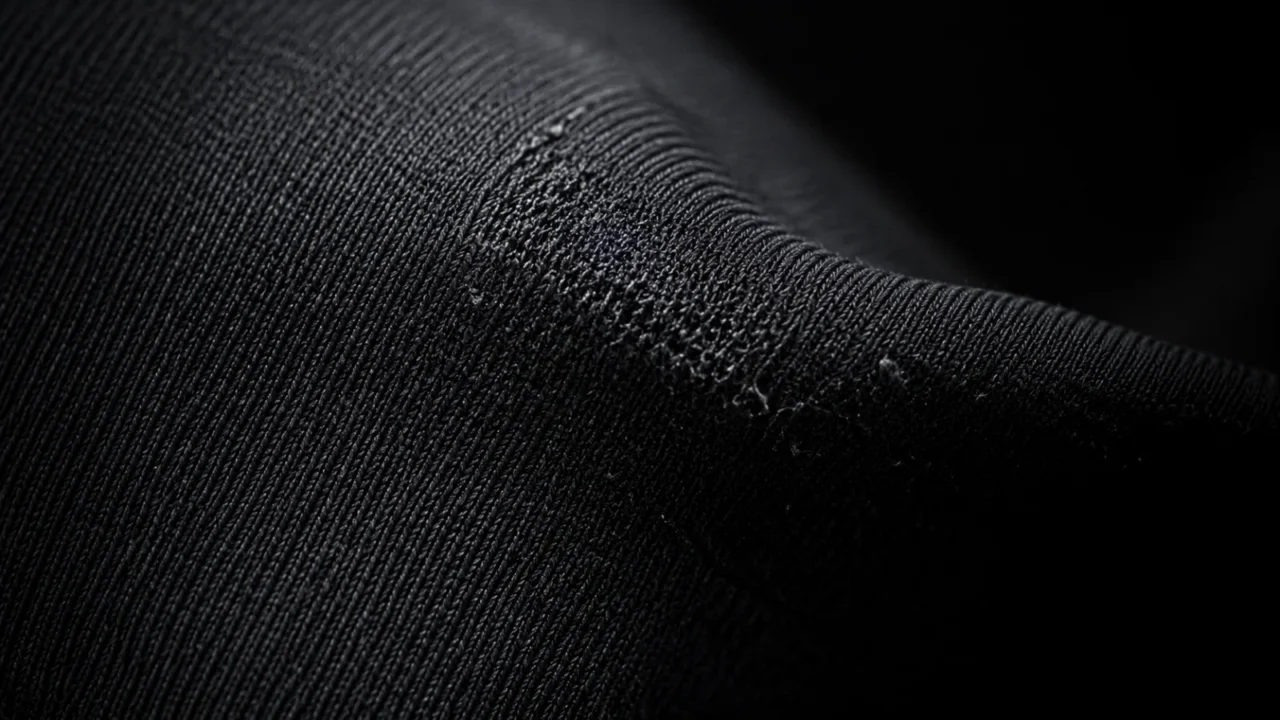
Pilling is fibre ends working loose under abrasion and tangling into balls. It is driven by yarn construction, knit structure and fabric weight — heavier, denser fabrics resist it better, which is one reason our legging range sits at 220–320 g/m² rather than lighter — plus how the garment is used and washed. Washing inside out, closing zips, and not overloading the drum all measurably reduce it. The manufacturing side of the story is in why activewear pills, and the weight trade-offs in the fabric weight guide.
Primary sources on fabric durability testing
- AATCC — test methods for pilling, dimensional change, and colorfastness to laundering — https://www.aatcc.org/
- ASTM International — standard test methods for abrasion resistance and stretch properties of textiles — https://www.astm.org/
- ISO — international standards for textile care labelling symbols and their meaning — https://www.iso.org/
Diagnose your own garment
| Symptom | Most likely cause | Not the cause |
|---|---|---|
| Waistband slack, general bagging | Heat (dryer/hot wash) or worn-out elastane | Stain remover |
| Stopped absorbing sweat | Fabric softener or surfactant residue | Fibre quality |
| Faded patches, uneven colour | Chlorine or a solvent spot treatment | Normal washing |
| Little balls on thighs / under arms | Friction, made worse by washing with rough items | Detergent |
| Logo edges lifting | Heat, sometimes solvent nearby | Water |
| Fabric feels thin and shiny | Abrasion over time | One-off accident |
What the factory controls, and what you control
Fabric weight, knit density, elastane content and finish quality are set in manufacturing — those decide how much abuse a garment can take. We check finished goods at AQL 2.5 against spec, and we test shrinkage, torque and stretch-recovery before bulk, because a garment that fails those tests fails in the customer’s hands regardless of how it’s washed.
But no specification survives a dryer. The most durable performance fabric in our range and the cheapest one both lose elastane to heat — the good one just takes longer. That split of responsibility is why care labels exist, and why brands who write clear ones see fewer returns.
FAQ
Do stain removers damage polyester and nylon? Rarely by themselves — both fibres are chemically tough. In a blended garment the risk lands on the elastane and the finishes. Ranked against heat, chlorine, softener and friction, stain removers are a distant fifth cause of damage.
What actually ruins activewear fastest? Heat. Hot washes and tumble drying degrade elastane and soften the adhesives under prints. Skipping the dryer preserves fit longer than any change of detergent or stain remover.
Why did my leggings lose their stretch? Heat or chlorine, in most cases. Both damage elastane permanently, and the effect appears weeks later as bagging or a slack waistband — which is why the cause is so often missed.
Why did my activewear stop wicking sweat? Usually fabric softener or heavy surfactant residue coating the fibre surface, or a finish degraded by heat. Wicking depends on the fibre surface staying clean and intact.
Is pilling a sign of cheap fabric? Not necessarily. Pilling is driven by yarn and knit construction plus abrasion in use and washing. Denser, heavier fabrics resist it better, but any fabric will pill if washed with rough items or worn against abrasive surfaces.
Specifying a line and want to know what your fabric will survive? Send us the composition and target weight — we’ll tell you how it behaves through wash testing, before you commit to bulk. Reply within 24 hours on weekdays.
封面 prompt
> Extreme close-up of dark performance knit fabric showing subtle surface pilling and a slightly stretched, distorted area, one dramatic raking light picking out the fibre texture, dark background. Photorealistic editorial photograph, 16:9, high contrast, muted palette, extreme detail, clinical material-study aesthetic. No text, no logos, no visible faces. Shot on 100mm macro.