Why Some Printed Wash Labels Peel Off — and Why It’s Often By Design, Not a Defect
A customer sends you a photo. Six weeks into owning your bestselling leggings — a handful of washes — the little care label inside the waistband has gone patchy: the wash symbols are ghosting, the size is barely readable. Then comes the line that stings: “But your logo on the outside still looks brand new.” Your first instinct is that the factory cut a corner.
Sometimes it did. Just as often, the gap between those two labels is the design working exactly as intended. Once you know how the different labels inside a garment are built, “the peeling label” stops being a mystery and becomes a decision you get to make on purpose.
The four labels you’re actually choosing between
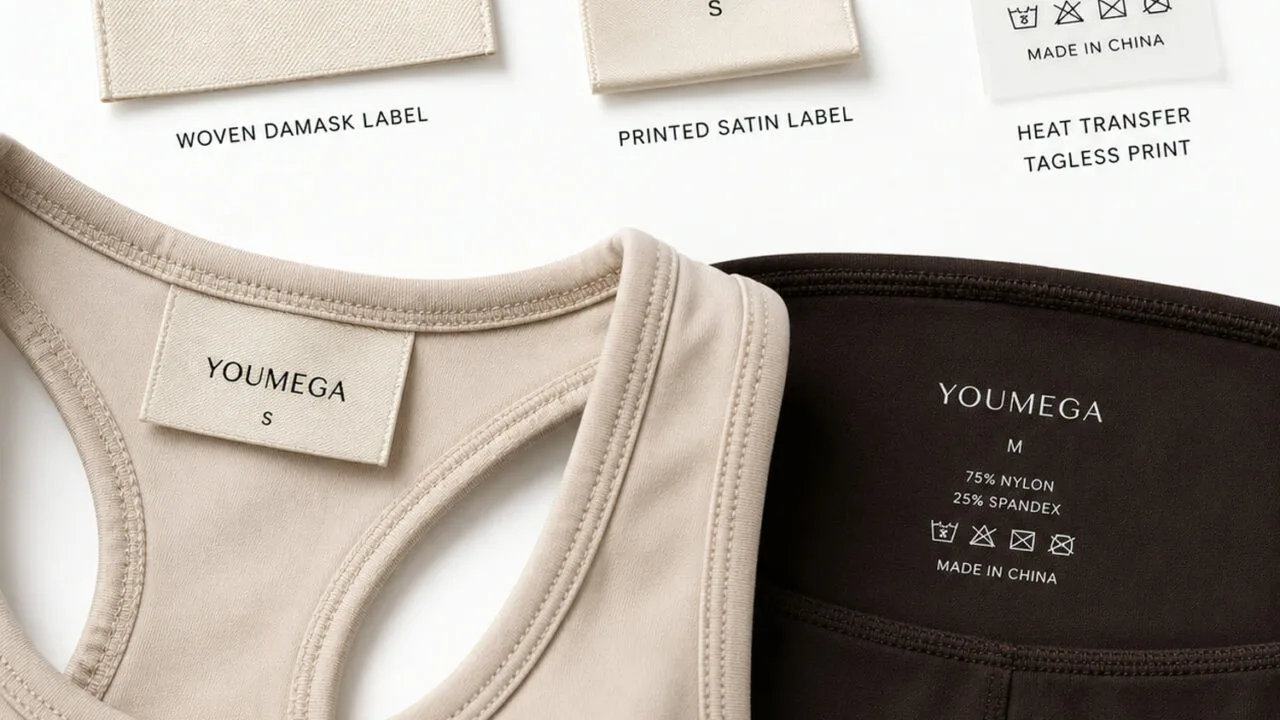
- Woven label. Threads woven into a narrow tape. Very durable — it survives the life of the garment — but the edge is firm and can scratch against bare skin.
- Printed / heat-transfer label. Ink or a thin film heat-pressed onto the fabric. Soft, flat, no scratch. Durability depends entirely on the transfer and is generally lower than woven. Heat transfer is one of several ways to put a mark on activewear, each with its own wash life.
- Printed satin label. A smooth printed ribbon, sewn in — a middle ground on both comfort and durability.
- Tagless print. The care information printed straight onto the inside of the garment, with no separate tag at all. The softest option, and the least permanent.
Notice the pattern: the softer and more skin-friendly the label, the less permanent it tends to be. That trade-off is the whole story.
Why a brand would want the inner label less permanent
Two reasons, and neither is “bad quality.”
1. Comfort. Next-to-skin activewear is exactly where a stiff woven tag annoys people most — the waistband, the neck, a sports-bra band. Tagless and heat-transfer prints exist because wearers hate scratchy tags. Choosing soft, by definition, means choosing less permanent. Labels are one of the quiet trims you lock down alongside the rest of your private-label packaging.
2. Discouraging “wardrobing.” This is the part few shoppers know. A familiar retail headache is buy-wear-and-return abuse — someone wears a garment for one event or a season, then sends it back as “new.” Brands push back in several ways, and one of them lives in the labels: the inner care print is allowed to be delicate while the outer brand mark is made genuinely wash-durable. A garment that’s been worn and laundered a few times shows it on that inner label, which quietly makes a “never worn” return harder to pass off. It isn’t aimed at the customer who keeps the product — it’s friction against the one who never meant to.
So when a founder is surprised the inner label ages while the outer logo holds, that’s often the intended construction, not a corner cut.
The honest nuance — where it is a real problem
This is not a licence to make everything fall off.
For the color interaction behind transferred marks, consult why a logo changes color after washing.
- Required information has to stay legible. In many markets, fiber content, care instructions and country of origin must remain readable for the reasonable life of the garment — a delicate print that’s gone after two washes can be a compliance problem, not a clever one. If you go with a soft inner print, make sure the legally required lines are carried durably enough; our label-compliance guide walks through what must last.
- A bad transfer is still a bad transfer. A mark that peels because the heat press was rushed, the film was cheap, or the fabric wasn’t prepped is a genuine defect — the kind a proper wash test and AQL check is meant to catch. The skill is delivering the durability you intended, not fragility you didn’t.
The tell is simple: on a well-made garment, the things that must last — brand mark, legally required info — do, and only the parts chosen to be soft are delicate. On a badly made one, things fall off at random.
A label-by-label comparison
| Label type | Feel next to skin | Wash durability | Relative cost | Where it tends to fit |
|---|---|---|---|---|
| Woven | Firm, can scratch | Very high | Higher | Outer brand mark, hidden loops, low-contact seams |
| Printed satin | Softer | Moderate–high | Medium | Loungewear, tees, lower-stretch pieces |
| Heat-transfer (applied) | Flat, low-scratch | Low–high (depends on cure/film) | Low–medium | Waistbands, next-to-skin care info |
| Tagless (direct print) | Effectively invisible | Low–high (depends on cure/substrate) | Low | Seamless, sports bras, high-stretch |
(Illustrative — actual wash life depends on the ink, the film, the cure profile, and the exact fabric it bonds to. Confirm with a wash test on your own material.)
How to choose — and where not to spend
- Make the brand mark durable. It’s your identity; it should outlast the garment.
- Keep legally required content (fiber, care, origin) durable enough for every market you sell in — check the rule, don’t guess.
- Use soft heat-transfer or tagless where comfort matters most (waistband, neck, bra band), and accept it’s less permanent. That’s a fair trade, not a defect.
- Spec the intended durability in writing and wash-test it, so “soft” doesn’t quietly become “defective.”
Where not to spend: don’t pay for a luxury woven damask care label buried inside a legging where no one sees it and it scratches — that’s money spent to make the garment slightly worse. And don’t engineer a label to fail as a returns hack; in most markets legibility is expected, and honest customers end up paying for a tactic aimed at the dishonest ones.
Read it like a factory: a 60-second label check
- Ask the build. Which label type — and for a transfer, which film/ink system and what cure profile (temperature, time, pressure)? A real factory answers in specifics.
- Ask about your fabric. Was the transfer tested on your substrate? A brushed poly-spandex releases differently than a smooth one — “it works on cotton” tells you nothing.
- Ask for a wash count. How many home-wash cycles did the label survive, and at what temperature? Many activewear programs aim for something like 20–30 warm washes with the print still legible.
- Run your own test. Wash two or three sample pieces about ten times before you approve — inside-out, normal detergent. Cheaper than a bad reorder.
- Che
For another component decision that belongs early in development, continue with removable, molded and bonded bra cups.
ck both labels.
If the outer logo is bulletproof and the inner care print vanishes, ask why. The answer tells you whether you’re looking at a deliberate spec or a curing shortcut.
FAQ
Is a peeling inner label always a quality problem? No. Soft heat-transfer and tagless prints are less permanent by design, and some brands deliberately keep the inner care label delicate while the outer logo stays wash-durable. Random peeling of things that should last is a defect; the delicate-inner-label pattern usually isn’t.
Woven or heat-transfer — which should I use? Woven lasts and looks premium but can scratch; heat-transfer and tagless are soft and flat but less durable. Many brands split it: woven or a durable print for the logo, a soft print for care info — comfort where it touches skin, durability where identity and compliance live.
Doesn’t care information legally have to last? In many markets, yes — fiber, care and origin should stay legible for the garment’s reasonable life. If you choose a delicate inner print, carry the required lines durably enough to comply, and confirm the rule for each market you sell in.
How do I tell intentional design from a real defect? Look at what survives. If the brand mark and legal info hold and only the soft comfort print is delicate, that’s design. If durable elements fail or things peel unpredictably, that’s a defect — check the transfer quality and the cure.
Send us your fabric and the label look you’re after — woven, printed, or fully tagless — and we’ll tell you honestly which will still be legible after a season of washing, and which is money better spent elsewhere. We reply within 24 hours.