Activewear Label Compliance for US Importers — FTC, Customs, and Where CPSIA Kicks In
It’s 6 a.m. and the marketplace has emailed you overnight: your top-selling high-waist legging — the one that took eight months to dial in — is suppressed, “compliance documentation required.” The same week, a reorder is sitting at the port on a customs hold. Two different problems, one root cause: a half-inch of printed fabric sewn into the side seam. The garment is perfect. The label isn’t.
Labels trip up more first-time activewear brands than fabric ever does, because the rules don’t live with your factory — they live with three US bodies, and all three point at you. Here’s what has to be on the tag, who actually carries the liability, and the one place people over-spend out of fear.
First, the uncomfortable part: the label is your job
Suppliers rarely say this plainly, so I will: the US importer of record — the brand — is legally responsible for the label, not the factory that printed it. The FTC owns fiber content and care; Customs and Border Protection (CBP) owns country of origin; the CPSC owns children’s products and flammability. Every one of them looks past the sewing floor to the importer.
Who counts as importer of record depends partly on your shipping terms — FOB, CIF, or DDP, but in nearly every setup it’s the brand. And the factory only ever prints what you hand it: your tech pack is the source of truth. Put “90% nylon, 10% spandex” on a fabric that’s really 88/12 and the factory printed a flawless label of your wrong number — that’s your exposure at the border, not theirs. A supplier worth keeping will flag an obviously wrong spec before printing (one more thing to vet a factory for), but the duty to be right stays with you.
The four things every adult activewear tag must carry
For everyday adult activewear, four pieces of information have to be present and legible:
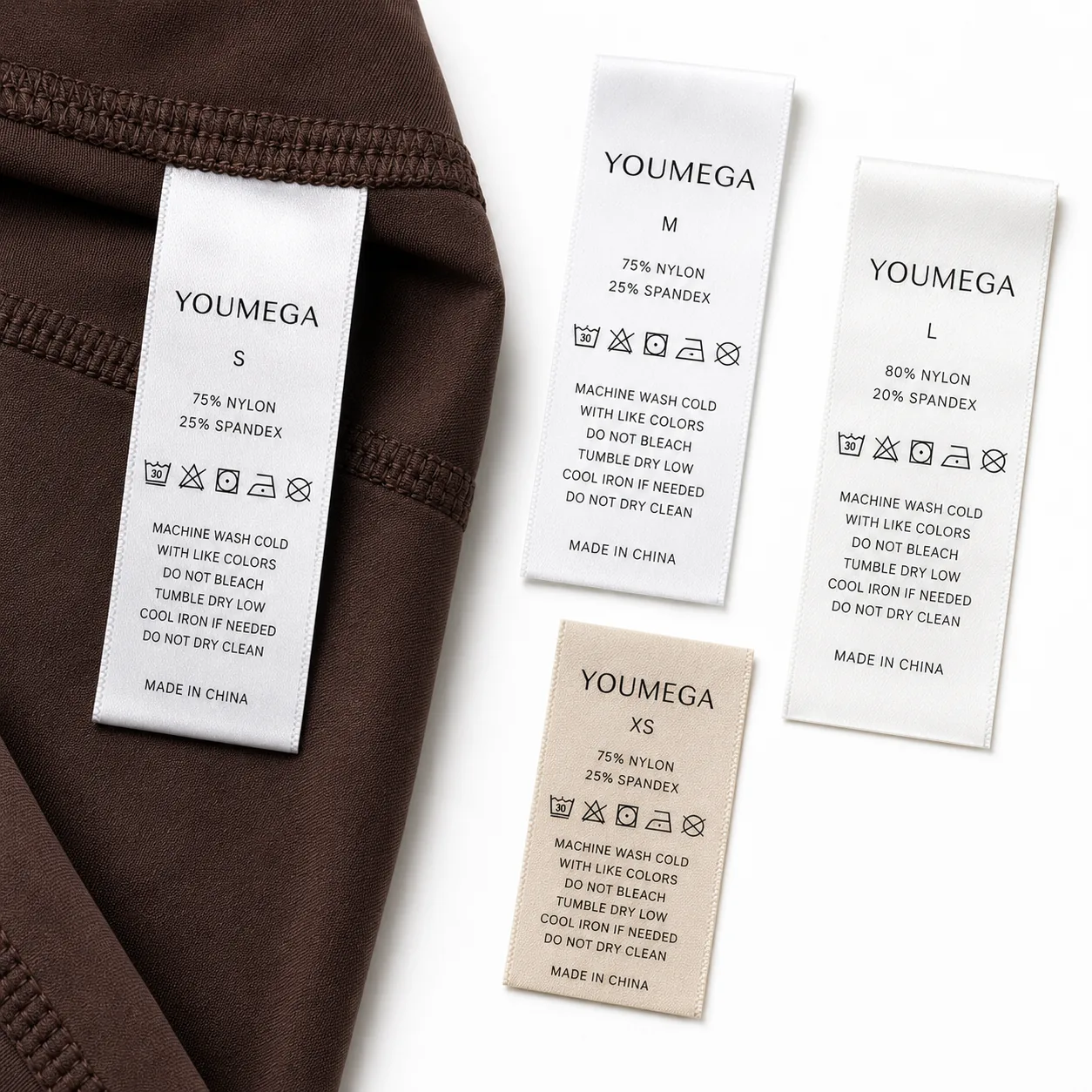
- Fiber content — generic fiber names with percentage by weight, in descending order (e.g., 88% Nylon, 12% Spandex). Fibers under 5% are normally grouped as “other fiber,” but spandex/elastane may be named even below 5% because its stretch has functional significance. This traces to the Textile Fiber Products Identification Act (TFPIA) and the FTC’s rules.
- Country of origin — Made in ___, stating where the garment was made. CBP enforces it at the border, it must appear in English, and it can’t be buried under other copy or hidden by a fold. (More on that in our guide to importing activewear from China.)
- Who made or imported it — either your full legal company name or an RN (Registered Identification Number). The RN is free from the FTC and optional; it simply lets a small brand keep a home address off every tag. It is a lookup number, not a licence or a quality mark.
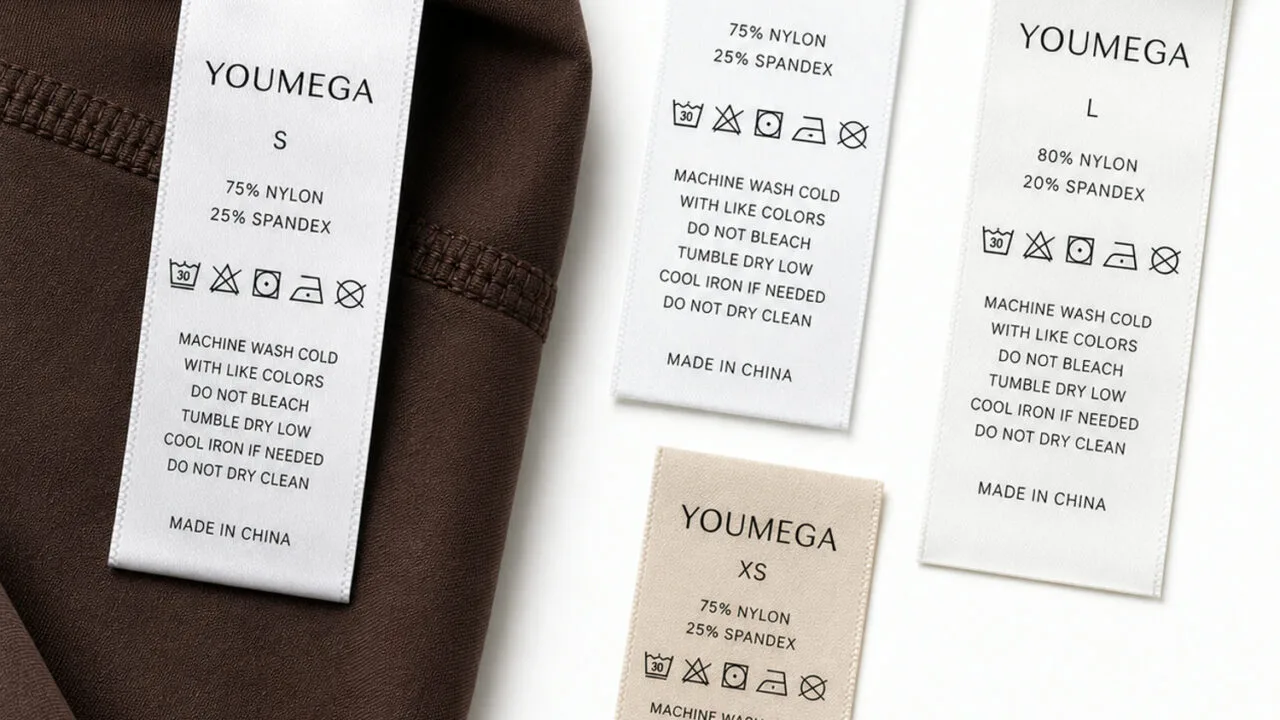
- Care instructions — a permanently attached care label covering washing, bleaching, drying, ironing, and any warnings, under the FTC Care Labeling Rule. You also need a reasonable basis for what it says — you can’t guess your way to “machine wash cold.”
The first three usually share one combined neck tag; the care label is a separate permanent one, often in the side seam. Spec all four before the fabric is cut, not after.
Care symbols: words, ASTM, or GINETEX
In the US, plain-English care wording is always accepted. Symbols on their own are accepted when they follow the ASTM D5489 guide — the care-symbol system US regulators recognize. The near-identical glyphs you’ve seen on European garments are the GINETEX system: same idea, different governing body and small differences. Selling US-only? English words or ASTM symbols are enough. Selling into Europe or Latin America too? Most brands just print both and move on.
For the market split behind label requirements, use US vs EU textile labeling.
Two honest cautions. First, these are labeling standards, not certifications — no factory is “certified” in ASTM or GINETEX, and nobody should sell you that. Don’t confuse legal label law with voluntary mill marks either: an OEKO-TEX® certificate is a testing claim about the fabric, not something US label law requires you to print. Second, a wrong care instruction is its own trap — “tumble dry medium” on a print that cracks or a fabric that shrinks builds a returns machine, not just a compliance slip. Run a wash test before you lock the wording.
Kids change everything: where CPSIA kicks in
Here’s the line that catches people. If your activewear is designed or intended primarily for children 12 and under, a whole extra layer applies under the CPSIA, enforced by the CPSC:
For the chemical-control question beside compliance, consult restricted-substance screening.
- A tracking label (CPSIA Section 103) — permanent marks on both the product and its packaging showing the source, the date and place of production, and batch/cohort detail, so any single unit can be traced back.
- A Children’s Product Certificate (CPC) — a document (not printed on the garment) based on third-party lab testing to the accepted limits for lead and phthalates, plus flammability.
- Drawstring rules — no drawstrings at the hood or neck of children’s upper outerwear. It’s a textbook recall trigger.
Adult activewear generally triggers none of that — no tracking label, no CPC, no third-party children’s testing. So here’s the place not to spend: if your line is adult-only, don’t pay for CPSIA lab testing or tracking labels, and don’t let anyone upsell them as “compliance insurance.” What does apply to all apparel, adult and kids alike, is flammability (16 CFR 1610) — a baseline the fabric has to meet, sitting behind the label rather than printed on it. Most activewear knits clear it as normal flammability, but it’s a legal floor, not a bonus.
Adult vs kids — what each label needs
| Requirement | Adult activewear | Kids’ (12 & under) |
|---|---|---|
| Fiber content (generic names, % by weight) | Required | Required |
| Country of origin (“Made in ___”) | Required | Required |
| Company legal name or RN | Required | Required |
| Permanent care label | Required | Required |
| CPSIA tracking label (garment + carton) | — | Required |
| Children’s Product Certificate (3rd-party tested) | — | Required |
| Flammability (16 CFR 1610) | Behind the label | Behind the label |
| No hood/neck drawstrings | n/a | Required |
(Illustrative summary — confirm exact wording and any state-level additions for your specific product and sales channel.)
Read your label like a customs officer would
- Fiber content: generic names, percentages by weight, descending, totalling 100 — and spandex named even under 5%.
- Country of origin: present, in English, “Made in ___,” not buried under other text or a fold.
- Identity: your exact legal company name, or a valid RN.
- Care label: permanent, legible
For adjacent durability and market-access questions, continue with why leggings lose their stretch, what to ask about PFAS in activewear, and preparing for the EU Digital Product Passport.
for the life of the garment, and backed by a real wash test — not a guess. - Kids’ line? tracking label on the garment and the carton, a CPC on file from a third-party lab, no hood/neck drawstrings.
- Language: English carries the legal weight; add other languages freely, but never drop English.
FAQ
Is the factory or the brand legally responsible for the label? The US importer of record — the brand. The factory prints to your spec; the FTC, CPSC, and CBP hold the importer accountable. Give the factory correct information and check the printed proof before the bulk run.
Do I need an RN number? No. You can print your full legal company name instead. An RN is a free, optional alternative from the FTC that lets a small brand keep a personal name and address off the tag. It is not a certification or a quality mark.
Can I use care symbols instead of words? In the US, plain-English wording is always accepted; symbols alone are accepted when they follow the ASTM D5489 guide. The GINETEX symbols common abroad look similar but are a separate system. If you sell in more than one market, many brands print both.
My activewear is for adults — do I need CPSIA testing and tracking labels? Generally no. The CPSIA tracking label and Children’s Product Certificate apply to products for children 12 and under. Adult apparel still has to meet flammability (16 CFR 1610), but that sits behind the label, not on a printed tag.
Send us your label spec — fiber content, country of origin, care wording or symbols, and whether the line is for adults or kids — and we’ll tell you honestly what’s missing or wrong before we print a single tag. We reply within 24 hours.