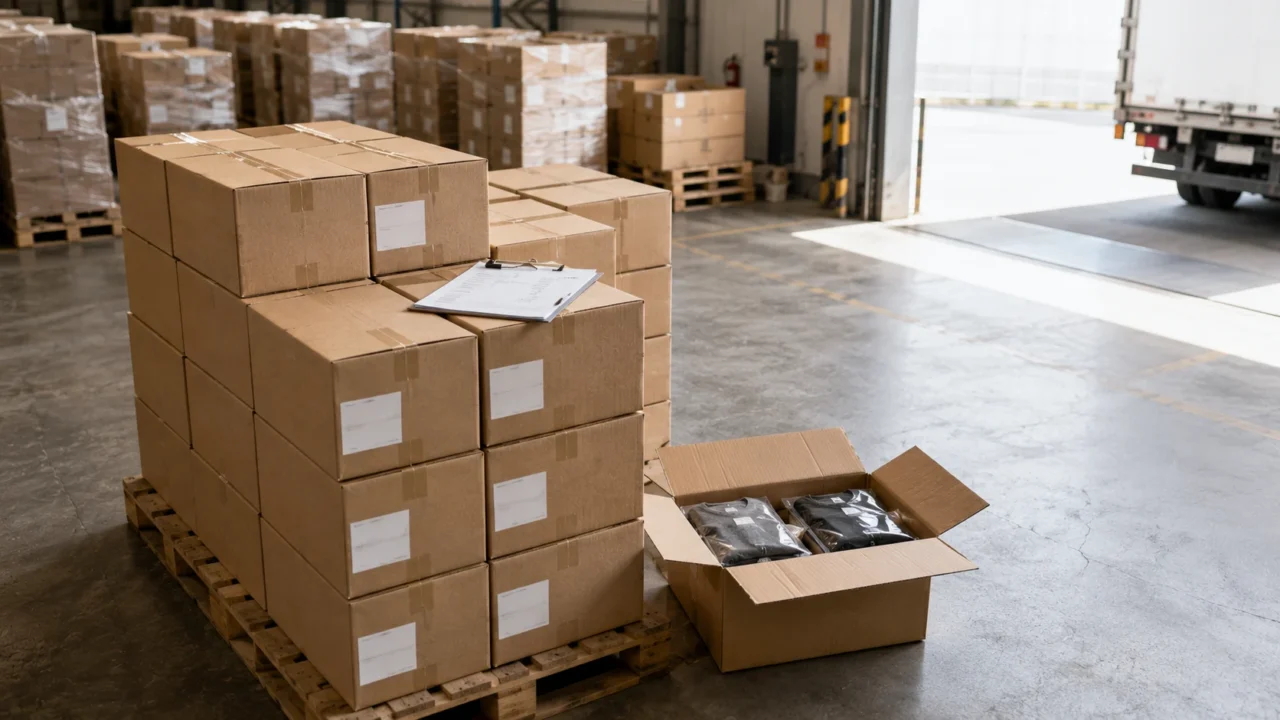
Once your activewear order is produced, the next question is how to get it from the factory in China to your warehouse. The three terms you’ll see in factory quotes — FOB, CIF, and DDP — aren’t interchangeable. Each shifts cost and risk between you and the factory in different ways, and choosing the wrong one can add 15–30% to your landed cost. This guide explains all three in plain English, with real 2026 freight numbers from Xiamen.
Quick Comparison
| Term | Who Pays Freight | Who Pays Insurance | Who Handles Customs | Best For |
|---|---|---|---|---|
| FOB (Free On Board) | Buyer (from China port) | Buyer | Buyer at destination | Buyers with their own forwarder |
| CIF (Cost, Insurance, Freight) | Seller to destination port | Seller | Buyer at destination | Buyers wanting one quote, port-to-warehouse handled by themselves |
| DDP (Delivered Duty Paid) | Seller all the way to door | Seller | Seller (incl. duties) | Buyers wanting zero logistics work |
FOB: The Industry Default
FOB stands for “Free On Board.” Under FOB terms, the factory’s responsibility ends when your goods are loaded onto the vessel at the Chinese port of departure (typically Xiamen, Shenzhen, Ningbo, or Shanghai for activewear). From that moment forward, you own the goods and you pay for everything that happens to them.
What the factory does: Production, packing, inland trucking to the port, export customs clearance, loading onto the vessel.
What you (or your forwarder) do: Ocean or air freight, marine insurance, destination port handling, import customs clearance, duties and taxes, last-mile delivery to your warehouse.
2026 cost example: A 1,000-piece activewear order from Xiamen to Los Angeles. FOB price might be $9.50 per piece ex-factory. Your additional costs would typically be:
- Ocean freight (LCL, 1 CBM ≈ 200–300 pieces of folded activewear): $180–280 per CBM in normal market conditions
- Origin charges (port handling, documentation): $80–150 per shipment
- Destination charges (port handling, terminal fees): $200–400
- US customs entry fee: $120–180
- US duties on activewear (HTS 6104/6108): 16–32% depending on fabric composition
- Last-mile trucking to warehouse: $200–500
When to choose FOB: You already have a freight forwarder relationship or you ship enough volume to negotiate your own rates. You want full visibility and control over the logistics chain.
CIF: Factory Handles Shipping to Your Port
CIF stands for “Cost, Insurance, Freight.” Under CIF terms, the factory pays for ocean freight and insurance up to your destination port — but customs clearance, duties, and last-mile delivery are still your responsibility.
What the factory does: Everything in FOB plus ocean freight to your nominated destination port and marine insurance for the voyage.
What you do: Destination port handling (still required since you’re picking up at the port), import customs, duties, last-mile to your warehouse.
2026 cost reality: For the same 1,000-piece order, a CIF quote to Los Angeles might be $10.50 per piece. The $1.00 difference roughly covers ocean freight + insurance for a small shipment. This is often worse economics than FOB if you have a freight forwarder relationship — factory mark-ups on freight can be 30–50% above what a forwarder would charge you directly.
When to choose CIF: You don’t have a freight forwarder yet but you can handle customs and last-mile at destination. You want a clean quote that includes the long-haul freight without negotiating it separately.
Watch out for: CIF only requires the factory to buy the minimum required insurance coverage, which often doesn’t cover the full value of your goods if something goes wrong. Always ask what insurance value is included and consider buying supplemental cargo insurance.
DDP: Factory Handles Everything to Your Door
DDP stands for “Delivered Duty Paid.” Under DDP terms, the factory is responsible for the entire shipment from factory to your warehouse door, including customs clearance, import duties, and last-mile delivery. Your job: receive the boxes.
What the factory does: Everything. Production, freight, insurance, both customs clearances, duties, taxes, last-mile.
What you do: Provide your address and EIN/VAT number. Receive the goods.
2026 cost example: A 1,000-piece DDP quote to your US warehouse might run $13.50 per piece. The extra ~$4 per piece over FOB covers freight, customs, duties, and last-mile, all bundled into one number.
The advantage: Zero logistics complexity. The factory takes the freight risk, customs delay risk, and duty calculation risk. For brands without a customs broker or freight team, this is the path of least resistance.
The hidden cost: DDP is the highest-margin shipping arrangement for factories because it bundles many cost categories that buyers can’t easily benchmark. A factory quoting $13.50 DDP might be paying $10.00 in actual delivered cost and pocketing $3.50 as logistics service fee. For larger volume orders (5,000+ pieces), the per-unit cost saving of switching from DDP to FOB + your own forwarder can be $1.50–3.00.
When to choose DDP: First or second order, low volume (under 2,000 pieces), no freight forwarder relationship, you value time over cost optimization. Also good for brands shipping into complex customs regions (Brazil, Russia, parts of MENA) where DIY customs is genuinely difficult.
EXW: The Term You Should Almost Never Choose
EXW (Ex Works) is sometimes quoted by factories and looks attractive because it’s the lowest number on the page. Under EXW, the factory’s responsibility ends when goods leave their warehouse — meaning you pay for inland trucking to the Chinese port, export customs clearance in China, and everything that follows.
The problem: as a foreign buyer, you cannot legally clear Chinese export customs without a Chinese entity. So you’ll need to hire a Chinese forwarder anyway to handle the inland trucking and export clearance, which usually costs $300–500 per shipment plus origin charges. FOB is almost always a better deal than EXW for foreign buyers — the factory adds this cost into FOB at near-cost, while a third-party forwarder will mark it up.
The only time EXW makes sense: you have your own logistics company in China handling consolidation across multiple suppliers. Otherwise, ask for FOB instead.
Air vs Sea Freight Decision
Separate from the Incoterms decision is the question of how the goods physically move. For activewear from China to most major markets, the choice is between ocean LCL/FCL and air freight.
| Method | Cost | Transit Time | Best For |
|---|---|---|---|
| Ocean LCL (less than container) | $180–280 / CBM | 28–45 days door-to-door | Under 10 CBM (~2,000–3,000 pieces) |
| Ocean FCL 20ft (full container) | $2,500–4,500 total | 25–40 days door-to-door | 10–25 CBM (~2,500–7,500 pieces) |
| Ocean FCL 40ft HQ | $3,200–5,500 total | 25–40 days door-to-door | 25–60 CBM (~7,000–18,000 pieces) |
| Air Freight | $4.00–8.00 / kg | 5–10 days door-to-door | Sample shipments, urgent restocks, sub-200kg lots |
For typical first activewear orders (100–500 pieces, 1–3 CBM), ocean LCL is usually the right choice — fast enough for most pre-launch timelines and significantly cheaper than air. Air freight enters the conversation only for urgent restocks or when production delays push your launch date.
What We Recommend at YOUMEGA
The right Incoterm depends on your order size, your logistics capability, and your destination country.
If you’re ordering 100–500 pieces and don’t have a freight forwarder: Take DDP. The convenience is worth the $1–3 per piece premium, and the absolute dollar amount is small at this volume.
If you’re ordering 500–2,000 pieces and don’t have a freight forwarder: CIF is often the right balance — factory handles long-haul freight, you handle the local customs broker. Find a customs broker first before your order ships; this takes 1–2 weeks to set up.
If you’re ordering 2,000+ pieces or you ship regularly: FOB with your own freight forwarder almost always wins on landed cost. The per-shipment savings of $1.50–3.00 per piece compound across orders.
At YOUMEGA we quote all three terms on every order so clients can pick what fits their operation. For first orders we usually recommend DDP unless the client specifies otherwise — it removes the most variables from a brand’s first production experience.
Frequently Asked Questions
What’s the difference between CIF and DDP in simple terms?
CIF means the factory pays freight to your port. DDP means the factory pays everything to your door. With CIF you still handle customs clearance, duties, and last-mile trucking. With DDP, the factory handles all of that and delivers boxes to your warehouse.
Are import duties included in FOB or CIF pricing?
No. Import duties are paid by the importer of record (you, the buyer) at the destination country. Neither FOB nor CIF includes duties. Only DDP includes import duties. US duties on activewear typically run 16–32% of the customs value depending on fabric composition and country of origin trade rules.
Can I switch Incoterms mid-order?
Usually no — the Incoterm is set in the proforma invoice at order confirmation. However, if you change your mind before the goods ship, factories will often accommodate a switch with updated paperwork. After the goods are in transit, switching becomes much harder because freight has already been arranged and paid.
What if I’m shipping to a country other than the US?
Same Incoterms logic applies, but duties vary dramatically. EU activewear duties run 12% base rate; UK runs 12%; Australia runs 5%; Canada runs 18%. For DDP into complex customs regions like Brazil or Russia, expect DDP premiums of $3–6 per piece because customs processing is more involved.
Who buys cargo insurance under each term?
Under CIF and DDP, the factory buys insurance. Under FOB, you (the buyer) should buy insurance for the ocean voyage. Note: even when the factory provides insurance under CIF, it’s often minimum legal coverage (110% of invoice value) which may not cover full replacement if goods are lost. Supplemental insurance through your forwarder is recommended for orders over $20,000 value.
About YOUMEGA
YOUMEGA (Xiamen Mega Garment Co., Ltd.) is a private-label and OEM activewear manufacturer based in Xiamen, China. We ship to clients in 40+ countries across Europe, North America, Latin America, and Oceania, and we quote FOB, CIF, and DDP on every order so brands can choose the shipping arrangement that matches their operation.
If you want to compare landed costs across the three shipping terms for your specific order, send us your destination country and target volume. We’ll send back FOB, CIF, and DDP quotes side by side with the breakdown of what’s included in each.
Buyer FAQ
Should activewear buyers choose FOB, CIF or DDP?
FOB is best when the buyer has a forwarder, CIF is useful for port-to-port control, and DDP is easiest for small brands that want duties and delivery handled in one landed cost.
What shipping details does a factory need?
Provide destination country, delivery address or port, order quantity, carton estimate if known, target delivery date, preferred incoterm and whether you need air, sea or courier options.
What is the biggest shipping mistake for first-time buyers?
The biggest mistake is comparing product unit price without landed cost. Duties, freight, local delivery, customs clearance and packaging volume can change the real margin.