Activewear Tech Pack Guide: What to Include (and How to Build One)
What is a tech pack — and do you need one? A tech pack is the blueprint your factory builds from: measurements, materials, construction details, colorways and size grading. If you work with a designer, they create it; if you don't, a good manufacturer can build one with you from sketches or a reference sample. You need it before sampling — it's what turns an idea into a repeatable, costed product.
No tech pack yet? You don't need one to start.
Just tell us your category and target quantity — we'll guide you and send an honest quote within 24 hours.
Already have specs? Use our free fill-in tech pack template (XLSX) — sports bras, leggings, yoga wear and sets: BOM, measurements, construction, colorways and packaging. Fill what you can and email it to [email protected].
Short answer: A tech pack is the spec sheet a factory needs to make your garment exactly as you intend — it covers fabric, measurements (size chart), construction details, logo/branding placement, colorways and packaging. A complete tech pack means faster, more accurate samples and fewer costly mistakes. You don’t need one to start, though — at YOUMEGA we build the tech pack with you from a reference sample, sketch or photos.
Why a tech pack matters
Without a tech pack, a factory guesses — and guesses become wrong samples and wasted weeks. A clear tech pack removes ambiguity: everyone works from the same numbers, so your sample comes back closer to right the first time and your bulk matches your sample.
What to include in an activewear tech pack
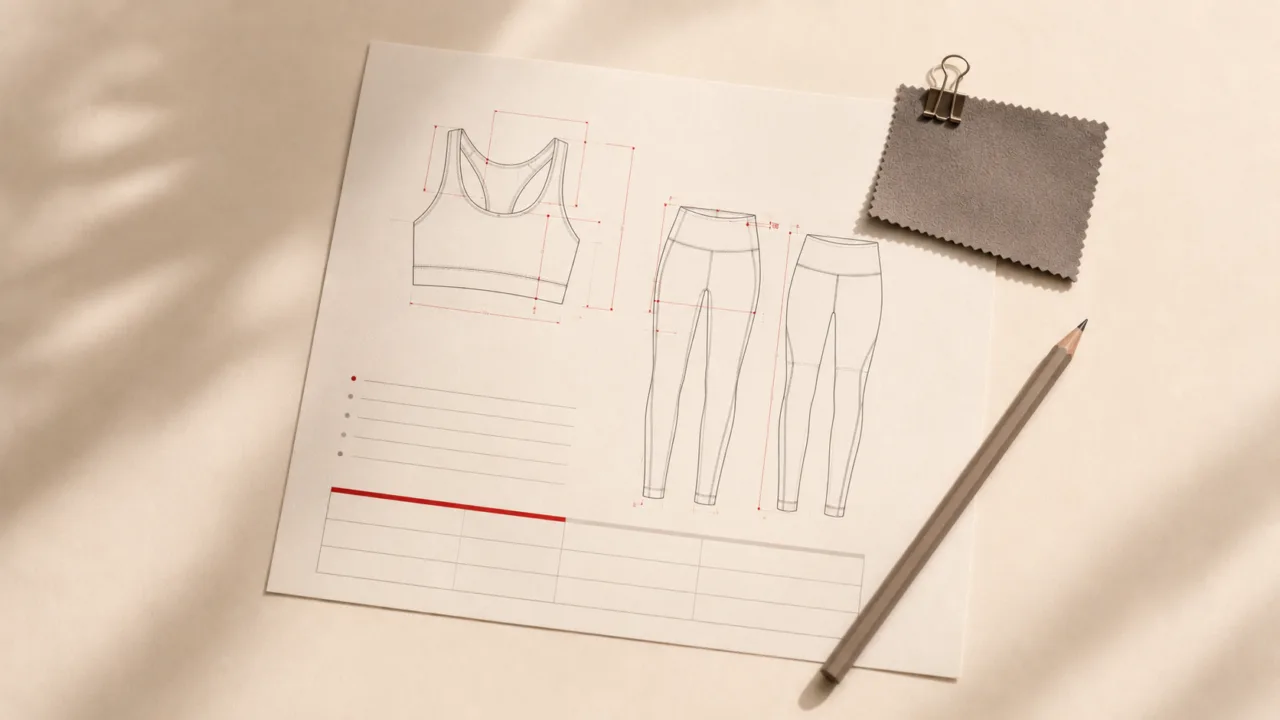
1. Tech sketch / flat — front and back line drawings of the garment, with callouts pointing to seams, panels, waistbands, pockets and trims.
For the component table inside the pack, use the trim sheet: elastics, drawcords and hardware.
2. Fabric & trims — composition (e.g. four-way-stretch polyamide-elastane), weight (GSM), finish (squat-proof, moisture-wicking, recycled rPET/ECONYL), plus elastic, drawcords, zippers and labels.
3. Measurements / size chart — a points-of-measure (POM) table for each size (e.g. XS–XL), with tolerances. Note any graded sizes (plus-size, petite) and how to grade them.
4. Construction details — stitch types (e.g. flatlock), seam allowances, gusset and rise construction, binding, and any reinforcement. This is where fit and durability are won or lost.
5. Colorways — each color with a Pantone reference for lab-dip matching, plus which components are which color.
6. Logo & branding — placement, size and method (embroidery vs print), tagless heat-press interior labels (brand / size / fabric composition), and any woven labels.
7. Packaging — polybags, hangtags, folding, and branded mailers if retail-ready.
8. Quantity & grading — quantities per style/color/size and your target MOQ.
How to make a tech pack (3 routes)
- DIY — build it in a spreadsheet or design tool from a template (use the checklist above). Best if you have design experience.
- Hire a tech designer — a freelancer turns your sketches into a pro tech pack. Adds cost and time.
- Let the factory build it with you (fastest) — send a reference sample or clear photos and your logo; we develop the tech pack, source fabric and produce a sample for approval. This is how most first-time founders we work with start.
Common tech-pack mistakes
- Vague fabric specs (“soft stretchy material”) instead of composition + GSM.
- No size chart, or one size with “scale up/down” instead of a grade
A complete specification handoff also benefits from proto, fit, size-set and PP samples and how inspection judges measurement tolerances.
d POM table. - Logo placement described in words, not measured on the flat.
- No Pantone references for custom colors.
- Forgetting packaging until after bulk is made.
(The H2 to add to the page is the line immediately below.)
Tech pack vs spec sheet, BOM, CAD, mock-up and pattern
Buyers often ask whether a tech pack is the same thing as a spec sheet, a BOM, a CAD file or a pattern. Mostly they are not alternatives — they are parts of the tech pack, or they are what the factory produces after the tech pack arrives.
| Document | What it is | Part of the tech pack? |
|---|---|---|
| Tech pack | The full specification package a factory quotes and builds from | It is the package |
| Tech sketch / CAD flat | Front and back line drawings with construction callouts | Yes — usually page one |
| Spec sheet / POM table | Points of measure for every size, with tolerances | Yes |
| BOM (bill of materials) | Every fabric, elastic, drawcord, zip, label and polybag, with placement | Yes |
| Mock-up / 3D render | A visual of how the finished garment should look | Optional — useful, never a substitute for measurements |
| Pattern | The cutting pieces, drafted to your measurements | No — we draft it from your tech pack |
| Marker and grading rules | How pieces are laid out and scaled across sizes | No — factory output |
Two practical consequences. A mock-up or a render on its own is not enough to cut fabric from, because neither carries a measurement or a tolerance. And a pattern is the factory’s answer to your tech pack, not an input you have to supply — if you already have one, or a reference garment, send it and we will work from that instead.
FAQ
Do I need a tech pack to get a sample?
No. Send a reference sample, sketches or photos plus your logo, and we’ll develop the tech pack with you before sampling.
What’s the most important part of an activewear tech pack?
Fabric spec (composition + GSM + finish), the measurement/size chart, and construction details — these drive fit, feel and durability.
Can you create the tech pack for me?
Yes — our development team builds the tech pack from your references and confirms it with you before we cut fabric.
How do I specify a custom color?
Give the Pantone code; we run a lab-dip for approval before bulk. Custom development is 300–500 pcs per style per color.
Can ChatGPT or another AI write my tech pack?
It can draft the structure, tidy up your wording and fill in a template, which does save time. What it cannot do is supply the numbers. Points of measure, tolerances, grading and Pantone codes have to come from a graded pattern or from a garment someone has actually measured — invented measurements read exactly like real ones, and we then have to query them, which costs a sampling round.
What software or file format should a tech pack be in?
Any format we can open and comment on. A spreadsheet or a PDF is fine and specialist PLM software is not required — the fill-in XLSX template above is the fastest start. What matters more than the tool: one file per style, the style name and number on every page, a version number and date, and measurements in a table rather than in prose.
What does a tech pack cost, and can I get one free?
It depends which of the three routes above you take. The fill-in template on this page is a free download and costs you only the time to complete it. A freelance tech designer quotes per style, and rates vary widely with how much drafting is involved. If you develop with us, our team builds the tech pack with you from your reference sample, sketches or photos as part of development.
Does the tech pack change for a hoodie, a tee or a sports bra?
The structure stays the same; the points of measure and the construction callouts change. A sports bra needs band, cup, strap and closure specs plus the elastic type at each edge. Leggings need rise, gusset and waistband construction. A hoodie or tee needs trims, hardware and a body-length grade. Build the measurement table around the garment — see our activewear size chart guide.
Send what you have
Reference sample, sketches or photos + your logo to [email protected] (or +86 156 0697 2725) — we’ll turn it into a tech pack, source fabric and quote a sample within 24 hours.
No tech pack yet? You don't need one to start.
Just tell us your category and target quantity — we'll guide you and send an honest quote within 24 hours.
Already have specs? Use our free fill-in tech pack template (XLSX) — sports bras, leggings, yoga wear and sets: BOM, measurements, construction, colorways and packaging. Fill what you can and email it to [email protected].