What Size Ratio Should Your First Activewear Order Be?
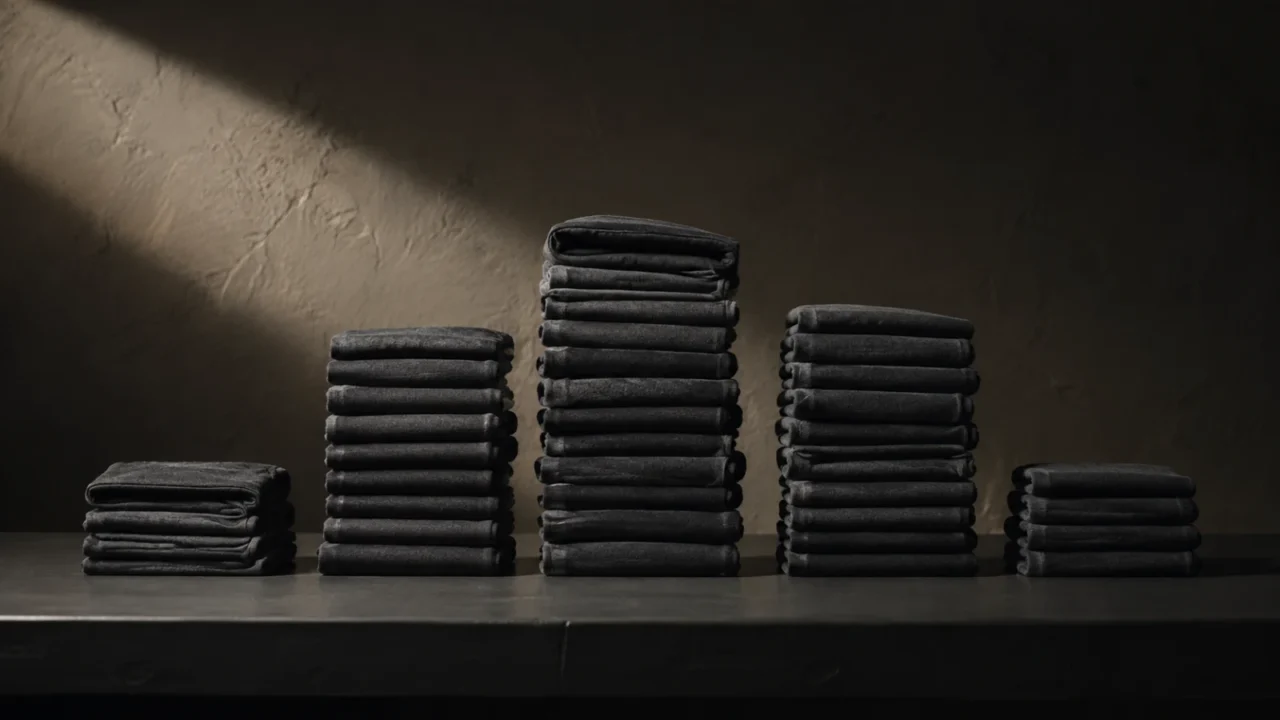
For a women’s activewear line selling to a general Western audience, the common starting point is a bell curve centred on M–L: roughly S 1 : M 2 : L 2 : XL 1, extended with a 2XL tail where you sell inclusive sizes. On 100 units of one style, that reads S 15 / M 30 / L 30 / XL 15 / 2XL 10. It is a starting assumption, not a law — the honest answer is that your first order is data collection, and the real skill is keeping the bet small enough that being wrong is cheap.
Here is how to set the curve, when to shift it, and how colour splits interact with it.
Why guessing wrong hurts twice
A wrong size curve costs you in both directions at once. The sizes you under-ordered sell out first — and those are, by definition, your best sellers, so the stockout lands exactly where demand lives. The sizes you over-ordered become dead inventory that ties up cash you needed for the reorder. One mistake, two bills.
That asymmetry is why experienced brands treat curve-setting as risk management rather than prediction: start from a defensible baseline, shift it only for reasons you can name, and let the second production run carry the precision your first order cannot.
Starting curves, and when to shift them
| Audience | Common starting curve | Why it shifts |
|---|---|---|
| General women’s activewear | S 1 : M 2 : L 2 : XL 1 | Demand clusters at the centre of the population |
| Inclusive / curve-forward positioning | Add 2XL–3XL at meaningful depth, centre moves toward L–XL | If extended sizes are your promise, tokenism shows — and sells out |
| Petite-skewing yoga / studio | Centre moves toward S–M | Studio demographics skew smaller in many markets |
| Compression / support-led styles | Slightly right of your normal curve | Support-seeking buyers concentrate in mid-to-upper sizes |
| Unisex programs | S 2 : M 3 : L 3 : XL 2 is a common flat-top start | Two overlapping populations widen the middle |
Two structural notes behind the table. First, population body-measurement data — the kind collected in national anthropometric surveys like the CDC’s NHANES program — is what sizing standards are ultimately built on, and it is why “centre on M–L” is a defensible default rather than folklore. Second, a curve is only as good as the grading behind it: if your 2XL is just an inflated M, the curve will “prove” big sizes don’t sell when what failed was the grading, not the demand.
Primary sources on sizing data and standards
- CDC / National Center for Health Statistics — NHANES anthropometric reference data, the population measurements behind sizing — https://www.cdc.gov/nchs/nhanes/
- ASTM International — standard body-measurement tables for adult female apparel sizing — https://www.astm.org/
- ISO/TC 133 — international standards for clothing size designation and designation systems — https://www.iso.org/committee/52374.html
Colour splits: the second curve nobody plans
The same logic applies across colours, with one twist: colour risk is style risk. A common working split on a first order is 60–70% in core neutrals (black first) and 30–40% in accent colours — because black legging demand is the most stable thing in this industry, and accent colours are where both the upside and the markdown risk live. A four-colour launch where every colour gets equal depth is four bets of equal size on wildly unequal odds.
Colour also compounds with size: an accent colour in a tail size is the slowest cell in your whole matrix. If you run four colours across six sizes, you are managing 24 inventory cells on order one — which is exactly the hidden cost of mixed-MOQ orders applied to a single style.
The catalogue shows how many colourways each style is already available in, which is usually where a colour split starts.
The structural answer: make the first bet mixable
Everything above assumes you must commit cell-by-cell. The cleaner solution is ordering in a format where you don’t: our stock program runs from 100 sets with colours and sizes mixed — the curve you order is adjustable across the matrix instead of locked per style, which turns the 24-cell bet into one decision you can actually revise. Custom development at 300–500 pieces per style per colour comes later, when your own sell-through data — not a table on the internet — sets the curve. And if your positioning includes genuine 2XL–3XL, our Santoni seamless program knits those sizes natively, so the tail of your curve is a real product, not an extrapolated one.
To turn that matrix into a working quantity by size and colour, use the First Order Calculator before you lock the brief.
First order collects the data. Second order spends it. Keeping style count disciplined and MOQ expectations realistic is what keeps that loop affordable.
Questions to answer before locking your first curve
- What audience signal — not hope — justifies any shift off the baseline curve?
- Which sizes does my grading actually fit, as sewn and worn?
- What share of units sits in core neutrals versus accent colours?
- How fast can I reorder a sold-out cell, and does my launch plan survive that gap?
FAQ
What size ratio should I order for a first activewear run? A common starting curve for general women’s activewear is S 1 : M 2 : L 2 : XL 1, with a 2XL tail if you sell it — on 100 units, roughly 15/30/30/15/10. Treat it as a baseline to shift for named reasons, then refine with your own sell-through data.
How should I split colours on a first order? A common working split is 60–70% core neutrals, black first, and 30–40% accents. Accent colours in tail sizes are the slowest inventory cells — plan them consciously rather than evenly.
What if my brand is inclusive-sizing focused? Then the curve must put real depth in 2XL–3XL and the centre moves toward L–XL — and the grading must genuinely fit those bodies, or the curve will misread failed fit as absent demand.
How do I fix a wrong size curve? With the reorder: first-order sell-through by size is the only data that reflects your actual audience. Keep the first order small enough to be wrong affordably, and reorder into what sold.
Is there a way to avoid betting on a fixed curve at all? Mixed-size, mixed-colour ordering. Our stock styles run from 100 sets mixed, so the matrix is one adjustable decision instead of a locked bet per style — that is the point of the format.
Not sure what curve fits your audience? Send us your market, size range and colour plan — we’ll suggest a starting split for a 100-set mixed first order and show you how the reorder loop works from there. Reply within 24 hours on weekdays.