Size Grading for Activewear XXS–4XL — How to Scale a Fit Without Losing It
Your fit sample in medium is perfect. The waistband sits, the compression holds, the inseam breaks in the right place. So you sign off and tell the factory to “scale it to XXS through 4XL.” Weeks later the size set arrives: the XS swims in the shoulders, the 2XL waistband gapes while the calf strangles, and the 3XL rise is two centimetres short of decent. Same pattern, same fabric — and the fit fell apart at both ends.
That gap between one good sample and a whole size run that fits is grading — quietly one of the most common reasons a line feels great on the model and wrong on real customers.
What grading actually is — and where your tech pack stops
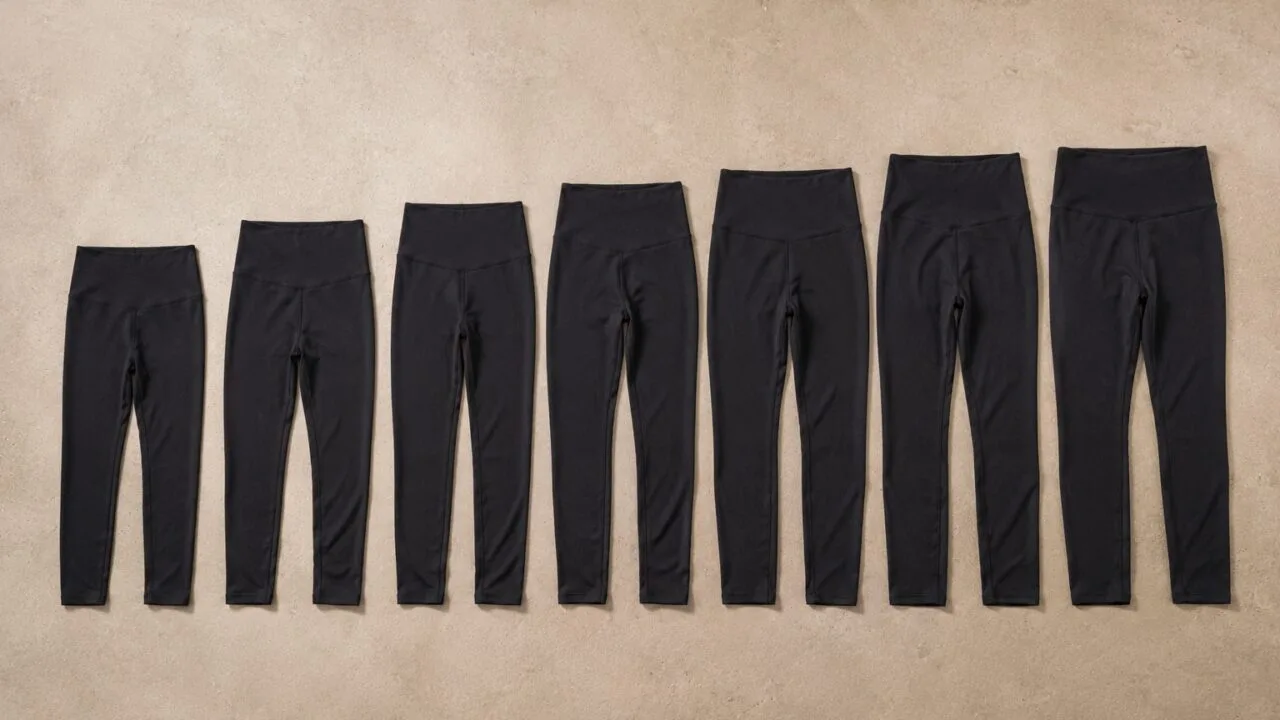
Grading is scaling one approved fit pattern up and down into a full run of sizes using a set of increments — the grade rules. It is not re-drafting each size from scratch, and it is not the same thing your tech pack does.
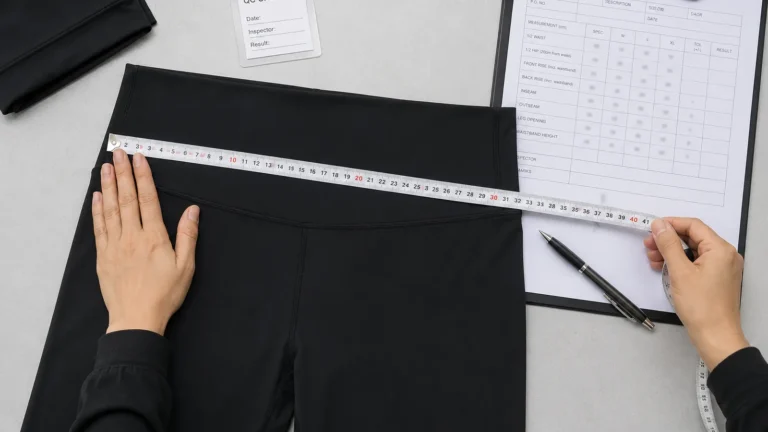
Your tech pack fixes one size: the base sample, its points of measure, its tolerances. Grading is the layer on top — the rules that decide how each point moves as you step out to the extremes. Two brands can hand a factory the same tech pack and get very different size runs, because it rarely says how to grow the waist versus the calf. Lock the base spec first; grading is what happens after it’s approved.
Why activewear grades harder than a woven
A woven blouse is forgiving. You add ease, the fabric doesn’t stretch, and a small grading error hides in the drape. Activewear removes every one of those cushions.
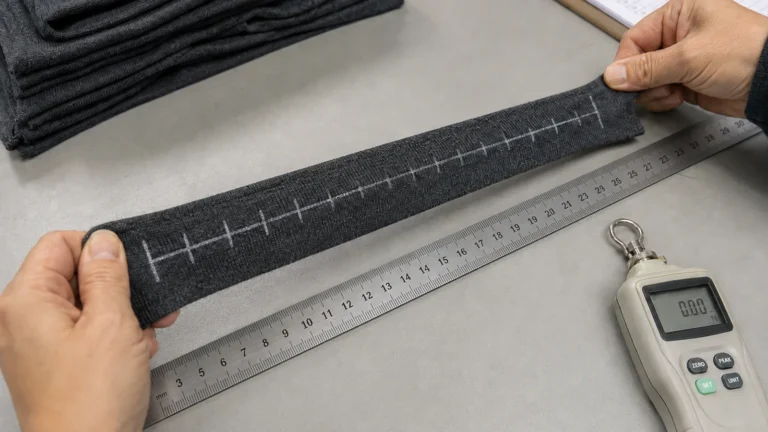
- Negative ease doesn’t scale linearly. A legging is cut smaller than the body and relies on stretch to close the gap. The percentage that feels supportive on a medium can read as a tourniquet on a 3XL thigh and slack on an XS. You aren’t grading a measurement — you’re grading a stretch relationship.
- Bodies don’t grow evenly. From M to 2XL, most people gain far more in waist, hip and thigh than in ankle, wrist or shoulder. Add a flat “2 cm everywhere” and you get a balloon at the waist and a pinch at the cuff — uniform grading is the single most common fit killer in the run.
- Compression intent shifts by body. What should stay firm (hold-in panels, waistband) and what should give (knee, calf) isn’t the same at XS as at 3XL. Compression grading has to preserve the purpose of each zone, not just its numbers.
- Fabric behaviour changes the math. A heavy, high-recovery compressive knit and a light, buttery knit forgive grading errors differently, so grade rules should be written for the specific fabric and weight, not copied between qualities.
Grade rules and size bands — how it’s really done
Grade rules aren’t a single number; they’re a table of increments, one per point of measure. Waist might grow 3 cm a size while inseam grows 1 cm and rise grows 1.5 cm — each point on its own curve.
The other decision is where to break the run into bands. A common, honest approach:
- Core band (roughly XXS–XL) shares one graded pattern and one set of rules.
- Extended band (2XL–4XL) usually needs its own grade rules, and often its own fit block, because proportions redistribute rather than simply enlarge.
The break point is where you switch rulesets. Ignore it, grade one rule straight from XXS to 4XL, and the fit lands right in the middle and wrong at both ends — exactly the size-set story above.
A worked example (illustrative)
Here’s how non-uniform grading looks on a single legging. The numbers are illustrative, to show the shape of a real grade — your fabric and block set the actual figures.
| Point of measure (cm) | XS | S | M (base) | L | XL | 2XL | 3XL |
|---|---|---|---|---|---|---|---|
| Waist (relaxed) | 62 | 66 | 70 | 75 | 80 | 86 | 92 |
| Hip | 84 | 88 | 92 | 97 | 102 | 108 | 114 |
| Thigh | 50 | 53 | 56 | 60 | 64 | 69 | 74 |
| Front rise | 24 | 25 | 26 | 27.5 | 29 | 31 | 33 |
| Inseam | 74 | 74.5 | 75 | 75.5 | 76 | 76 | 76 |
Notice the waist and thigh open up faster in the extended band — a bigger jump from XL to 2XL than from S to M — while the inseam barely moves, because leg length doesn’t scale with girth. A uniform grade adds the same step everywhere and misses both.
Extended and plus sizing — where the money should (and shouldn’t) go
Plus bodies aren’t scaled-up straight sizes: the waist-to-hip ratio changes, the rise needs more length, thigh and back rise grow. Extending your core rules unchanged is the classic way to lose the fit from 2XL up.
There’s also a machine limit worth knowing. Seamless knitting builds the garment as a tube on a circular machine, so the largest size is capped by the cylinder diameter. Larger cylinders — in the 17–21″ range — reach up to roughly 2XL/3XL; past that, or where you want more shaping at the top of the run, cut-and-sew is the honest route. Don’t put seamless 4XL on your size chart before you’ve confirmed the tube can hold it.
And a place not to spend: don’t fund a full custom 4XL block if your data says you’ll sell a handful — grade the band you’ll actually sell. Testing extended sizes as a stock style with your logo (lower MOQ, ~100 sets) before committing to full custom development (~300–500 pieces) shows you where real demand sits before you pay to grade and sample the whole tail.
Read a size run like a factory — a quick checklist
- Ask for the grade rule table, not just a size chart. Even increments across every point mean lazy, uniform grading; a proper grade shows different steps per measure.
- Confirm the break point — is 2XL and up on its own block or ruleset, or grafted onto the core rules?
- Insist on fit samples at the extremes and inside the extended band — on bodies or dress forms of that size, not just graded on paper.
- Check that negative ease is specified as a target measurement or stretch percentage, not “same as M.”
- For seamless, get the largest size the cylinder can hold in writing before you publish your size chart.
FAQ
Can’t the factory just scale my medium pattern to every size? It can, and that’s precisely how fit breaks. Uniform scaling ignores that waist, thigh and rise grow at different rates from ankle and shoulder — so you end up right in the middle and wrong at both ends.
How many fit samples do I actually need? At a minimum: the base size, the smallest, the largest, and one inside the extended band. Sell across a wide range and you fit-check more break points; a narrow core range needs fewer.
Do XXS and 4XL need their own patterns? Often the extremes need their own grade rules, and sometimes a separate block, while the middle sizes share one. The wider your range, the more the ends diverge from a single ruleset.
Can seamless go all the way up to plus sizes? Up to a point. Seamless size is capped by the machine’s cylinder diameter; large 17–21″ cylinders reach roughly 2XL/3XL. Beyond that, or where you want more shaping at the top of the range, cut-and-sew is the reliable choice.
Send us your size chart and the sizes you actually sell, and we’ll tell you honestly where your grade rules will hold, where the fit is likely to break, and whether seamless or cut-and-sew suits your range. We reply within 24 hours.