Private Label Compression Wear Manufacturing: How to Spec It Right
The single decision that determines whether a private label compression legging works on the first sample is construction — not colorway, not branding, and not the tightness of the pattern. Compression is engineered through fabric selection, knit density, and paneling. A factory that achieves it by simply cutting the pattern smaller delivers a garment that restricts movement, fails the squat-proof test under load, and returns from your first customer as a refund. That is the starting point every brand commissioning compression activewear needs to understand before the development conversation begins.
YOUMEGA has produced compression leggings, tights, and base layers in both seamless and cut-and-sew construction since 2017, across women’s and men’s categories, for brands ranging from emerging fitness labels to established performance lines. This guide distills what we have learned about specifying compression wear correctly — so your brief to us, or to any compression wear manufacturer, produces a garment that actually performs.
Compression Is a Construction Decision, Not a Pattern Decision
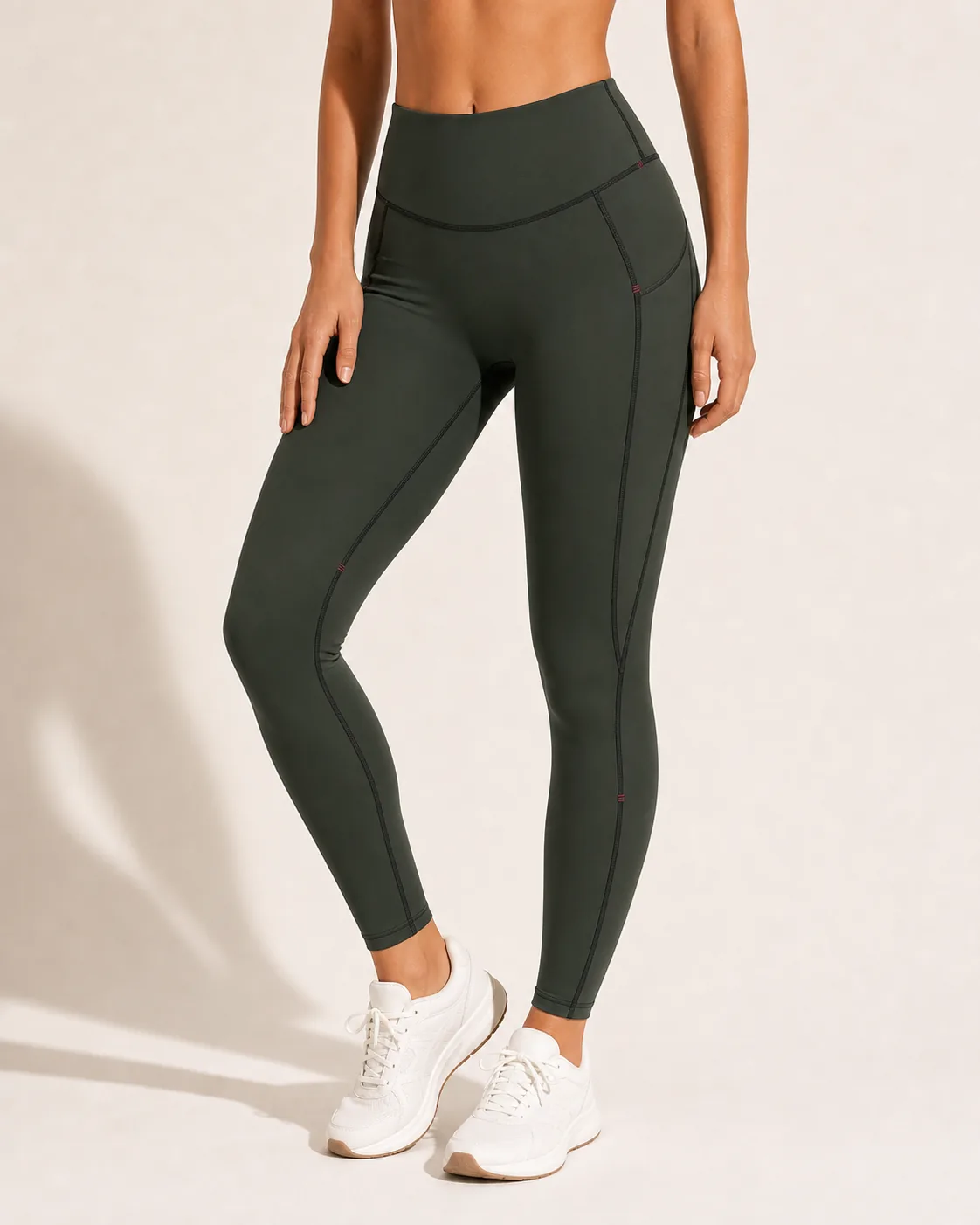
Conventional fitted leggings are designed to move with the body without exerting meaningful force on the underlying muscle or fascia. They sit close to the skin because the fabric has good four-way stretch and reasonable recovery; the pattern simply removes excess ease. True athletic compression works differently: the fabric itself, or a defined zone of fabric within the garment, generates consistent inward force against the body when worn. That force is the product of two variables — elastane content and knit density — not the result of cutting the pattern tighter.
A standard fitted legging from YOUMEGA uses a 94% polyamide / 6% elastane four-way stretch fabric. At that elastane percentage, the fabric has excellent stretch and recovery, moisture-wicking performance, and squat-proof opacity — it is a high-quality garment construction. But it is not a compression garment in the athletic engineering sense. To move into true compression, you raise the elastane content, increase the knit density of the loop structure, or both. You can also layer in a power-knit or power-mesh panel — a tighter, denser construction bonded or sewn into specific anatomical zones — to deliver compression where it is functionally relevant without making the entire garment restrictive. These are distinct technical decisions, and they need to appear in your tech pack as explicit material specifications, not as a direction to "make it tighter."
The pattern implication matters here too. When fabric carries the compression load, the pattern can be graded normally across the size run. When pattern manipulation carries the load instead, the compression level changes non-linearly between sizes — a size XS is proportionally more compressed than a size XL, which is a quality and fit consistency problem you will find in returns data.
Fabric Weight and Blend for Compression Activewear
The base fabric for YOUMEGA compression builds is a polyamide / elastane four-way stretch construction. For athletic compression, we use higher-elastane or denser power-knit constructions coordinated through approved fabric mill partners. For clients with sustainability requirements, rPET / ECONYL options are available at equivalent performance grades; see our legging fabric weight guide for a broader breakdown of GSM, fiber blend, and end-use matching.
The key fabric parameters to call out in a compression brief are:
- Fiber blend: polyamide-elastane is preferred for compression activewear over polyester-elastane at equivalent weights; it recovers more cleanly after repeated stretch cycles and maintains opacity better under load.
- Elastane percentage: specify a minimum, not a target. A range of "20–24% elastane" gives the mill workable tolerance; "maximum compression possible" is not a specification.
- Knit construction: four-way stretch weft knit is the baseline; power knit or double-knit construction increases compressive force at equivalent elastane percentages by tightening the loop density.
- GSM: compression fabrics typically run heavier than standard fitted legging fabrics — expect 220–280 GSM depending on the compression level targeted. Lighter fabrics at equivalent elastane percentages tend to produce inconsistent compression across the wear cycle as the fabric fatigues.
- Opacity and squat-proof performance: compression fabric under load must maintain opacity when the wearer is in a deep squat or lunge. This is tested on the finished garment, not inferred from the fabric spec alone.
Fitted vs True Compression: The Difference in Construction
| Attribute | Fitted / Sculpt Legging | True Athletic Compression |
|---|---|---|
| Elastane content | 6–12% | 15–25%+ (varies by zone) |
| Knit construction | Standard four-way weft knit | Power knit, double knit, or power-mesh panels |
| Compression source | Garment fit / pattern | Fabric properties + knit density |
| Pattern sizing approach | Normal ease reduction | Neutral to slight ease; fabric does the work |
| Size consistency of compression | Consistent — fabric-driven | Consistent — fabric-driven (incorrect if pattern-driven) |
| Squat-proof opacity under load | High at rest, variable under tension | High at rest and under compression load |
| Typical GSM | 180–240 | 220–280 |
| End use | Yoga, pilates, lifestyle, low-impact training | Running, cycling, HIIT, weightlifting, base layer |
| Price point relative to standard | Baseline | Higher, reflecting fabric cost and construction |
This table is the practical filter for your product brief. If your target customer is a yoga or pilates buyer, a high-quality sculpt legging in our 94/6 polyamide construction will deliver the right combination of softness, recovery, and opacity without the cost structure of a true compression build. If your target customer is a runner, cyclist, or strength training athlete expecting the garment to actively support muscle groups during activity, the construction requirements are different and the brief needs to say so explicitly.
Uniform vs Graduated Compression: What a Factory Can Deliver
The distinction between uniform and graduated compression is frequently discussed in compression wear marketing but less frequently specified correctly in tech packs. Here is what the terms mean in construction terms and what YOUMEGA can deliver against each.
Uniform compression means the garment applies consistent compressive force across all areas covered by that fabric zone. This is the standard output of a single-fabric cut-and-sew compression build, or a seamless build with a consistent stitch pattern throughout the leg panel. For most athletic compression applications — tights for weightlifting, compression shorts for HIIT, base layer tops for team sport — uniform compression is the appropriate construction and is the more cost-effective build.
Graduated or zoned compression means different anatomical zones of the garment apply different compression levels. In lower-body compression, a common zoning approach applies higher-compression panels at the calf and lower leg and progressively lighter compression moving up the thigh. In cut-and-sew construction, this is achieved by using different fabric panels with different elastane percentages or knit densities in each zone, bonded or sewn together at defined seam lines. In seamless construction on our Santoni 17–21" machines in Yiwu, graduated compression can be engineered through the machine program, varying the stitch density by zone without additional seaming.
The key point for buyers: graduated compression in cut-and-sew is an additional cost because it requires multiple fabric components within a single garment and precise seam placement at anatomical transition points. The seam placement affects fit and aesthetic, which needs to be considered alongside function. Our legging front seam visibility and gusset design guide covers this in the context of flatlock vs butt seam construction. In seamless, the cost uplift is smaller because graduation is programmed rather than sewn, but seamless machines have geometric constraints on where panels can transition.
| Uniform Compression | Graduated / Zoned Compression | |
|---|---|---|
| Construction method | Single fabric zone, consistent throughout | Multiple panels (cut-and-sew) or programmed zones (seamless) |
| Cost | Baseline compression | Higher — additional fabric components or machine programming |
| Seam complexity | Lower | Higher — panel junctions at anatomical transitions |
| Seamless capability | Yes | Yes — programmed on Santoni machines, within geometric constraints |
| Cut-and-sew capability | Yes | Yes — panel count and complexity depend on zone count |
| Typical use | Tights, compression shorts, base layers | Running tights, cycling tights, calf sleeves, full-leg builds |
| Sample complexity | Standard | Requires additional sign-off on zone placement and transition |
| Tech pack requirement | Fabric spec + construction method | Full panel map + per-zone fabric spec + seam placement callouts |
For most private label brands entering the compression category, we recommend starting with a well-specified uniform compression build across one or two hero styles, proving the market, and introducing zoned compression as a second-generation product.
Seamless Compression vs Cut-and-Sew Compression
Both production methods are available at YOUMEGA. Our seamless capability runs on Santoni 17–21" machines at our Yiwu operation; cut-and-sew compression builds are produced at Xiamen HQ. The choice between them is not purely aesthetic — it affects fit behavior, compression delivery, size range capability, and development timelines.
For a deeper technical comparison of the two methods across all activewear categories, see our dedicated article on seamless vs cut-and-sew activewear. For compression specifically, the relevant differences are:
- Seamless compression has no side seams or inseam, which eliminates potential irritation points in high-friction zones. The compression is delivered through the engineered stitch structure, which can vary by zone without visible seam lines. The Santoni machines have a diameter constraint that sets the range of circumference the tube can accommodate, so size grading across a wide size run (e.g., XS through 3XL) requires a multi-machine or multi-program approach.
- Cut-and-sew compression can accommodate a wider size range from a single pattern set, allows more precise anatomical shaping (especially for the seat, gusset, and waistband), and permits the use of power-mesh or power-knit panels in specific zones without machine constraints. The seam lines, if positioned and constructed correctly using flatlock or cover-stitch methods, are not a source of discomfort in athletic use.
For men’s compression builds — discussed in the next section — cut-and-sew is usually the more practical starting point because of the fit difference in the seat and thigh block relative to women’s.
Men’s Compression Is a Different Fit Block, Not a Scaled Women’s Pattern
Yes, YOUMEGA produces men’s compression tights, shorts, base layer tops, and full-leg builds. This is a confirmed capability across both seamless and cut-and-sew construction, for both OEM and private label clients.
The critical production point for men’s compression: the fit block is not derived from the women’s pattern by scaling or mirroring. Men’s compression tights and shorts require a purpose-built block with a different seat curve, a different inseam angle, and an appropriately constructed front rise. Using a modified women’s pattern for men’s compression produces fit failures at the inseam and crotch that will appear in the first sample and often persist through multiple revision rounds because the root cause is the pattern, not individual measurements.
Men’s compression base layer tops require attention to the sleeve and shoulder block — the trapezius and deltoid are proportionally larger in the male upper body and the compression layer needs to accommodate that range of motion without cutting across the shoulder when the arms are raised. This is specified in the sleeve rotation and shoulder seam placement in the tech pack.
If you are developing a men’s and women’s compression range simultaneously, plan for separate grading and separate sampling rounds for each gender. Budget the MOQ accordingly — the MOQ realities for activewear in 2026 article covers how to structure a multi-style development run efficiently.
Compression Affects Sizing: How to Account for It in Your Size Set
This is a frequently underestimated issue in compression wear development. Because the fabric exerts force on the body, a compression legging in size M will feel and measure differently on the body than a standard fitted legging in size M from the same brand. Two specific sizing implications:
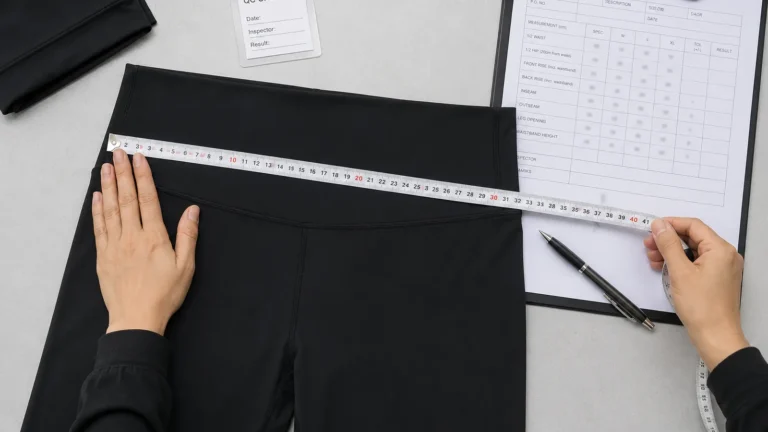
Finished garment measurements vs on-body measurements. A compression legging measures smaller flat and off the body than its size label implies, because the garment is designed to be worn under tension. If you grade a compression style using the same finished garment measurement targets as your standard legging, the size M will fit like a size S in wear. Compression sizing should be graded to on-body measurements at a defined tension level, agreed in the tech pack.
Squat-proof performance varies by size within a style. Because larger sizes put the fabric under greater tension at the hip and seat, opacity at the largest sizes in the run must be specifically tested. We conduct this test on bulk fabric ahead of production sign-off.
Buyers who are launching compression as an extension of an existing non-compression legging line should plan for a size note in product copy that addresses how the fit and sizing relates to the rest of the range. Customers will compare, and the difference is real.
How long does compression wear development actually take?
This depends on which YOUMEGA service route you use and how complete your brief is when development starts.
For stock + logo programs — where we apply your branding to an existing YOUMEGA compression construction — lead time is approximately 30–35 days from artwork approval to shipped bulk. This is the fastest route and appropriate for brands testing the compression category before committing to a custom build.
For full OEM programs — where you are specifying your own compression construction, fabric, and fit block — plan for approximately 40–50 days production lead time after pre-production sample approval. That sample round typically takes 10–14 days. If fabric development is required (custom Pantone color on a compression fabric, for example, sits in the same 300-500 pcs per style per color range), the fabric sourcing stage adds time before sampling begins. Full ODM programs, where we develop the design from a brief or reference, run approximately 45–55 days in production.
The biggest variable in compression development timelines is not the factory production window — it is the number of sample revision rounds before sign-off. Compression wear with panel maps, gusset specifications, and zone-transition seam callouts requires more review steps than a standard legging. Brands that arrive with a detailed tech pack — fabric spec, compression zone map, measurement chart with defined tension level, and branding placement — move through sampling faster than those iterating on an open brief. See our OEM/ODM services page for a full breakdown of what each service tier includes and what documentation is required.
For compliance reference: YOUMEGA holds OEKO-TEX Standard 100 certification, is BSCI audited, and maintains REACH and CPSIA compliance. We hold our own export license and ship FOB, CIF, EXW, or DDP to 50+ countries.
Frequently Asked Questions
What actually makes a legging "compression" rather than just fitted or tight?
The difference is construction, not pattern dimensions. A fitted legging achieves its close silhouette through pattern ease reduction — the pattern is cut close to body measurements and a standard-elastane fabric follows the shape. A true athletic compression legging achieves its compressive force through the fabric’s own properties: higher elastane content (typically 15–25%), denser knit construction (power knit or double knit), or the inclusion of power-mesh or bonded panels in specific anatomical zones. When compression comes from the fabric and knit structure, the garment can expand freely with body movement and still return consistent force. When it comes from a tight pattern, the garment restricts movement at extremes of range and the seams carry stress they are not designed for.
What is the difference between uniform and graduated compression, and can a factory produce both?
Uniform compression applies consistent compressive force across the covered area and is achieved through a single fabric specification throughout the garment or zone. Graduated compression applies varying levels of compression at different anatomical zones — typically higher toward the extremities and lighter toward the torso. YOUMEGA produces both. Uniform compression is the standard output of a well-specified single-fabric build. Graduated compression in cut-and-sew requires multiple fabric panels with different elastane percentages or knit densities, joined at defined anatomical seam lines. In seamless construction on our Santoni machines, graduation is engineered through stitch programming rather than seaming.
Can you make men’s compression tights, shorts, and base layers?
Yes. Men’s compression is a confirmed production capability at YOUMEGA across both seamless and cut-and-sew construction. Men’s styles are developed from a dedicated men’s fit block — the seat curve, inseam angle, front rise, and upper-body sleeve rotation are specified separately from women’s patterns and are not derived from scaling or modifying a women’s base. If you are developing a men’s and women’s compression range in the same program, plan for separate sampling rounds and separate grading for each gender.
What fabric weight and blend do you use for compression?
Our base four-way stretch fabric is 94% polyamide / 6% elastane. For athletic compression builds, we work with higher-elastane constructions and denser power-knit or double-knit fabrics, typically in the 220–280 GSM range depending on the compression level targeted. All compression fabrics are moisture-wicking and tested for squat-proof opacity under tension. rPET and ECONYL recycled-fiber options are available at comparable compression performance grades for sustainability-positioned brands.
Can I private-label compression wear with my own logo, labels, and packaging, and what is the MOQ?
Yes, full private labeling is available including heat transfer logos, silicone 3D branding, embroidery, woven labels, hangtags, custom Pantone colors, and retail-ready packaging. MOQ tiers are: stock construction with your logo from 100 sets per style; full OEM/ODM custom builds is 300-500 pcs per style per color, including custom Pantone colorways. For context on how to structure a multi-style launch against these minimums, see our article on realistic MOQ for activewear.
How does compression affect fit, sizing, and squat-proof opacity?
Compression garments are designed to be worn under tension, so finished garment measurements off the body will be smaller than the equivalent size in a standard fitted legging. Size grading must be based on on-body measurements at a specified tension level, not on flat finished measurements — this is a tech pack specification that must be agreed before grading begins. Squat-proof opacity in compression fabric is generally strong because higher-density knit constructions refract less light under load, but it must be tested specifically at the largest size in the run, where the fabric is under the greatest tension at the seat and hip.
What is the difference between seamless and cut-and-sew compression?
Seamless compression is produced on circular knitting machines (YOUMEGA uses Santoni 17–21" in Yiwu) that knit the garment tube without side seams, varying stitch density by zone to engineer compression graduation. The result is a smooth, seam-free surface with programmed compression zones. Cut-and-sew compression uses separate fabric panels sewn together with flatlock or cover-stitch seams; it offers more flexibility in size range grading and anatomical shaping (particularly at the seat, gusset, and waistband), and allows power-mesh or power-knit panels to be placed at precise anatomical locations. Both are viable for athletic compression. For a full comparison, see our seamless vs cut-and-sew activewear guide.
What QC standard applies to compression wear at YOUMEGA?
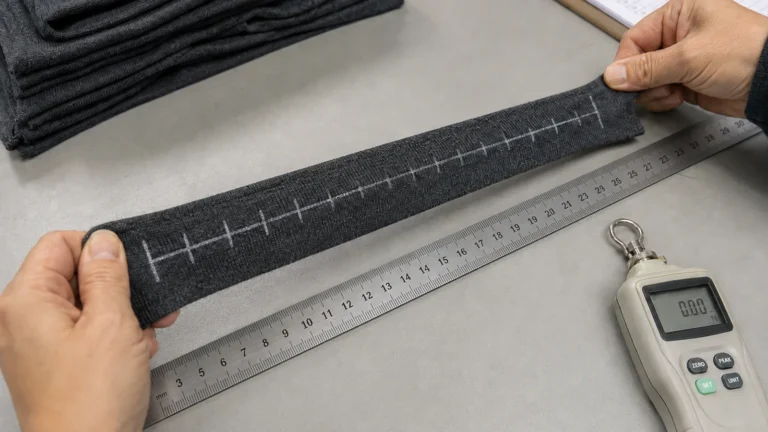
All production runs are inspected to AQL 2.5. For compression specifically, in-process checks include four-way stretch performance testing on fabric rolls before cutting, panel-alignment checks at the in-line stage, and opacity testing under tension on finished garments. Measurement tolerances are verified against the approved pre-production sample, with on-body fit measurements at the defined tension level specified in the tech pack.
Have a compression wear question? We reply in 24 hours.
Next step for your activewear project
— YOUMEGA Editorial Team
YOUMEGA (Xiamen Mega Garment Co., Ltd.) is a private label and OEM/ODM activewear manufacturer in Xiamen, China, specializing in low-MOQ runs for emerging and growing brands.