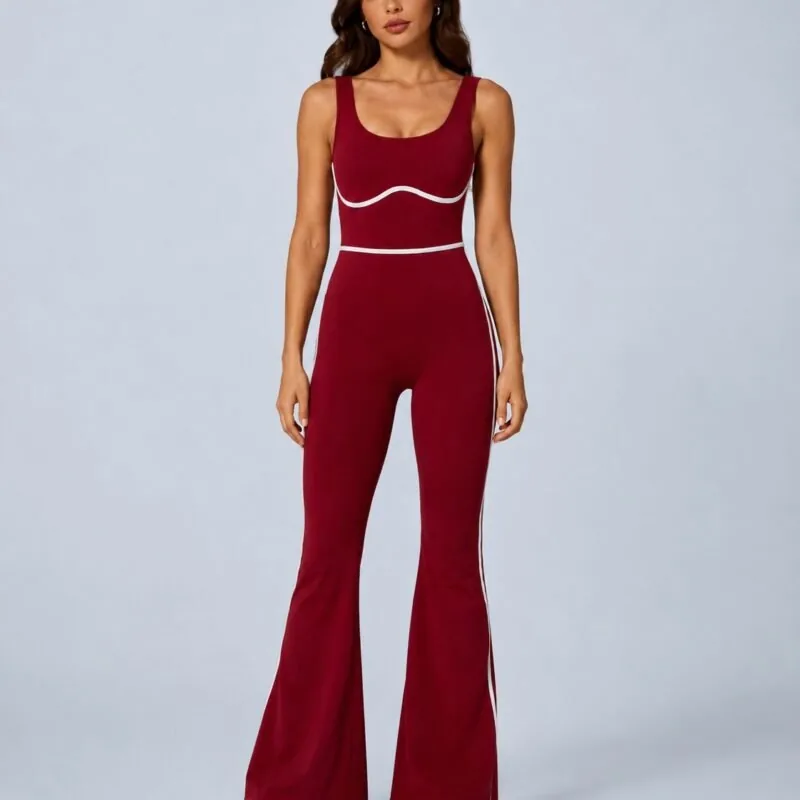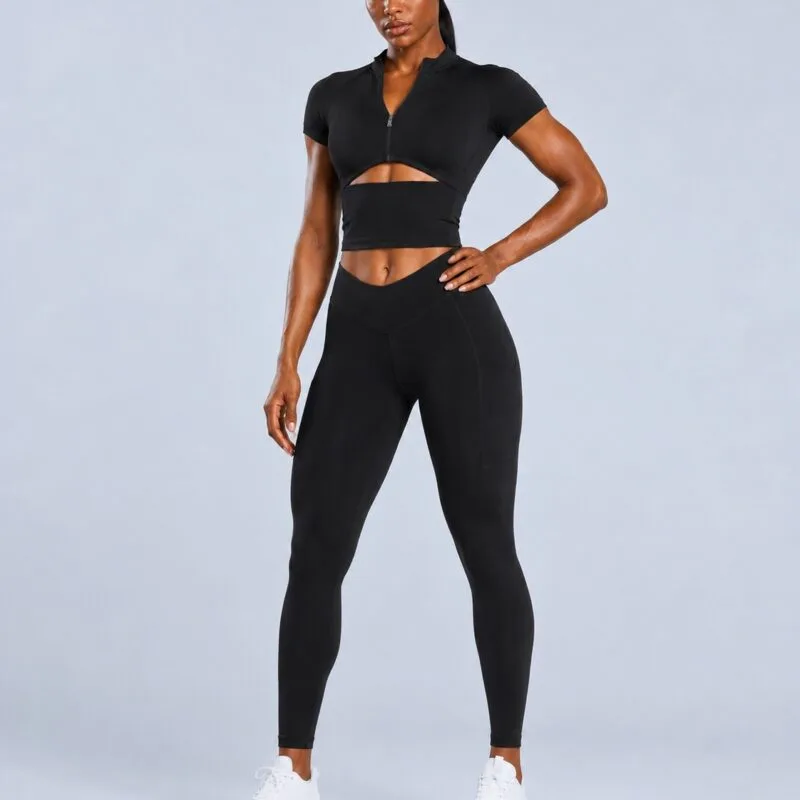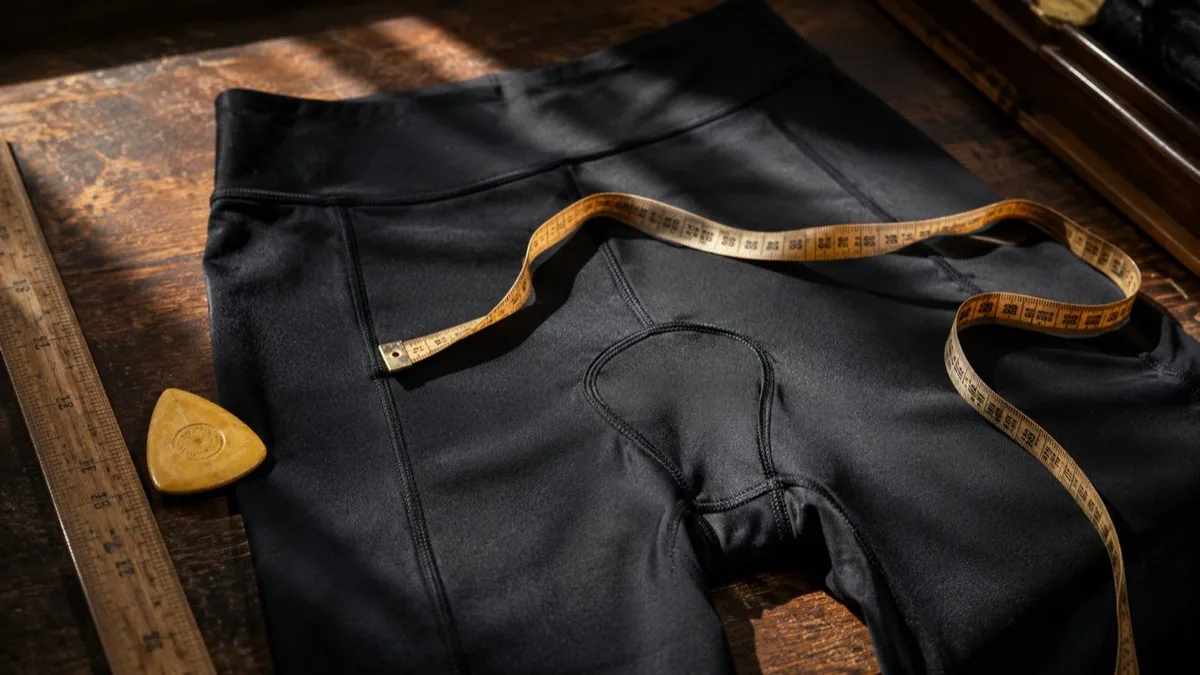
Yoga leggings have a front seam because two front pattern panels are joined there; that seam can help shape and stabilise the fit, but its placement, rise and gusset design determine how it looks and feels.
Front seam visibility in leggings — what’s commonly called “camel toe” — is a fabric and pattern engineering issue, not a body issue or a sizing issue. Most consumer advice treats it as something to hide with longer tops or specific underwear. The real fix happens at the factory: gusset shape, front rise length, fabric weight, and recovery rate.
This guide explains why removing the front center seam isn’t always the answer, the four gusset constructions used in production, and what brands should specify when sourcing leggings to minimize visibility for the widest range of bodies.
What’s actually happening physically
When fabric is pulled tight across the front pelvic area, it follows the body’s contours. Three forces are at work:
- Tension: How tightly the fabric stretches across the front
- Compression: How much the fabric pushes inward at flex points
- Recovery: How quickly the fabric returns to its resting shape after stretch
When all three balance well, the fabric sits smoothly without dipping into the body’s natural separation lines. When any one is off — fabric too thin, gusset poorly shaped, or recovery weak — the fabric pulls into a visible front seam line.
This is a measurable engineering problem. It can be designed out. It often isn’t, because doing it right costs more.
Why “no front seam” alone doesn’t solve it
The activewear industry has responded to consumer complaints by introducing “no front seam” or “seamless front” leggings. Some major brands now have entire product lines built around this feature.
But community feedback shows mixed results. On forums, some users report that removing the front seam actually makes front visibility more pronounced on certain body types — particularly when the fabric is too thin or the gusset shape isn’t optimized for the new construction.
The reason: a front center seam, when properly placed, can act like a structural divider. Removing it without compensating elsewhere (heavier fabric, optimized gusset, better recovery) just transfers the problem somewhere else.
The honest answer is that no single design choice works for every body. Brands serious about this issue need two construction options, not one.
What brands actually changed when they removed the front seam (2024–2026)
If you have searched for this topic recently, you have probably seen the phrase “no front seam” on almost every major legging launch. It is worth reading what the brands say they did, because it confirms the point above: the seam was never the whole problem, and the brands that removed it changed something else at the same time.
| Brand | What the brand says, in its own words | What else changed |
|---|---|---|
| Gymshark | “All of our women’s leggings are designed without a front seam for a smoother, more comfortable fit” [1]. Its fit guide is unusually direct: front-seam visibility is “largely down to anatomy,” but “the combo of legging fabric, rise, and seam placement can make all the difference,” and front seams that exist “for added shaping and body contouring… can also create unwanted bunching and discomfort, especially with thinner fabrics or a legging that has a tighter fit” [2] | Its per-line comparison lists “Front seam: No” across Vital Seamless, Adapt, Everyday Seamless, Whitney, Soft Sculpt, Training and Lift Seamless, with rise noted per line — Vital Seamless described as “one of the highest across our collections” [3]. The Training 2.0 update raised the waistband to fully high-waisted, increased thigh measurements and moved to flatlock seams [4] |
| Lululemon | Its no-front-seam collection (Align No Line, Wunder Train No Line, No Line Running Tight) is described as “designed to provide a smooth silhouette, these leggings eliminate the front seam for a distraction-free fit” [5] | The brand told press that “to achieve No Line, we slightly adjusted the gusset position to ensure your tights stay put, as it would with a front seam” [6] — a direct confirmation that removing the seam forces a gusset change |
| Nike | Zenvy: “No front seam helps keep the fabric from riding up, giving you a smooth fit and seamless look” [7] | “We raised the waistband slightly for a true high-waisted fit” — same page. Universa: “the absence of a front seam helps keep the fabric from riding up” [8] |
| Alo Yoga | Airlift Sleek: “designed with a bonded waistband (that means no front seam!)” [9] | On its seamless knits Alo explains that “we add an inner seam and gusset after the fact, but it’s only so we can truly perfect the fit” [10] — seamless fabric still gets a gusset |
| Athleta | Elation: “Your favorite legging, now with no front seam” [11] | — |
Read the right-hand column. Every brand that took the seam out did at least one of three other things: raised the rise, moved or added the gusset, or changed the fabric weight. That is not marketing coincidence; it is pattern-making necessity.
The reason is the one industrial pattern makers have described for years. Front-seam visibility forms when “the center front of the pant has too much fabric in it” and the crotch curve is “straighter and shorter” than the body it has to wrap [12]. The fix on the pattern is to scoop the front curve and lower the center-front waist — and, after the fact, “the only solution… is to install some gussets,” because a gusset lengthens the crotch curve [13]. Deleting the seam removes the line that draws the eye; it does nothing to the length of the curve. A seamless front on the same short curve simply shows the shape without the stitch. That is why Lululemon moved the gusset and why Gymshark’s own advice pairs “no front seam” with “not sizing down too much, as tight fabric across the front can increase the definition in that area” [2].
For a brand sourcing leggings, the practical translation is: when your factory shows you a “no front seam” sample, ask what happened to the front-rise length and where the gusset now sits. If the answer is “we just cut the front on the fold,” you have a smoother-looking version of the same fit problem — and thinner or lighter-colour fabrics will show it. Gymshark itself notes that some of its lightweight seamless styles “can become sheer when it’s stretched” [14]; that is fabric weight and recovery doing the work the seam never did, which is exactly the subject of the next sections.
The 4 gusset constructions used in production
The gusset is the diamond or shaped fabric piece sewn into the crotch area. Its shape, size, and layering directly determine front visibility behavior.
1. T-shape gusset
A horizontal panel with a vertical extension running up the front center. Common in budget leggings.
- Pros: Cheap, fast to sew, uses minimal fabric
- Cons: Creates visible front seam line, fabric tension concentrates at center
- Front visibility risk: High
2. Diamond gusset
A diamond-shaped panel set into the crotch on all four sides. The standard for mid-tier activewear.
- Pros: Distributes tension in 4 directions, no front center seam
- Cons: Visible at extreme stretch positions (deep squat) if fabric is thin
- Front visibility risk: Medium
3. Curved gusset (anatomical)
A curved panel shaped to follow the body’s natural lines. Used in premium activewear.
- Pros: Fabric tension follows body geometry, no flat surface to pull tight across
- Cons: Requires more pattern engineering, slower production
- Front visibility risk: Low
4. Double-layer curved gusset
A curved gusset with an additional internal fabric layer covering the front pelvic area. Used in squat-proof and high-end activewear.
- Pros: Optical opacity boost, eliminates fabric thinning at flex points, prevents both front visibility and see-through
- Cons: 15-25% higher fabric cost, requires precision sewing
- Front visibility risk: Minimal
| Gusset type | Cost tier | Front visibility risk | Best fit |
|---|---|---|---|
| T-shape | Budget | High | Avoid for visible-front concerns |
| Diamond | Mid | Medium | General activewear |
| Curved | Premium | Low | Bodies sensitive to front visibility |
| Double-layer curved | High-end | Minimal | Squat-proof + privacy-focused brands |
Why front rise length matters more than people think
Front rise is the measurement from the top of the waistband to the center of the gusset along the front. It’s one of the most underdiscussed factors in front visibility.
Shorter front rise (under 24 cm / 9.5 inches in size M) pulls fabric tight across the lower abdomen and pelvic area, increasing tension at the front center. This is common in “low-rise” or “mid-rise” leggings.
Longer front rise (28-32 cm / 11-12.5 inches in size M) gives fabric room to drape over the front pelvic area instead of pulling tight against it. This is why “high-rise” leggings often have less front visibility — not because the waistband is higher, but because the pattern allows more fabric in front.
Typical specifications by category:
| Style | Front rise (size M) | Visibility risk |
|---|---|---|
| Low-rise | 20-22 cm | High |
| Mid-rise | 23-25 cm | Medium |
| High-rise | 26-28 cm | Low |
| Ultra-high / contour | 29-32 cm | Lowest |
Fabric weight and recovery — the unsexy fundamentals
Even the best gusset construction can fail with the wrong fabric.
Fabric weight (GSM): Lighter fabrics (below 220 GSM) show more body contour. They feel cool and soft, which is why they sell well — but they reveal more. The sweet spot for visibility control:
- 220-240 GSM: Acceptable for general activewear, some visibility on tighter fits
- 240-280 GSM: Industry standard for “squat-proof” and front-visibility-optimized leggings
- 280+ GSM: High compression, minimal visibility, slightly stiffer hand
Recovery rate: Measured as the percentage of original shape recovered after stretch. A fabric at 95%+ recovery snaps back smoothly. A fabric at 80-90% stays slightly distorted, which means fabric stays settled into body contours instead of bouncing back.
Recovery is mostly determined by the spandex content and the quality of the spandex itself. Premium leggings use 20-25% spandex with high-grade fiber (LYCRA brand or equivalent). Budget leggings often use 10-15% lower-grade spandex, which loses recovery within 20-30 wears.
Which body types actually need which construction
One uncomfortable truth most brands avoid stating: no single legging design works equally well for every body. Pattern engineers know this. Most marketing teams pretend otherwise.
General guidance based on production experience:
| Body type / consideration | Better construction |
|---|---|
| Bodies with prominent labial / pubic separation | Diamond or curved gusset + ≥240 GSM + front rise ≥26 cm |
| Bodies with less prominent contour | Standard no-front-seam works at any rise |
| Plus-size bodies | Double-layer curved gusset + ≥260 GSM + extended front rise |
| Athletic / muscular thighs | Diamond gusset (provides lateral give) + high recovery fabric |
| Wears for deep flexion (yoga, gymnastics) | Double-layer curved gusset essential |
Brands serious about inclusivity should offer at least two construction options — typically a “smooth front” (no center seam) version and a “structured front” (curved gusset with strategic seam) version — and let customers self-select based on their bodies.
How factories actually test for this before bulk
Pattern engineers and QC teams use a standardized test sequence on samples. Brands can request these tests be documented:
- Mirror test (standing): Model wears sample, stands relaxed in front of mirror, photographed at front-facing 0° and 45° angles under standard lighting. Visible front line is measured against a calibrated scale.
- Squat test (90° / 120°): Same model in deep squat positions. Fabric stretches to maximum tension. Front visibility documented at peak stretch.
- Recovery test (5 reps): Squat-stand-squat-stand cycle 5 times. After the 5th rep, fabric should return to smooth resting state within 3 seconds. If it stays distorted, recovery rate is below spec.
- Wash + wear test: Sample washed 10 cycles, dried per care instructions, retested. Many fabrics show acceptable initial visibility but fail after washing as recovery degrades.
If a manufacturer can’t produce documentation from these tests on their own samples, the brand should run them independently before placing a bulk order. The cost is trivial (one sample, one afternoon) compared to the cost of bulk returns and refunds.
Measurement references for a repeatable fit check
Buyers searching phrases such as “Gymshark leggings camel toe issue” are usually describing this same front-rise and gusset visibility problem; “camel toe” is the common consumer term, not a diagnosis of any brand or a supplier relationship. Build the check around measurements instead: ASTM D5585 provides adult female body-measurement tables for apparel design, ASTM D2594/D2594M covers knit stretch and growth, and AATCC standard laundering resources support controlled before/after testing. Record front rise, gusset construction and stretch-recovery results on the same approved size, then repeat after laundering.
What this means for brands sourcing leggings
The actionable specifications brands should request from manufacturers:
- Gusset construction: Diamond, curved, or double-layer curved — not T-shape
- Front rise (size M): Minimum 24 cm for mid-rise, 26 cm+ for visibility-sensitive styles
- Fabric weight: 240 GSM minimum for visibility-focused styles, 260+ GSM for premium
- Spandex content: 20-25%, with documented spandex grade (LYCRA or equivalent)
- Recovery spec: 95%+ recovery after standard stretch test
- Test documentation: Mirror test + squat test + post-wash retest on bulk fabric sample
These specifications add roughly $1.50-3.00 per piece to the FOB cost. They also separate brands that take this issue seriously from those that publish marketing copy without addressing the engineering.
Frequently asked questions
Does wearing seamless underwear actually help?
Slightly. Underwear without a center seam removes one source of visible line, but the dominant factor is still the legging itself. If the legging has a T-shape gusset and thin fabric, no underwear choice fully prevents front visibility.
Are higher-priced leggings always better for this issue?
Not automatically. Some premium-priced leggings use lighter, softer fabric for “buttery feel” — which is the opposite of what reduces front visibility. Price correlates with quality but isn’t a guarantee. The fabric tech sheet matters more than the price tag.
Why don’t more brands offer two construction options?
Inventory cost. Carrying two SKUs per color per size is expensive. Most brands choose one construction and design around it, then frame the limitation as a “design choice.” Brands that offer both treat it as an inclusivity feature and typically charge a small premium for the dual line.
Can I tell from photos whether a legging will have this issue?
Partially. Photos taken on standing models with neutral lighting show baseline visibility. Photos in deep squats or stretched positions reveal worst-case behavior. Brands that only show standing model photos are usually hiding stretched-position visibility. Brands that show squats publicly are usually confident in their engineering.
Does this issue get worse over time?
Yes, if recovery rate degrades. After 30-50 wash cycles, lower-grade spandex starts losing elasticity. Fabric that initially held shape begins to settle into body contours permanently. This is why expensive leggings made with premium spandex outperform budget versions over the legging’s full lifespan, even if both look similar new.
Did Gymshark change its leggings to fix front-seam visibility?
Gymshark states that all of its women’s leggings are now designed without a front seam, and its fit guide attributes visibility mainly to anatomy plus “legging fabric, rise, and seam placement.” Its newer versions also changed rise, waistband height and thigh measurements — which, as explained above, matter as much as the seam. Its own advice is to choose the no-front-seam lines (Whitney, Soft Sculpt, Adapt) and not to size down.
If a legging has no front seam, can it still show a visible line?
Yes. The seam is the stitch line; the visible shape comes from a front-rise curve that is too short for the body and from fabric that is too light or has lost recovery. Brands that removed the seam also moved the gusset or raised the rise for this reason. Fabric weight and four-way stretch performance decide the rest.
What is the front seam or centre front seam on leggings?
It is the stitched join between the two front leg panels, running down from the front rise. It is a construction detail, not a fabric type. Its shape and placement work with the rise and gusset to control fit.
How do front-seam and no-front-seam leggings differ?
Front-seam leggings join the front panels along the centre. No-front-seam styles remove that visible join but still need a pattern and gusset that fit the body. Neither construction guarantees comfort or a smooth appearance on its own; compare the same size in movement.
What is a diamond gusset in leggings?
It is a diamond-shaped fabric insert at the crotch that joins the leg panels and moves seam intersections away from a single point. Its size and placement can improve movement and reduce seam concentration, but the result also depends on rise, fabric and fit.
Do the newer no-front-seam leggings actually fix the problem?
Reports are mixed, and that is consistent with the engineering. Removing the stitch line removes what the eye follows, not the short crotch curve underneath it. The newer styles that do perform better also raised the rise, moved the gusset or went to a heavier fabric — which is why two “no front seam” leggings can behave completely differently on the same body.
How do I measure the front rise on leggings I already own?
Lay the legging flat, front up, and measure from the top edge of the waistband straight down the center front to the point where the gusset begins. Compare that against the size-M bands in the front-rise table in this guide — under about 24 cm is where front tension starts to show. Measure the same way every time, and re-measure after a few washes.
Sources for this section
- Gymshark women’s leggings collection — https://www.gymshark.com/collections/leggings/womens
- Gymshark leggings fit guide (section “Seams… and Cameltoe”) — https://www.gymshark.com/blog/article/gymshark-leggings-fit-guide
- Gymshark leggings comparison guide — https://www.gymshark.com/blog/article/gymshark-leggings-comparison
- Gymshark Training Leggings 2.0 — https://www.gymshark.com/products/gymshark-training-legging-2-0-leggings-black-aw25
- Lululemon No Front Seam collection — https://shop.lululemon.com/a/no-front-seam-leggings-0baz01c
- Lululemon statement on Align No Line, reported by Cosmopolitan via Yahoo (13 May 2025) — https://www.yahoo.com/lifestyle/big-news-lululemon-releasing-no-185800361.html
- Nike Zenvy 7/8 with No Front Seam — https://www.nike.com/t/zenvy-womens-high-waisted-7-8-leggings-with-no-front-seam-dJ0ObYD4
- Nike Universa 7/8 with No Front Seam — https://www.nike.com/t/universa-womens-high-waisted-7-8-leggings-with-no-front-seam-tTQDxt
- Alo Yoga Airlift High-Waist Sleek Legging — https://www.aloyoga.com/products/w54184r-airlift-high-waist-sleek-legging-black
- Alo Yoga, “Go Seamless” — https://www.aloyoga.com/blogs/alo-blog/go-seamless
- Athleta Elation No Front Seam Legging — https://athleta.gap.com/browse/product.do?pid=769074012
- Fasanella, “How to fix a camel toe” — https://fashion-incubator.com/how_to_fix_a_camel_toe/
- Fasanella, “Adding a gusset to pants pt.1” — https://fashion-incubator.com/adding-a-gusset-to-pants-pt1/
- Gymshark Soft Sculpt Leggings — https://www.gymshark.com/products/gymshark-soft-sculpt-leggings-black-ss25
This article was written by the manufacturing team at YOUMEGA, an activewear OEM/ODM factory in Xiamen, China. We work with brands on construction details like gusset shape, front rise, and fabric specifications — and we’re happy to walk through what’s in a current product or what to specify when sourcing a new one. Get in touch if you want to talk specs.