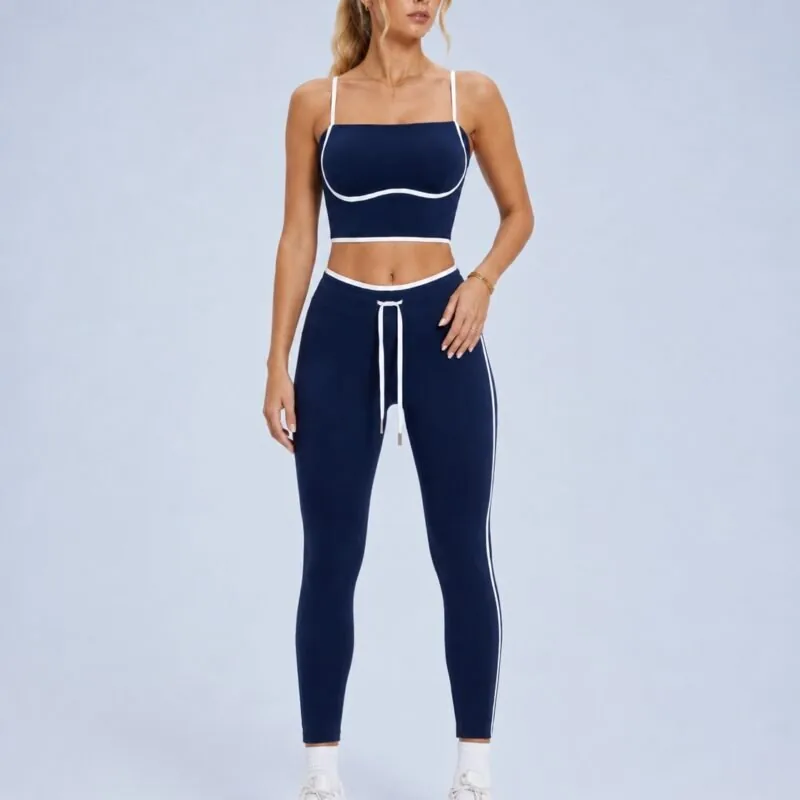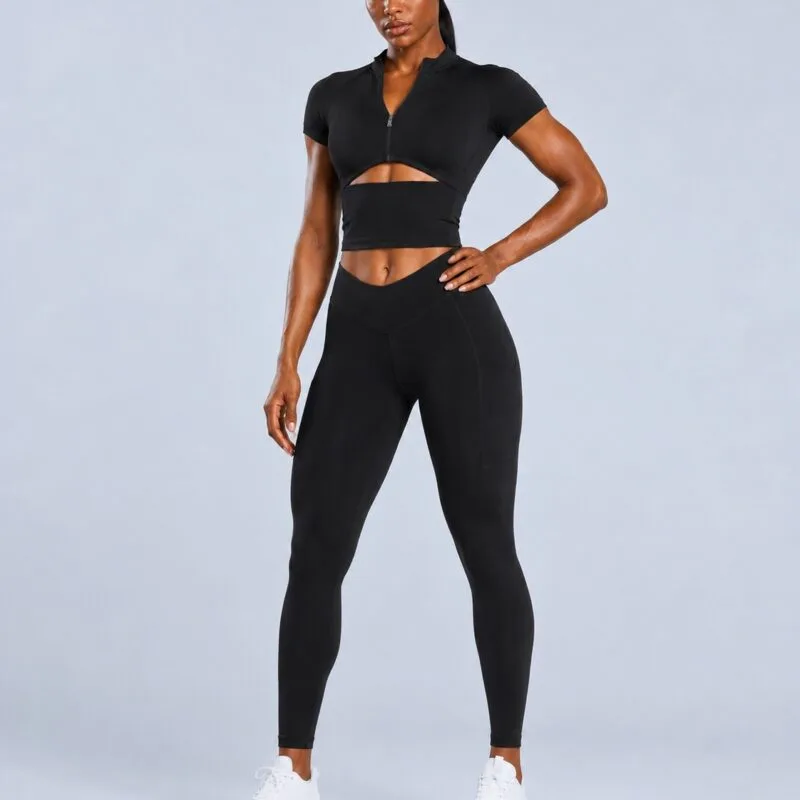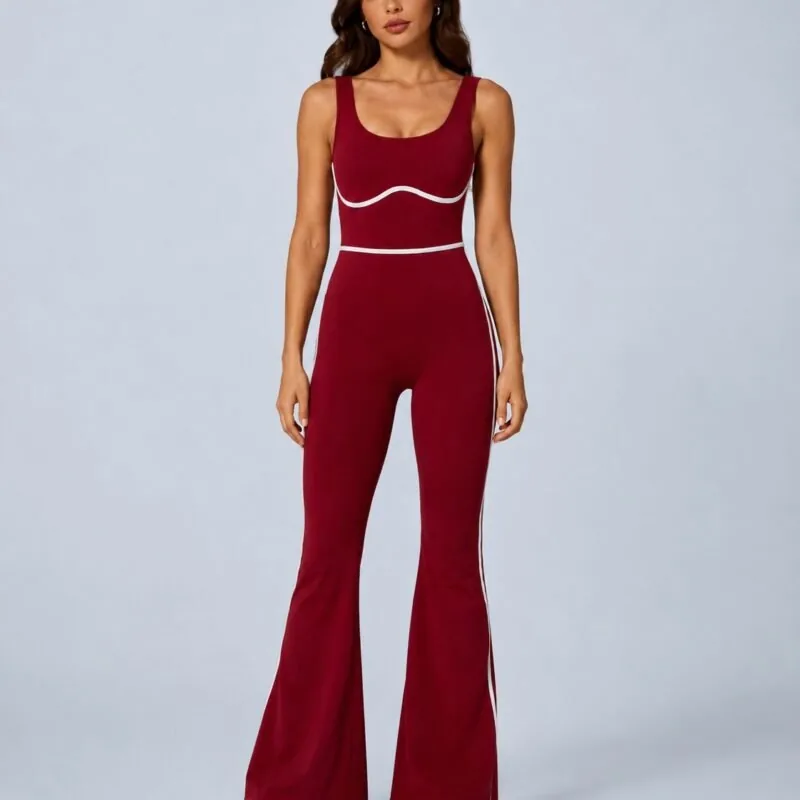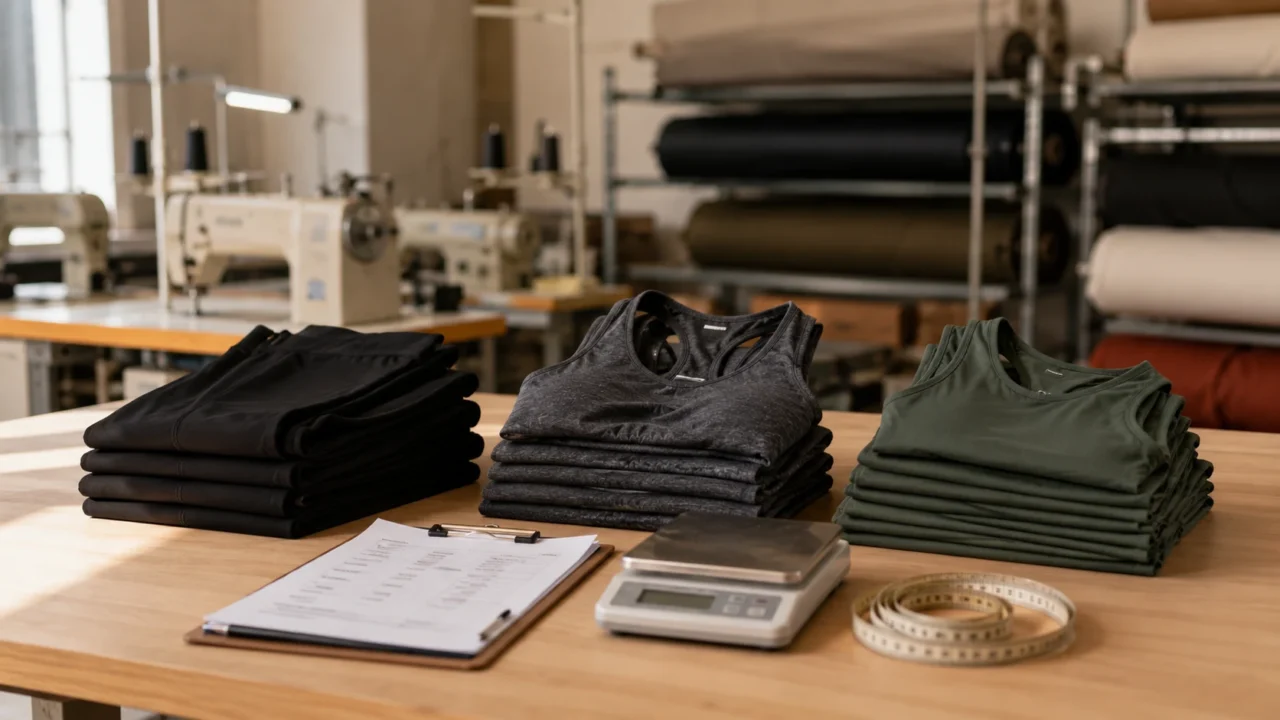
“What’s your MOQ?” is the first question 9 out of 10 first-time activewear brand founders ask us. It’s also the most misleading question — because there isn’t one answer. The real MOQ for your project depends on fabric source, customization level, and how the factory is structured. This guide cuts through the marketing claims and gives you the actual 2026 numbers, based on what we run at our Xiamen facility and what we see across the industry.
What MOQ Actually Means
MOQ (Minimum Order Quantity) is the smallest production run a factory will accept for a given style and color. It’s not a single number — most factories quote MOQ in two different ways depending on what you’re ordering:
Per-style MOQ: The minimum pieces per individual design. If a factory says “100 pieces per style,” ordering 5 different leggings styles means 500 pieces total minimum.
Per-color MOQ: The minimum pieces per fabric color within a style. If a factory says “50 pieces per color” with a 100-piece style minimum, you can order 100 pieces split as 50 black + 50 navy, but not 30 black + 30 navy + 40 grey.
The confusion compounds when a factory quotes “MOQ 100” without specifying whether it’s per style, per color, or total order. Always clarify both numbers before requesting samples.
The Real MOQ Ranges in 2026
Below are realistic MOQ ranges across activewear categories, based on what mid-sized Chinese factories (50–200 workers) accept in 2026. Larger factories may quote 2–3x higher; smaller workshops may go lower but with quality trade-offs.
Cut-and-Sew Activewear (Standard)
| Product | Stock Fabric MOQ | Custom Fabric MOQ | Why |
|---|---|---|---|
| Leggings / Bike Shorts | 100 pcs / style | 300–500 pcs / style | Stretch knit cutting setup time |
| Sports Bras | 100 pcs / style | 300–500 pcs / style | Pad sourcing minimums |
| Crop Tops / Tanks | 100 pcs / style | 300 pcs / style | Simplest construction |
| Joggers / Track Pants | 150 pcs / style | 500 pcs / style | More fabric per unit, complex sewing |
| Hoodies / Zip-Ups | 150 pcs / style | 500 pcs / style | Zipper, hood, drawcord trim minimums |
| Matching Sets (2-pc) | 100 sets / style | 300 sets / style | Counts as 1 SKU for MOQ purposes |
Seamless Activewear
| Product | Stock Fabric MOQ | Custom Yarn MOQ | Why |
|---|---|---|---|
| Seamless Leggings | 200 pcs / style | 1,000+ pcs / style | Machine setup is per-yarn-color |
| Seamless Sports Bras | 200 pcs / style | 1,000+ pcs / style | Same as above |
| Seamless Sets | 200 sets / style | 1,000+ sets / style | Combined machine programming |
Seamless production has higher MOQs because seamless knitting machines are set up per yarn color. Re-threading a machine for a small run wastes 4–8 hours of production capacity. This is why most “low MOQ seamless” claims under 100 pieces require you to accept stock yarn colors only.
Performance Outerwear (Jackets, Windbreakers)
| Product | Stock Fabric MOQ | Custom Fabric MOQ |
|---|---|---|
| Lightweight Windbreaker | 200 pcs / style | 500–1,000 pcs / style |
| Insulated Jacket | 300 pcs / style | 1,000+ pcs / style |
Why MOQs Exist (And Why They’re Not Going Away)
Factories don’t set MOQs arbitrarily to be difficult. MOQs reflect three real costs that exist regardless of order size:
1. Fabric mill minimums. Activewear fabric mills typically have 500–1,000 meter minimums per color per quality. A 1,000-piece legging order uses roughly 650 meters of fabric — already pushing against the mill minimum. A 100-piece order uses 65 meters. The factory has to either find leftover stock from a previous run or pay the mill’s “small lot” premium of 30–60%.
2. Production line setup time. A sewing line takes 2–4 hours to set up for a new style: pattern grading verification, marker preparation, machine adjustment, first-piece approval. That setup time is the same whether the run is 50 pieces or 5,000 pieces. The smaller the run, the higher the per-unit setup cost.
3. Trim and label minimums. Custom woven labels, hangtags, polybags, and care labels all have their own MOQs from suppliers — typically 500–1,000 units. Below that, you pay 2–3x per unit, which a factory has to absorb or pass to you.
This is why genuine low MOQ in activewear is around 100 pieces per style using stock fabrics. Anything below 50 pieces per style usually means one of three things: the factory is subcontracting to a workshop, you’re paying a heavy premium per unit, or quality control is compromised.
Three Strategies to Work With Lower MOQs
If 100 pieces per style is still too much for your launch budget, here are realistic ways to lower your effective MOQ without compromising production quality.
Strategy 1: Stock Fabric + Stock Style + Custom Logo
Order an existing factory style (one they’ve already produced for other brands) in stock fabric, customized only with your logo and label. MOQs can drop to 50 pieces per color, 100 pieces total. At YOUMEGA we run 100-set MOQs on stock styles with mix-and-match colors and sizes — it’s how most of our first-time brands launch.
Strategy 2: One Style, Multiple Colors
Instead of launching 5 different styles at 100 pieces each (500 total), launch 1 winning style in 5 colors at 100 pieces each (still 500 total — but lower brand-risk because you’re not betting on 5 design hits). This also gives you better cost per unit because you’re amortizing pattern and sample costs across more pieces.
Strategy 3: Capsule Pre-Orders
Run a pre-order campaign on your own site or Kickstarter to validate demand before placing the factory order. This works especially well for brands that already have an audience. Your customer pays before your factory does, so MOQ becomes a cash-flow question rather than a risk question.
MOQ Red Flags: When to Walk Away
Some factory quotes look attractive but signal real problems. Watch for these in your supplier conversations:
“Yes, we can do 10 pieces per style — no problem.” A real factory can’t produce 10 pieces profitably without either subcontracting to a workshop (quality risk) or charging 4–5x your expected price. If the price still seems reasonable at 10 pieces, the factory is probably either lying about quantity or planning to ship sample-quality goods.
“Our MOQ is 100 pieces — but the price is the same as 1,000 pieces.” This usually means the 100-piece price is inflated to where it would be uneconomical for the factory, or the 1,000-piece price has hidden costs. Ask for a quote at 100, 500, and 1,000 pieces — a real factory will show clear price breaks.
“No MOQ — order any quantity.” Unless the factory is running a stock dropshipping program (basic blank items in standard sizes), “no MOQ” usually means workshop-level production with no quality system. Acceptable for samples, dangerous for product you’ll sell to real customers.
We covered the full supplier evaluation checklist in our guide to comparing activewear supplier quotes.
What MOQs Look Like at YOUMEGA Specifically
For full transparency, here are the actual MOQs we work with at YOUMEGA in 2026:
| Order Type | MOQ | Lead Time |
|---|---|---|
| Stock styles + custom logo | 100 pcs / order (mix styles & colors) | 15–25 days |
| OEM with our stock fabric | 100 pcs / style | 25–40 days |
| OEM with custom mill fabric | 300–500 pcs / style | 40–60 days |
| Full ODM development | 500 pcs / style | 50–75 days |
| Seamless (stock yarn) | 200 pcs / style | 30–45 days |
The 100-set entry point is what we built our manufacturing system around — we keep 30+ tested activewear knits in stock and run a small-batch line that handles 100–300 piece orders without the per-unit cost explosion that hits most factories at that volume.
Frequently Asked Questions
What’s the absolute minimum MOQ for custom activewear?
For a real factory (not a workshop), the absolute minimum is around 50 pieces per style using stock fabric and stock styles with custom logo only. Below 50 pieces, the per-unit cost typically doubles or triples because fabric mill minimums, trim minimums, and line setup costs cannot be spread economically.
Can I mix sizes and colors to reach the MOQ?
At most factories yes — but the per-color and per-size minimums still apply. A common structure: 100 pieces total MOQ with minimum 25 pieces per color and minimum 5 pieces per size. So you could order 25 black S/M/L/XL + 25 navy S/M/L/XL + 50 grey S/M/L/XL/XXL to hit 100 pieces across 3 colors and 5 sizes.
Why is custom-fabric MOQ so much higher than stock-fabric MOQ?
Custom fabric requires the mill to develop and run a new dye lot specifically for your order. Mills have minimum dye lot sizes of 500–1,000 meters per color, which translates to roughly 800–1,600 finished garments. Stock fabric is already woven, dyed, and inventoried — the factory just pulls what you need.
Will MOQ go down if I commit to repeat orders?
Yes, but more so on price than MOQ. Most factories will hold MOQ at 100 pieces minimum but offer better unit pricing if you commit to 3+ orders in a 12-month window. This is because the second and third orders skip pattern development and most sampling cost, which gets amortized into the first order’s quote.
What happens if I order less than MOQ?
Three things usually happen: (1) the factory adds a “small lot fee” of 15–40% to the per-unit price, (2) you wait longer because your order has to be combined with other small orders to run efficiently, or (3) the factory politely declines and refers you elsewhere. The first option is reasonable for testing; the third is honest.
About YOUMEGA
YOUMEGA (Xiamen Mega Garment Co., Ltd.) is a private-label and OEM activewear manufacturer based in Xiamen, China. We’ve helped 200+ activewear brands launch their first production runs since 2017, with realistic MOQs that match what new brands can actually commit to.
If you’re planning your first activewear production run and want a clear MOQ + price quote with no marketing fluff, send us your product brief. We’ll respond within 24 hours with a sample quote at three different volume tiers (100 / 300 / 1,000 pieces) so you can see exactly where the price breaks are.
Buyer FAQ
What MOQ is realistic for activewear in 2026?
Stock styles with custom logo can start from 100 sets. Full custom OEM/ODM normally starts around 300-500 pcs per style per color, and custom Pantone dye sits in that same range.
Why do factories advertise MOQ 100 but refuse small orders?
Some factories use low MOQ as a lead magnet, then avoid production because setup time, fabric loss, labor allocation and QC cost make the order unattractive at true small quantity.
How can buyers lower MOQ risk?
Start with fewer styles, use stock colors when possible, combine sizes carefully, choose one logo method and confirm whether MOQ is per style, per color or per order before sampling.