All-Over Sublimation Printing Only Works on Polyester — What That Means for Your Line
Buyers usually meet sublimation from the design end: “we want an all-over print.” Factories meet it from the chemistry end: sublimation is a dye that turns into gas under heat and bonds inside polyester fiber — and only polyester. That one sentence quietly decides your fabric, your hand feel, your colorway economics and sometimes your whole product roadmap. Here’s the full logic, before you fall in love with a print your fabric can’t wear.
The chemistry, in plain terms
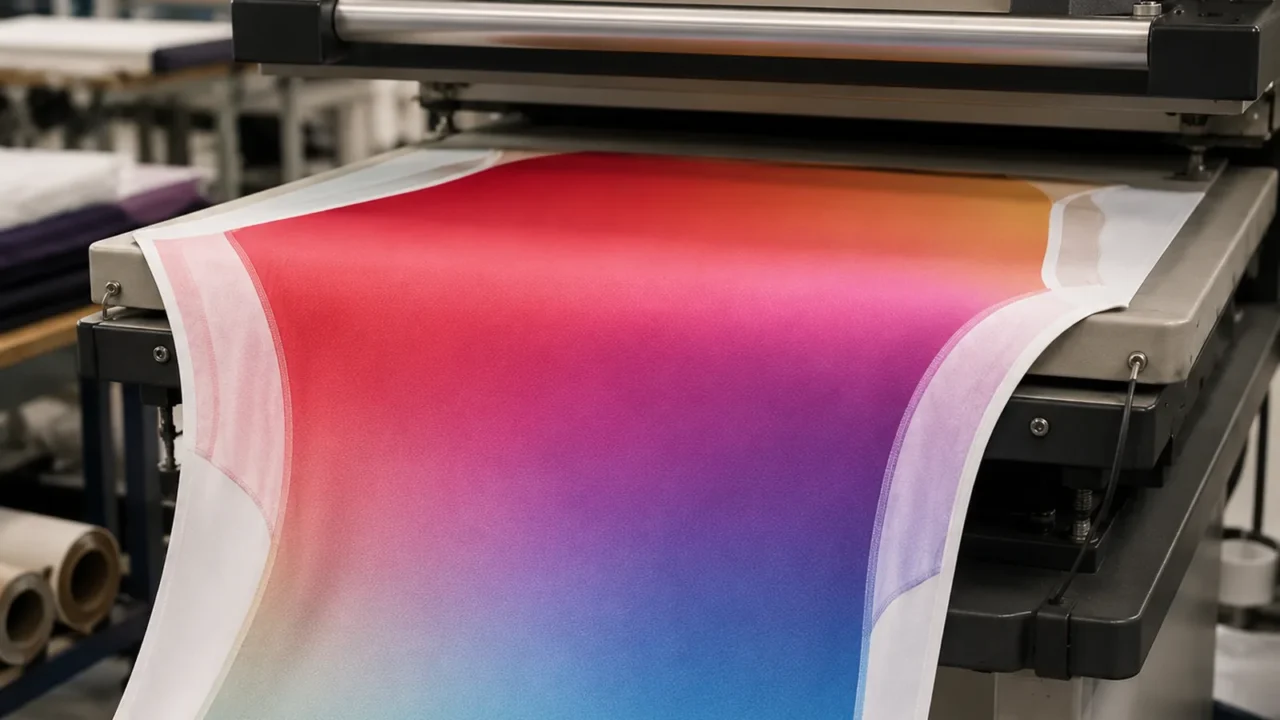
At roughly 200°C (about 400°F) for under a minute, sublimation ink vaporizes and migrates into polyester fiber, then solidifies inside it as the fiber cools. The print isn’t sitting on the surface like a plastisol logo — it is the fiber’s new color. That’s why good sublimation has zero hand feel, doesn’t crack or peel, and survives washing about as well as the fabric itself.
Three consequences follow directly:
- Nylon is out. Nylon doesn’t hold sublimation dye in any commercially reliable way. If your brand’s signature is buttery nylon-elastane, all-over sublimation isn’t your technique — your options are polyester bases engineered for softness, or different print methods.
- Elastane complicates. Spandex content scorches and yellows under full sublimation heat — irreversibly. Blends need lower temperatures and shorter dwell times, which is a real process window, not a checkbox. High-elastane compression fabrics and sublimation are an uneasy pair.
- White is structural. The fabric starts white; the print supplies every color. Anywhere the dye doesn’t reach — deep seam allowances, stretched creases — stays white. Which leads to the panel question.
Panel-print vs roll-print: where the white lines come from
Roll printing (print the whole fabric roll, then cut) is efficient — but when a seam opens under stretch, the unprinted seam allowance can flash white at the seams.
Panel printing (print each cut piece’s shape, then sew) puts ink exactly where the pattern needs it, including over edges — cleaner result, more setup, more waste, higher cost. Placement-critical designs (engineered prints that align across seams) are panel-print territory by definition.
Moisture is the other classic defect source: damp fabric or shifted transfer paper produces ghosting — a faint double image. Pre-pressing to drive out moisture and proper paper handling prevent nearly all of it. If a supplier’s sublimation samples show ghosting, you’re seeing their process discipline, not bad luck.
When sublimation is the right call — and when it isn’t
| Choose sublimation when | Choose solid dye + applied logo when |
|---|---|
| All-over prints, gradients, photographic designs | Solid-color premium basics |
| Polyester base is acceptable (or desired — e.g. rPET stories) | Nylon-elastane hand feel is the product |
| Colorways = new artwork files, not new dye lots | Colorways follow Pantone lab-dip logic |
| Tennis, golf, team-style and statement pieces | Yoga staples where feel sells |
One economic note buyers like: a sublimation colorway is a file change, not a dye lot — which interacts nicely with our stock program logic (from 100 sets, mixed colors and sizes) on sublimation-ready styles, while custom developments run 300–500 pcs per style per color. And since rPET is polyester, recycled-content stories and all-over print combine naturally.
FAQ
Can you sublimate on nylon leggings? Not reliably, and we won’t pretend otherwise. All-over print ambitions on a nylon base mean either switching to a soft polyester or switching print method — we’ll show you both quoted.
Will the print fade in the wash? Sublimation lives inside the fiber, so wash durability tracks the fabric, not a surface coating. Fading risk shifts to UV and heat abuse instead — same enemies as elastane.
Why do my seams flash white? Roll-printed fabric with seam allowances opening under stretch. Panel printing or darker base engineering solves it — at a price we’ll quote honestly.
Is sublimation cheaper than other printing? Per colorway at scale, often yes (no dye lots, no screens). Per single sample, no — setup dominates. The economics flip with your quantity, which is exactly what the quote shows.
Have an all-over print concept? Send the artwork and your target hand feel — we’ll tell you within 24 hours (weekdays) whether it’s a sublimation project or a different route wearing sublimation’s clothes.