Best Fabric for Leggings: What to Choose, Use by Use
Short answer: There is no best fibre or GSM for every legging. Compare candidate nylon–elastane and polyester–elastane fabrics as finished samples for hand feel, opacity under stretch, recovery, pilling, colour and wash performance. For conventional dye-sublimation printing, ask for a strike-off on a suitable light-coloured polyester-rich fabric; confirm any alternative process with the printer.
The decision, use by use
Start from what the leggings are for, not from a fabric name.
| What they're for | Fibre | Surface | Weight | What to settle before bulk |
|---|---|---|---|---|
| Studio yoga, lounge — a soft hand | Compare candidate blends | Brushed or smooth samples | Set after sampling | Hand feel, opacity and recovery on a washed sample |
| Everyday and lifestyle | Compare candidate blends | Smooth or lightly brushed | Set after sampling | Colour and pilling on the actual fabric |
| Gym, training, compression | Compare candidate blends | Confirm on sample | Set after sampling | Recovery and fit after repeated stretching |
| Running and hot weather | Compare candidate blends | Confirm on sample | Set after sampling | Comfort and drying under the intended use conditions |
| All-over printed designs | Confirm printer-compatible fabric | Test the actual finish | Set after strike-off | Print strike-off seen stretched and washed |
| Value tier | Compare actual supplier quotes | Confirm on sample | Set after costing | Pilling and fit after washing |
| Recycled line | Verify proposed recycled content | Confirm on sample | Set after sampling | Chain-of-custody paperwork and performance tests |
For the weight in detail — what 220, 240 and 280 GSM each feel like — see our leggings fabric weight guide, or try the GSM selector.
Nylon or polyester: the differences that matter
Both are synthetic fibres. Leggings may combine either with elastane, but the fibre label alone cannot establish the finished garment's hand, drying rate, opacity or price. Specify the actual yarn, knit, finish and test conditions before comparing offers.
| Nylon–spandex | Polyester–spandex | |
|---|---|---|
| Hand feel | Compare the proposed knit and finish | Compare the proposed knit and finish |
| Drying | Test the finished sample under matched conditions | Test the finished sample under matched conditions |
| Colour and printing | Check dye or print method and wash fastness | Check dye or print method and wash fastness |
| Cost | Request a quote for the actual specification | Request a quote for the actual specification |
Moisture regain is not a finished-garment drying test. Knit structure, thickness, finish and test conditions must be held constant to compare drying claims.
Conventional dye-sublimation transfer is commonly specified on a suitable light-coloured polyester-rich base. That does not rule out other printing methods for nylon or mixed fabrics. Approve a printer's strike-off and wash-fastness result on the exact fabric; see five logo printing methods compared.
Neither fibre is better in general. Compare the proposed fabrics against the same brief and test methods. Recovery after repeated stretching matters more to a specific fit claim than the fibre name alone — see stretch and recovery testing.
Brushed or smooth
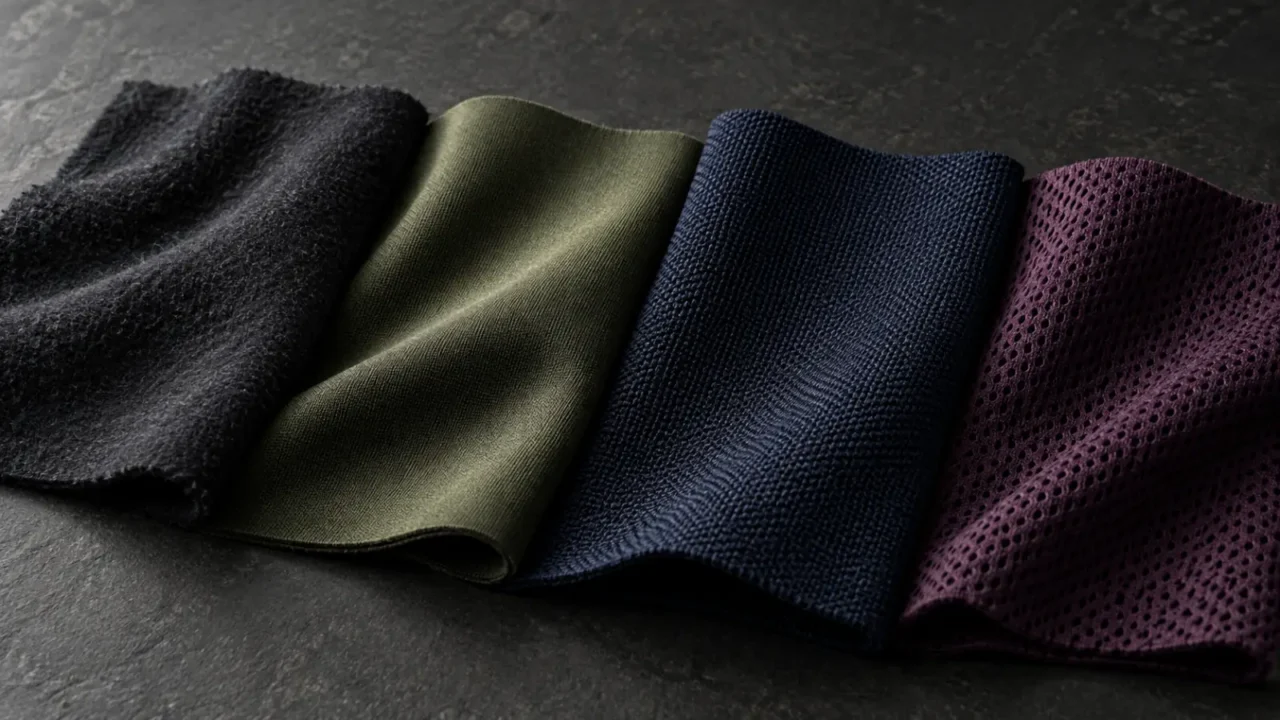
The surface finish changes the feel as much as the fibre does.
- Brushed (peached): brushing changes the surface hand and appearance. Test opacity, pilling and recovery on the proposed fabric; the finish alone does not determine them.
- Smooth: compare its hand and appearance with the brushed option on physical samples.
Decide the intended feel and use, then approve the fabric and sewn sample against that brief.
Knit structure
Leggings can use different knit constructions, including jersey, interlock and warp-knit options. None guarantees opacity, support or recovery. Ask the supplier to identify the construction and test a sewn sample over the knee and seat; our explainer on rib, jersey and interlock knits covers terminology.
Many seamless leggings use a circular knitting route that forms much of the garment's shape before finishing; construction varies by style, so confirm which panels or seams remain. This differs from cutting every panel from a roll. See seamless vs cut-and-sew activewear.
How to prove the fabric before you order bulk
- Approve a physical swatch in your colour, not just a GSM target.
- Wear-test a real sample. A swatch tells you the hand; only a sewn sample tells you how the fabric behaves on a body.
- Ask for the test report and read it properly — our guide to reading an activewear fabric test report shows what to look for.
- Match each performance claim to a test. If a supplier says "anti-pilling", ask which method, which grade and which fabric lot: see which tests back which activewear claims.
- Check shrinkage and twist before you grade sizes: shrinkage and torque testing.
What to confirm before bulk production
For your order, confirm the proposed composition and GSM by style, then agree which shrinkage and stretch-recovery checks are needed, who records the results and how they affect the size chart. Specify whether "Lycra" in the brief means the branded fibre or generic elastane. For custom dyeing, agree on a lab dip against the Pantone reference before bulk dyeing; stock colours do not require a new dyeing approval. Custom Pantone dyeing starts at 300–500 pieces per style per colour, depending on the product. Finished goods are inspected in house to AQL 2.5. If you are choosing between a stock fabric and developing your own, see stock fabric vs custom-knitted fabric.
FAQ
What is the best fabric for leggings? The one that meets your fit, hand, opacity, recovery, care and cost brief in a finished sample. Compare candidate blends and GSM values under the same test conditions rather than choosing from a universal range.
Is nylon or polyester better for leggings? Neither is universally better. Compare specific fabrics for hand, drying, colour, pilling and price. Conventional dye-sublimation often uses a suitable light-coloured polyester-rich base, but printing suitability still needs a strike-off.
What are buttery-soft leggings made of? "Buttery" describes hand feel, not a certified composition. A brushed knit is one possible route. Approve the actual sample and test its opacity, pilling and recovery before treating it as suitable for a use case.
Can nylon leggings be sublimation printed? Do not assume a conventional polyester dye-sublimation setup suits nylon. Ask the printer which process supports the exact fabric and approve a washed strike-off. Other print or logo methods may be possible; see five logo printing methods compared.
What fabric weight should leggings be? There is no universal range. Set a target after comparing actual swatches and sewn samples for opacity, stretch, recovery, hand and fit. GSM alone does not describe those properties.
Can I have leggings in recycled fabric? Ask for a proposed recycled rPET or regenerated-nylon material and its composition and performance tests. For a proposed GRS-backed order, verify the source mill's or dye house's current scope, the applicable transaction certificate and the custody path for that material. In YOUMEGA's current sourcing, the GRS scope certificate is held by the source mill or dye house, not by YOUMEGA; this does not certify every proposed fabric. See GRS scope certificate vs transaction certificate.
Choosing between two fabrics for a first style? Send us the use case and your target price, and we will tell you which one we would pick, and why.
Sources
- Epson, Dye-Sublimation Printers for Makers (conventional light-coloured polyester-base guidance): https://epson.com/sublimation-printers-for-makers