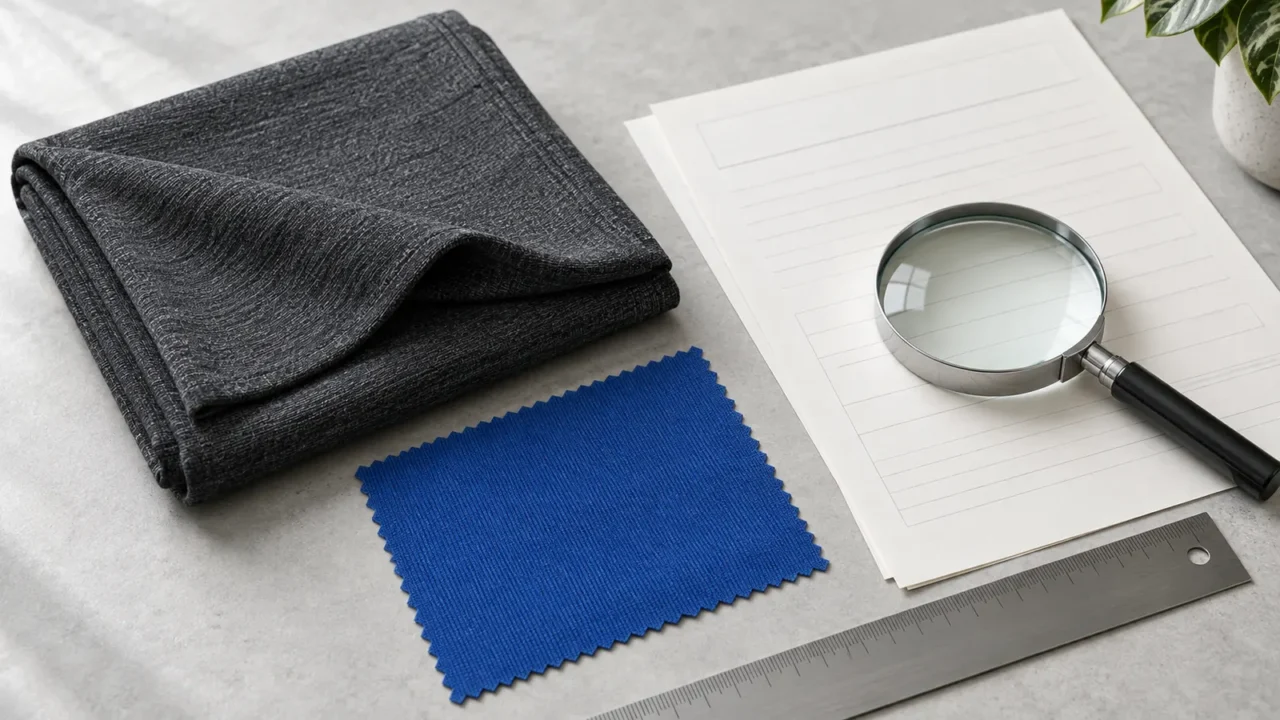
A useful fabric test report connects the material you intend to buy to a specific sample, a defined test method and an agreed acceptance requirement. A PASS label alone does not establish that connection. Before approving fabric for leggings, sports bras or a coordinated set, check what was tested, which results apply to your order and what still needs verification on the finished garment.
This is a buyer's review checklist, not a substitute for a laboratory assessment or a market-specific compliance review. It does not set universal pass grades or claim that one report approves an entire collection.
Start with the sample, not the logo on the report
Place the report beside your purchase specification and approved swatch. Can you connect the sample description to the fabric reference, colour, composition, construction and production lot you are ordering? Record any information that comes from the supplier rather than from the laboratory's own observations. A photo helps identification, but it cannot establish fibre content or performance by itself.
If the report describes a development swatch and your order uses a different finish or material batch, ask the laboratory or responsible technical reviewer what additional evidence is needed. Do not silently extend the result to the new material. Likewise, a test on one component should not automatically become a claim about every component of a finished sports bra.
| Report field | Buyer question | Useful follow-up |
|---|---|---|
| Report identifier and revision | Is this the complete, final document? | Request all pages and any superseded-version note. |
| Sample description | Does it identify the material being approved? | Reconcile the description with the specification and retained swatch. |
| Sample receipt and test dates | Which development or production stage was tested? | Link the report to the approval timeline. |
| Colour and material reference | Is this the same combination as the order? | Ask the reviewer to define the report's applicability. |
| Result and requirement | What limit produced the pass or fail decision? | Obtain the referenced specification and its version. |
These are practical purchasing checks, not a claim that every report must use the same layout. Put the agreed material description into your activewear tech pack so the supplier and reviewer work from the same reference.
Verify laboratory competence for the work involved
ISO/IEC 17025 concerns laboratory competence, impartiality and consistent operation. It is not a certificate that the clothing brand itself holds, nor a universal product approval. See the official ISO/IEC 17025 overview.
Check the laboratory's identity and relevant accreditation scope through the accreditation body's directory, rather than trusting a badge in a forwarded PDF. ILAC explains that accreditation bodies maintain these directories and that laboratories perform work within their accredited scopes; ILAC itself does not issue your product's test report. Its official laboratory and accreditation FAQ also cautions that acceptance in a destination market is not automatic.
Where authenticity or scope is unclear, contact the laboratory using independently verified contact details. Ask whether it can confirm the report identifier, revision and relevant test coverage. A genuine laboratory name and a valid report are separate things to establish.
Read the method and result together
Different methods answer different questions. AATCC's public method directory distinguishes fabric dimensional change after home laundering (TM135) from garment dimensional change (TM150). It also distinguishes colour change evaluation from staining evaluation. Those names are not interchangeable results. Check the AATCC method and evaluation-procedure directory against the method actually cited in the report.
Ask for the method edition, reported conditions, units and any deviations relevant to the comparison. Two reports headed "wash test" are not necessarily comparable. Do not infer a universal wash temperature, number of cycles or acceptance grade from the method title alone; the applicable procedure and purchasing requirement must supply those details.
For example, a reported dimensional-change result describes the property tested under the stated conditions. It does not, by itself, answer whether the waistband feels comfortable, the finished garment fits the approved size curve or the logo survives the intended care routine. Choose evidence that answers each actual product claim. Our performance-claims guide separates those questions.
Find out who supplied the acceptance limit
Look for the requirement beside each result and identify its source: a buyer specification, a named product standard, a regulatory requirement or another stated criterion. Ask for clarification where a PASS appears without a visible limit or reference. A test method describes how a property is evaluated; it does not necessarily supply the buyer's commercial acceptance threshold.
If a result is near a limit, ask the laboratory how the conformity decision was made, including any relevant decision rule or uncertainty treatment. Do not round the value yourself to turn an ambiguous result into an approval. Keep the technical review and commercial decision documented separately.
Separate fabric evidence from shipment acceptance
A laboratory report and a pre-shipment inspection serve different purposes. Keep the report with the material approval, then check the actual order against its specification and approved sample. Use the AQL inspection guide to prepare that separate inspection brief. A passed material test is not proof that every shipped garment has correct measurements, workmanship and packing.
For changes between sampling and production, maintain a simple approval record: what changed, who reviewed it, whether existing evidence still applies, what must be retested and who authorised release. The sample-versus-bulk guide covers the production comparison; the report-review task is to make sure the evidence follows that decision.
A report-review request you can send
Please send the complete final report, identify the tested material and its relationship to our proposed production lot, and confirm the relevant laboratory scope. For each result, show the method and edition, stated conditions, acceptance requirement and any limitation. Please also identify which finished-garment checks remain outside this report.
Keep this request attached to the material specification rather than buried in a separate chat. When discussing a project with YOUMEGA's quality team, bring the intended use, destination market and proposed claims as well as the PDF. The useful outcome is an agreed evidence gap list, not simply a folder containing more certificates.
Questions buyers ask
Does an accredited laboratory report certify my whole collection?
No. Review the report's sample, scope and results, then determine which products and claims the evidence actually supports. Do not extend a material result to other colours, components or finished garments without an appropriate technical review.
Can I compare two reports that both say PASS?
Not from that word alone. Compare the tested materials, methods, conditions and acceptance requirements before deciding whether the results answer the same question.
Should I approve bulk production if the report is incomplete?
Record what is missing and resolve it with the supplier or laboratory before using the report as your approval evidence. A commercial deadline does not make an unidentified sample or unexplained limit more reliable.