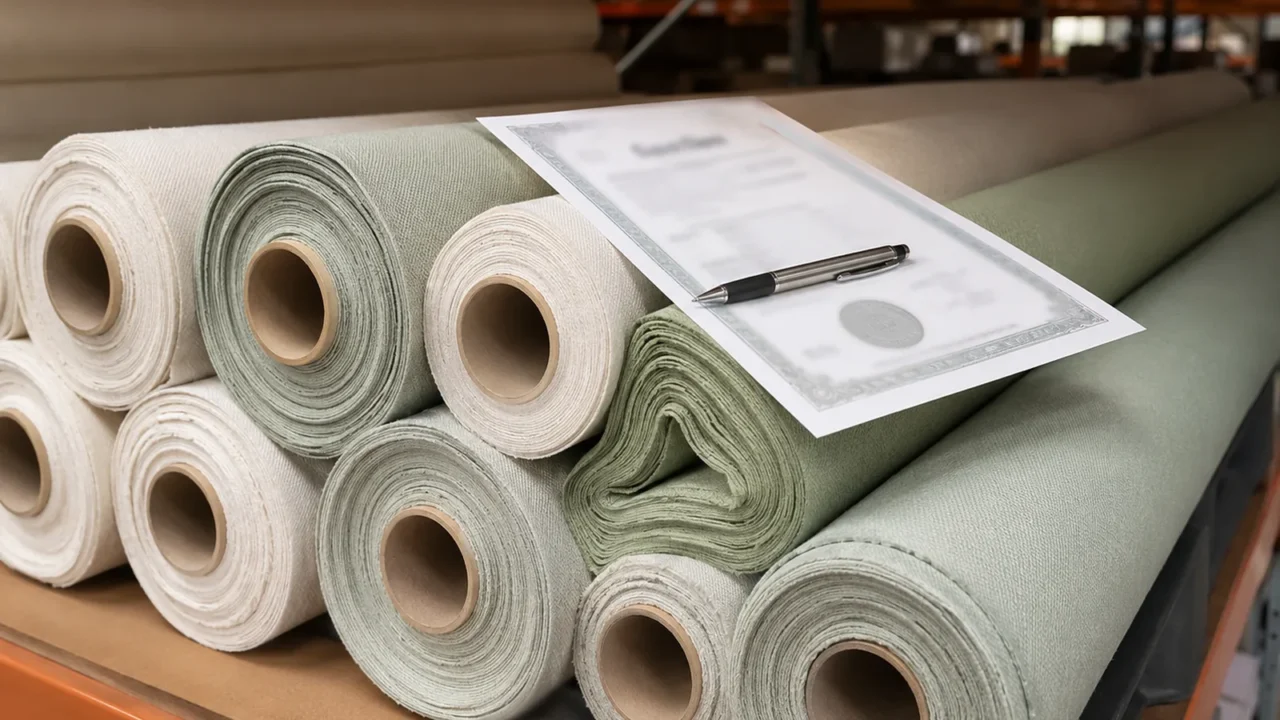
GRS Scope Certificate vs Transaction Certificate: What Buyers Actually Need
Ask ten suppliers “are you GRS certified?” and you will get ten confident yeses. Ask the follow-up question — “certified as what, and can you issue a transaction certificate for my order?” — and most of the conversation falls apart.
That is not because everyone is lying. It is because GRS certification has two different documents that do two different jobs, and most sourcing conversations never separate them. This article does.
The two documents, in one table
| Scope Certificate (SC) | Transaction Certificate (TC) | |
|---|---|---|
| What it certifies | A facility and its processes | A specific shipment of goods |
| Issued to | The mill, dye house or factory, after audit | The buyer of that shipment, on request |
| Issued by | An approved certification body | The same certification body, per transaction |
| Valid for | About one year, renewed by audit | That transaction only |
| What it proves | “This facility is qualified to process GRS material” | “These exact goods are GRS-certified material” |
The Global Recycled Standard is owned by Textile Exchange, and both documents can be authenticated through certification bodies — a legitimate certificate holder will never object to you checking.
Why the difference decides your product claims
Here is the part that matters for your brand:
A supplier showing you a mill’s scope certificate has shown you the mill is qualified — not that your goods are certified. For your shipment to be GRS-certified material, the fabric transaction needs its own TC. And for a finished garment to carry GRS claims all the way to retail, every processing stage in the chain needs scope certification, with transaction certificates connecting each link.
That chain is expensive to build and maintain. It is why “GRS certified” appears on a thousand supplier homepages and on very few actual hangtags.
Where YOUMEGA honestly stands
We work with recycled nylon and recycled polyester (rPET, and ECONYL-type regenerated nylon) for brands that want recycled content in their line. The GRS scope certificates in our supply chain are held where the certified processing actually happens — at the mill and dye-house level. We do not present source-held certificates as our own, and we do not print certificate numbers on a marketing page.
What we do instead: during supplier qualification, we share the relevant documentation for your project — the mill’s scope certificate, and where your order requires it, transaction certificates for the fabric lots that go into your production. You can verify both with the issuing body.
What most brands actually need (and it is not a logo)
For most private-label activewear brands, the real requirement is credible, checkable recycled-content documentation — for your website, your buyers and your own conscience. That is achievable with a certified mill and fabric-level TCs, without building a full garment-level chain.
If you specifically need on-product GRS labeling, that is a bigger conversation: garment-stage scope certification, chain-of-custody paperwork and lead-time implications. We will tell you honestly what is possible on your timeline before you commit — not after sampling.
Questions to ask any supplier (including us)
- Is the scope certificate in your company’s name, or the mill’s? (Either answer can be honest — hiding the difference is not.)
- Can you provide a transaction certificate for the fabric in my order?
- Can I verify the certificate with the certification body?
- What recycled percentage does the certified fabric actually contain?
A supplier who answers all four without flinching is telling you the truth. A supplier who answers “we are fully certified” to all four is hoping you stop asking.
FAQ
Does a mill’s GRS scope certificate make my garments “GRS certified”? No. It qualifies the mill’s processes. Your fabric shipment needs a transaction certificate, and on-product GRS claims need scope certification through every processing stage, including garment manufacturing.
Can YOUMEGA supply GRS-documented recycled fabrics? Yes — recycled polyester and recycled nylon options with mill-level scope certification, and transaction certificates for qualifying fabric lots. Documentation is shared per project during supplier qualification.
What is the difference between GRS and RCS? Both track recycled content. GRS adds social, environmental and chemical processing requirements on top; RCS tracks recycled content only. GRS is the stricter and more recognized of the two for apparel.
How do I verify a GRS certificate? Ask for the certificate, then check it with the issuing certification body. Textile Exchange maintains authentication routes for exactly this purpose.
Does recycled fabric change MOQ or price? Certified recycled yarns typically carry a premium over virgin equivalents, and custom colors still follow dye-lot minimums — 300–500 pcs per style per color. Stock recycled options from 100 sets are available on selected styles.
Building a line with recycled content? Send your quantity and target market — we will tell you which documentation route fits, within 24 hours on weekdays.