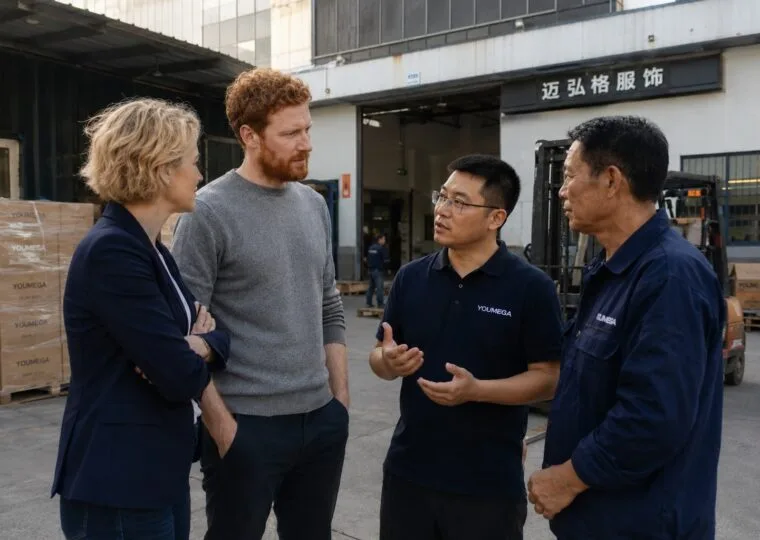
One founder. Two years of self-funded development. One container that had to land clean.
Anna built Goosgym Sports from Amsterdam over two years before she placed her first full container order. Goosgym Sports was a solo operation — design, sourcing, marketing, customer service, finance, everything ran through her. She had self-funded the first two test runs at smaller volumes through previous suppliers and had used that period to refine her product line down to the three styles, eight colors and one fabric system she now wanted to scale.
Goosgym Sports’ first container order with us was 2,400 sets across those three styles and eight colors, shipped as a 40HQ to Rotterdam. The order was, for her business, significant — a meaningful percentage of her available capital was committed to a single shipment that had to land clean, on time, and in the season window her e-commerce calendar had been built around. There was no buffer. A delayed container or a quality issue at this scale was not a setback she could absorb and reorder around. It was a brand-stopping event.
This is the situation a solo founder is in by definition: every order is the largest order they have ever placed, every shipment is the most concentrated risk on their balance sheet, and the factory they place it with is the single biggest operational dependency in their business. Most factories know this and price it. Some factories know this and ignore the customer. The ones worth working with treat the 2,400-set order with the same operational discipline they would apply to a 24,000-set repeat.
Same pre-production process. Same QC standard. Same packing discipline. Different communication frequency.
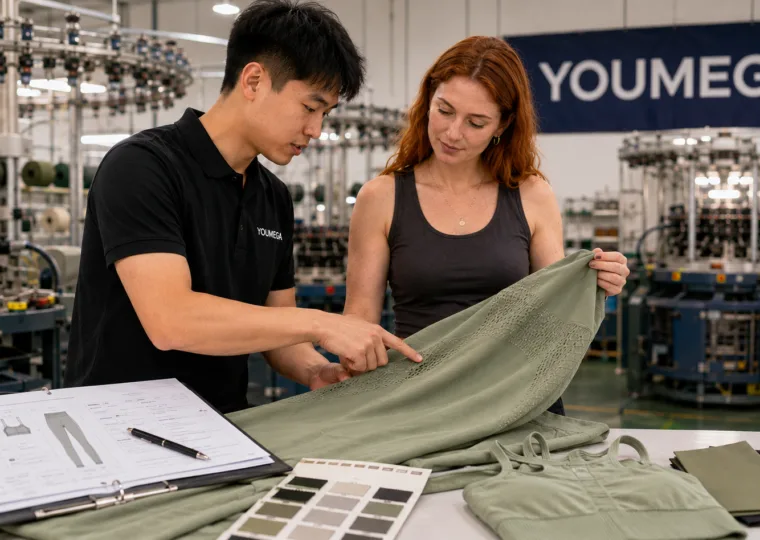
The production side of Goosgym Sports’ order was identical to what we would run for a much larger customer. Lab-dips on all eight Pantone colors, locked to a documented standard. Pre-production samples across all three styles, approved before bulk cutting. AQL 2.5 final inspection on the full lot. Export packing built around the standard 40HQ container load with documented carton dimensions and weight distribution.
What was different — deliberately — was the communication frequency. For a solo founder funding a container out of her own balance sheet, the cost of uncertainty during production is higher than the cost of additional progress updates. We sent her photos of the fabric lot arriving from the mill, the cut bundles being prepared, the first sewing line outputs, the final inspection in progress, and the carton seal photographs before the container left. Most of these communications were not strictly necessary for the order to ship correctly. They were necessary for the founder running the brand to be able to plan downstream — when to time the email campaign, when to brief her warehouse partner, when to update her e-commerce platform with the new inventory dates.
The total elapsed time from PO confirmation to container arrival at Rotterdam was twelve weeks, in line with what we had committed to at order placement.
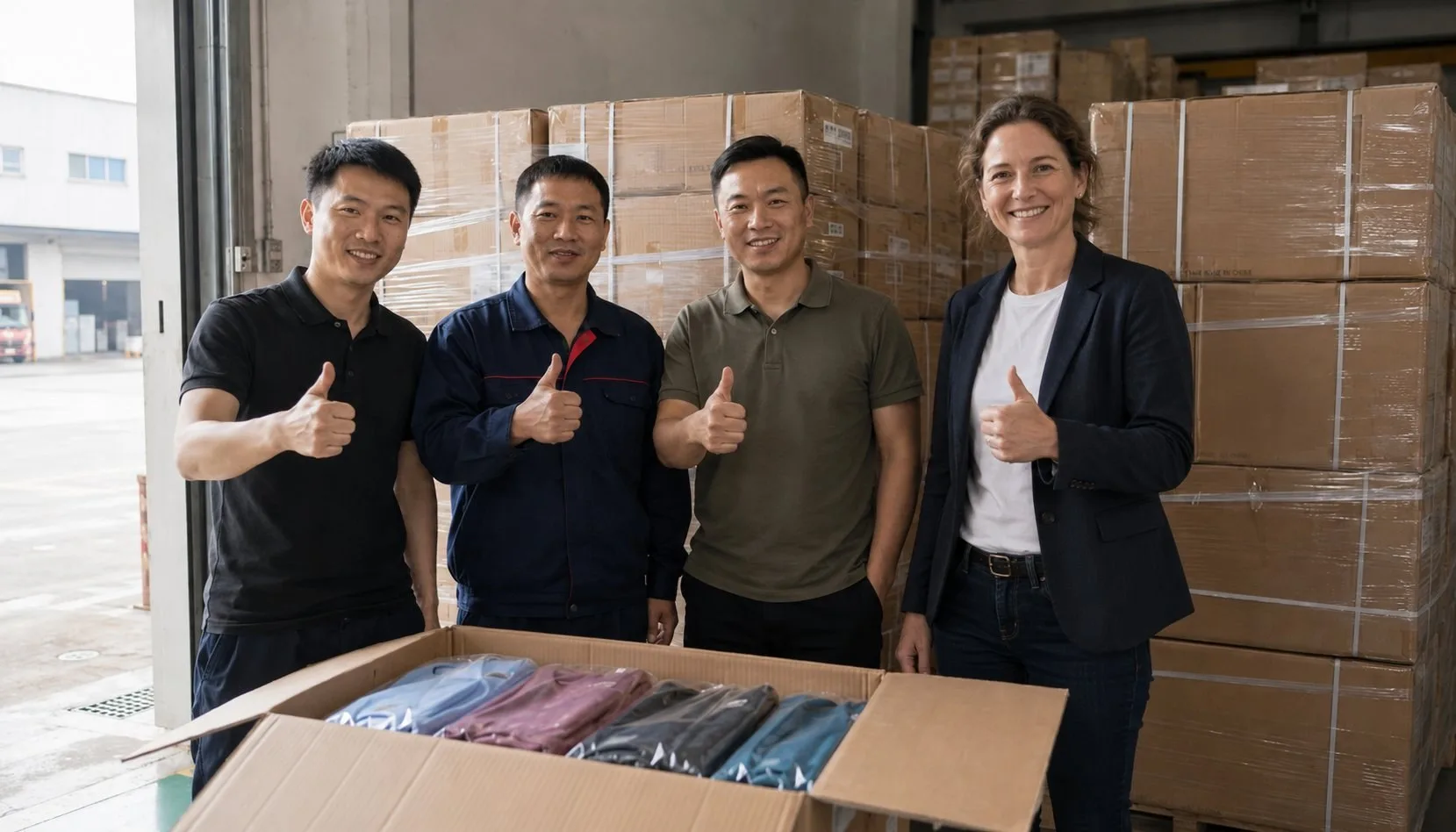
The container arrived intact. The brand launched the season clean.
Three things went right on this order that we want to highlight, because they are the things that most often go wrong on a solo founder’s first container. First, the fabric lot arrived from the mill three days late but production absorbed the delay internally without changing the final shipping date — we burned the buffer instead of moving the deadline. Second, two of the eight Pantone colors required a second lab-dip round to land exactly where Anna wanted them; we ran the additional rounds without rebilling the development cost or extending the timeline. Third, a customs documentation error on our side was caught during our internal pre-export review, not by Anna’s customs broker on arrival — we corrected and re-filed before the container left the port. None of these moments became problems for the brand. All three would have become problems with most factories, because most factories pass these costs to the customer.
The 40HQ landed at Rotterdam, was unloaded into Anna’s distribution partner, and inspected against the packing lists. Zero damages, zero short-shipped SKUs, zero out-of-spec units identified in the receiving check. The fabric weights matched the approved specification within tolerance. The Pantone colors held against the lab-dip references. The carton labels matched the warehouse system. The launch happened on the date the brand’s marketing calendar had been built around.
For Goosgym Sports, the value of a clean container is not just the absence of problems. It is the absence of the kind of problem that would have consumed her time at the exact moment her brand needed her to be marketing the launch, not managing a return shipment or rerouting inventory. The container arrived clean, and Anna spent the launch week doing the work the launch actually required.
Small customers become large customers. The factories that recognize this are the ones who grow with them.
The activewear supply chain has a structural bias toward large customers. Larger MOQs are easier to plan around. Larger margins justify more sales attention. Larger volumes simplify dye scheduling and cutting layouts. Most factories quietly route their best capacity, their most experienced production managers and their most disciplined QC teams toward their largest accounts.
This bias is rational in the short term and self-defeating in the long term. Every large activewear brand in the world started as a small order at some factory. The ones that grow into the large brands grow with the factory that treated their first 200-set test order with the same operational discipline as their 20,000-set fifth-year reorder. Goosgym Sports placed its first container with us because two years of smaller test runs had told her exactly how a factory treats a customer who is, for now, easy to under-prioritize. If you are a solo founder evaluating manufacturing partners for your first meaningful order, the only meaningful test is how the factory treats you at the volume you are placing today — not at the volume you intend to grow into.