For most private-label activewear brands, full custom packaging — hangtag, woven main label, printed wash label, branded polybag, and outer carton marking — adds roughly $0.40–1.20 per garment at 100-set MOQ, with all components produced in-house in 5–10 days after artwork approval. The right setup depends less on budget and more on which sales channel the product is heading to.
Packaging is often treated as the last step in sourcing. That is a mistake. For many private label brands, activewear packaging is the first physical brand impression the customer receives. A clean garment in weak packaging looks unfinished. A well-packed garment feels more premium before the customer even tries it on.
Start with the sales channel
Before choosing packaging, ask where the product will be sold:
- Direct-to-consumer website
- Boutique retail
- Distributor or studio sales
- Marketplace fulfillment (Amazon, etc.)
The packaging structure should match the channel. A DTC brand may care more about presentation. A distributor may care more about clean bulk packing and label accuracy. Marketplace orders may need barcode-ready packaging.
Channel vs packaging priority matrix
Different channels demand different packaging priorities. The same investment looks different depending on where the customer encounters the product:
| Channel | Highest priority | Often optional |
|---|---|---|
| DTC website / unboxing | Hangtag design, tissue paper, branded poly mailer | Barcode, retail-format polybag |
| Boutique retail | Woven label, premium hangtag with size, branded polybag | Tissue, inner inserts |
| Distributor / wholesale | Carton labeling, consistent polybag size, accurate count per carton | Tissue, premium hangtag finishes |
| Amazon FBA / marketplaces | FNSKU labeling, suffocation warning, exact polybag dimensions | Tissue, branded mailer |
| Gift / subscription box | Tissue, sticker seal, message card | Heavy hangtag, retail polybag |
What is usually included in activewear packaging?
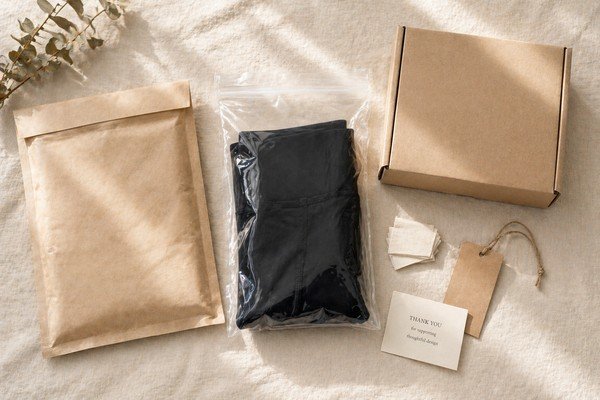
A standard private label packaging setup may include:
- Main brand label
- Wash care label
- Size label
- Hangtag
- Polybag
- Outer carton labeling
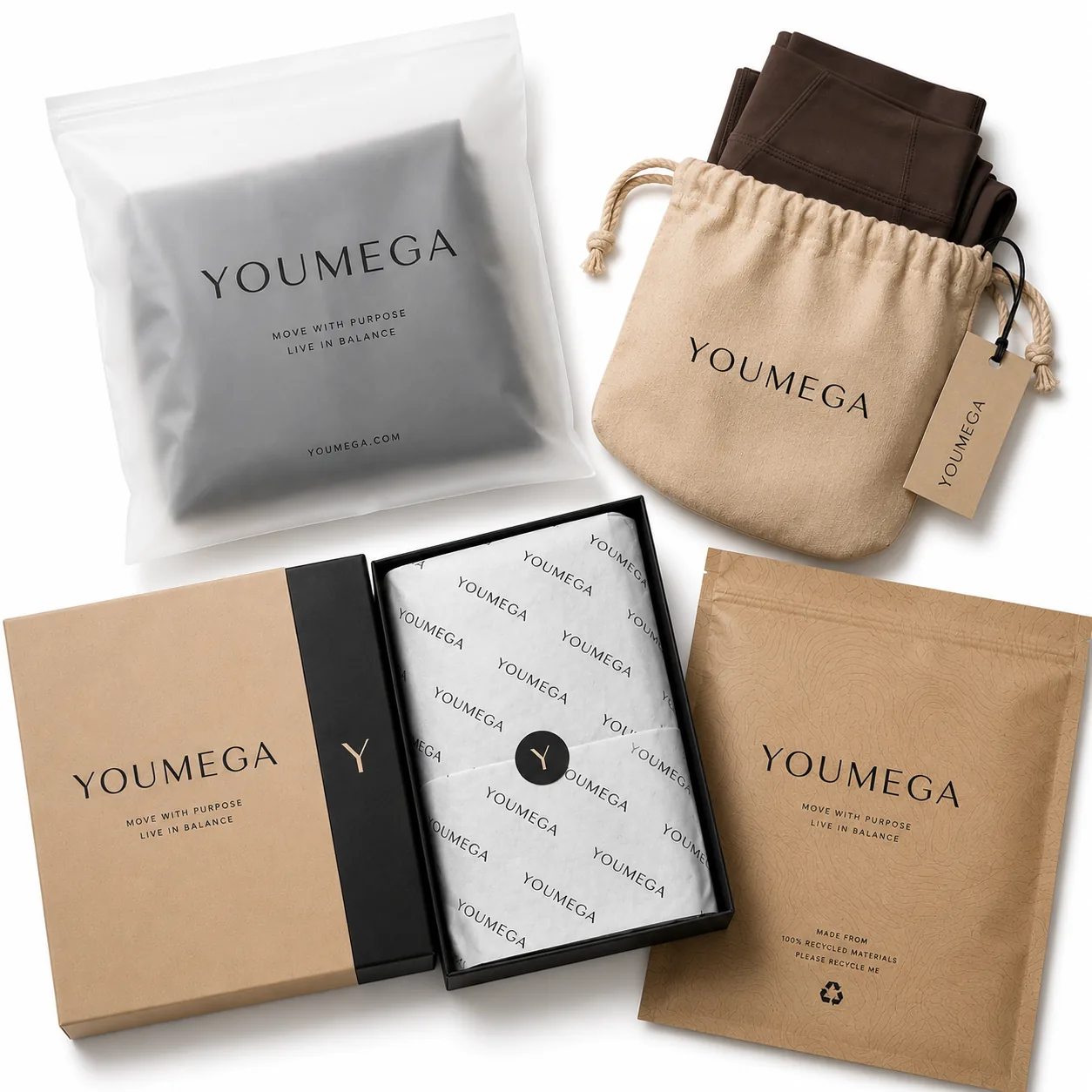
Not every collection needs all of these at the highest level of customization, especially at low MOQ. But buyers should decide early which parts matter most. At YOUMEGA, all of these are produced in-house — see our services page for the full list.
Packaging component breakdown: MOQ, lead time and cost
Each component has its own production economics. Knowing the typical ranges helps you budget realistically:
| Component | MOQ | Lead time after artwork | Cost per unit (typical) |
|---|---|---|---|
| Woven main label | 1,000 pcs | 7–10 days | $0.04–0.10 |
| Printed wash care label | 500 pcs | 3–5 days | $0.02–0.05 |
| Hangtag (paper, single side) | 500 pcs | 5–7 days | $0.05–0.15 |
| Hangtag (premium finish, foil/emboss) | 1,000 pcs | 10–14 days | $0.15–0.40 |
| Clear polybag (basic) | 1,000 pcs | 3–5 days | $0.02–0.05 |
| Branded polybag (1-color print) | 3,000 pcs | 7–10 days | $0.06–0.12 |
| Tissue paper (branded) | 2,000 sheets | 7–10 days | $0.04–0.10 |
| Custom carton (5-layer) | 500 pcs | 5–7 days | $0.40–0.80 |
For first-launch brands below these component MOQs, we typically combine your order with our buffer stock for stock-component options (standard hangtag cards, neutral polybags). This lets a 100-set first order still ship with a branded hangtag and a clean polybag, even though the polybag itself isn’t custom-printed yet.
Hangtags: small detail, strong branding signal
A hangtag is one of the easiest ways to make a stock style feel like a real branded product. A simple branded hangtag works well when the buyer wants a cleaner first presentation, basic product information, size or style ID, or retail-ready appearance. It does not need to be complex. Even a simple matte card with clean typography can raise perceived value.
Polybags matter more than many brands expect
Some buyers think polybags are only for protection. They also affect organization, barcode application and final presentation. Questions to decide:
- Plain or branded polybag?
- Resealable or not?
- Warning text needed for destination market?
- Barcode sticker on bag or on hangtag?
For buyers shipping to a warehouse or 3PL, labeling accuracy matters as much as appearance.
Woven labels vs printed labels
Woven labels feel more premium and durable. Printed labels can reduce irritation and keep the inside cleaner depending on the product type. Some brands use both: woven main label for brand identity, printed wash label for care information. The right choice depends on brand image, budget and garment construction.
Label compliance: what your destination market requires
Beyond branding, wash and content labels carry legal requirements that vary by destination. Getting these wrong creates customs delays or retailer rejections that are entirely preventable:
- EU: Fiber composition required in all official languages of the country of sale; care symbols per ISO 3758; country of origin recommended.
- US: FTC requires fiber content, country of origin, RN number (or company name), care instructions in English per 16 CFR Part 423.
- UK: Similar to EU post-Brexit, with English-language content required.
- Canada: Bilingual English/French fiber content and care instructions.
- Australia: Care symbols per AS/NZS 1957; fiber content per Australian Consumer Law.
We handle these requirements as part of our standard label production for any destination buyer specifies. The compliance burden is low when planned upfront and expensive when discovered at customs.
Sustainable packaging options
Sustainability claims are getting more scrutiny, and packaging is one of the more credible places to make them concrete. Common upgrades and their cost impact:
- Recycled paper hangtags (FSC-certified): +10–20% cost vs standard paper; minimal lead time impact.
- Recycled polybags (rPE 50–100%): +20–35% cost vs virgin; same lead time at MOQ 3,000+.
- Compostable mailers (PBAT/PLA): +50–100% cost vs standard poly mailer; suited for DTC, not bulk wholesale.
- OEKO-TEX certified labels: Marginal cost premium; useful if your brand makes textile safety claims.
- Recycled carton (post-consumer): Roughly equal cost; widely available and rarely a credible differentiator on its own.
Sustainable packaging works best when it’s consistent with the product story. A brand using recycled fabric in the garment but virgin plastic in the polybag invites credibility questions.
Outer cartons are part of the system too
Outer carton planning affects warehouse receiving, shipping damage and customs clarity. Important details:
- Carton dimensions
- Quantity per carton
- Mixed SKU or single SKU per carton
- Carton marking requirements
- Destination-specific labeling
These decisions are not glamorous, but they matter when the order reaches a warehouse.
Common packaging artwork mistakes
A few patterns we see repeatedly in artwork submissions that cause delays:
- Artwork supplied in RGB instead of CMYK. Brand colors shift in print; deep blues become muddy purple. Always send CMYK or include a Pantone reference (see our Pantone guide).
- Fonts not converted to outlines. If you send an editable file with a font we don’t have, the typography defaults to something else. Always outline or supply the font file.
- Logos at low resolution (under 300 dpi). Looks fine on screen, prints blurry. Vector format (AI, SVG, EPS) avoids this entirely.
- Bleed area missing. Hangtags and labels need 3mm bleed around the trim line, or you risk a white edge after cutting.
- Wash symbols supplied as images. Use the standard ISO 3758 symbol set, supplied as vector. Custom-drawn symbols are not recognized as compliant care instructions.
Final thought
Packaging should not be treated like decoration added at the end. It is part of the product system. For growing activewear brands, the right packaging setup helps with presentation, organization and repeatability — and makes the product feel more complete from the first order onward. Plan it alongside the styles, not after.
Want our team to review your project?
Send us your reference image, target quantity and timeline. We reply within 24 hours on weekdays — in English, Spanish or Chinese — with fabric options, MOQ, sample lead time and a transparent price breakdown. MOQ desde 100 sets, mixed colors and sizes allowed.
Frequently asked questions
Can I order custom packaging at low MOQ?
Yes. At YOUMEGA, custom hangtags, woven labels, wash labels, polybags and carton boxes are produced in-house. Typical turnaround is 5–10 days after artwork approval. For 100-set first orders we typically combine your custom hangtag with stock-format polybags to keep MOQ workable, then move to fully branded polybags from your second order onward.
Do I need barcodes on my activewear packaging?
Only if you sell through marketplaces (Amazon, Walmart) or large retailers. Most DTC brands don’t need barcodes initially. If you do need them, decide whether they go on the polybag, hangtag, or both, before bulk production starts. Adding barcodes after production usually means relabeling at your warehouse, which is slow and error-prone.
What’s the difference between woven labels and printed labels?
Woven labels feel more premium and durable but can be slightly itchy. Printed labels (heat transfer) are softer against the skin and cheaper, but wear faster. Many brands use a woven main label and a printed wash care label as a middle path.
How long does packaging production take?
Custom hangtags, woven labels and polybags typically take 5–10 days to produce after artwork approval. We coordinate this in parallel with bulk garment production so it doesn’t add to your overall lead time. Premium finishes like foil stamping or embossing add another 3–5 days.
What’s the total packaging cost per garment?
For a typical setup — woven main label, printed wash label, paper hangtag, branded polybag, custom carton — total packaging cost is roughly $0.40–1.20 per garment at 100-set MOQ. Premium upgrades (foil hangtag, recycled materials, tissue paper) can push this to $1.50–2.50. Stripped-down setups using stock components run as low as $0.20–0.40.
Can you handle sustainable packaging requirements?
Yes. We can source FSC-certified hangtag paper, rPE recycled polybags (50–100% recycled content), compostable mailers, and OEKO-TEX certified labels. The cost premium ranges from 10% to 100% depending on the material. Send us your sustainability targets and we’ll quote the available options for your volume.
Do you handle Amazon FBA packaging requirements?
Yes. We can prepare orders to Amazon FBA standards including FNSKU labeling, polybag suffocation warnings, exact bag dimensions, and carton marking per Amazon’s shipping plan. Let us know your Amazon shipment plan when you place the order so we can configure carton counts and labeling correctly the first time.