Why Big Activewear Factories Subcontract Your Order (And What That Costs You)
The bigger the Chinese activewear factory, the less likely they sew your order themselves — especially if your order is under 5,000 pcs. The 500-worker factory you signed with takes a 15-25% margin and routes your work to a 30-80 worker workshop 30 kilometers away. Their certifications don’t legally apply to your goods, their QC isn’t present during sewing, and you’re paying big-factory pricing for small-factory output. The mid-sized factory that does your work in-house usually delivers better margin, better quality, and clearer accountability.
There's a quiet rule in Chinese activewear manufacturing that buyers rarely hear about until something goes wrong: the bigger the factory, the less likely they actually sew your order themselves.
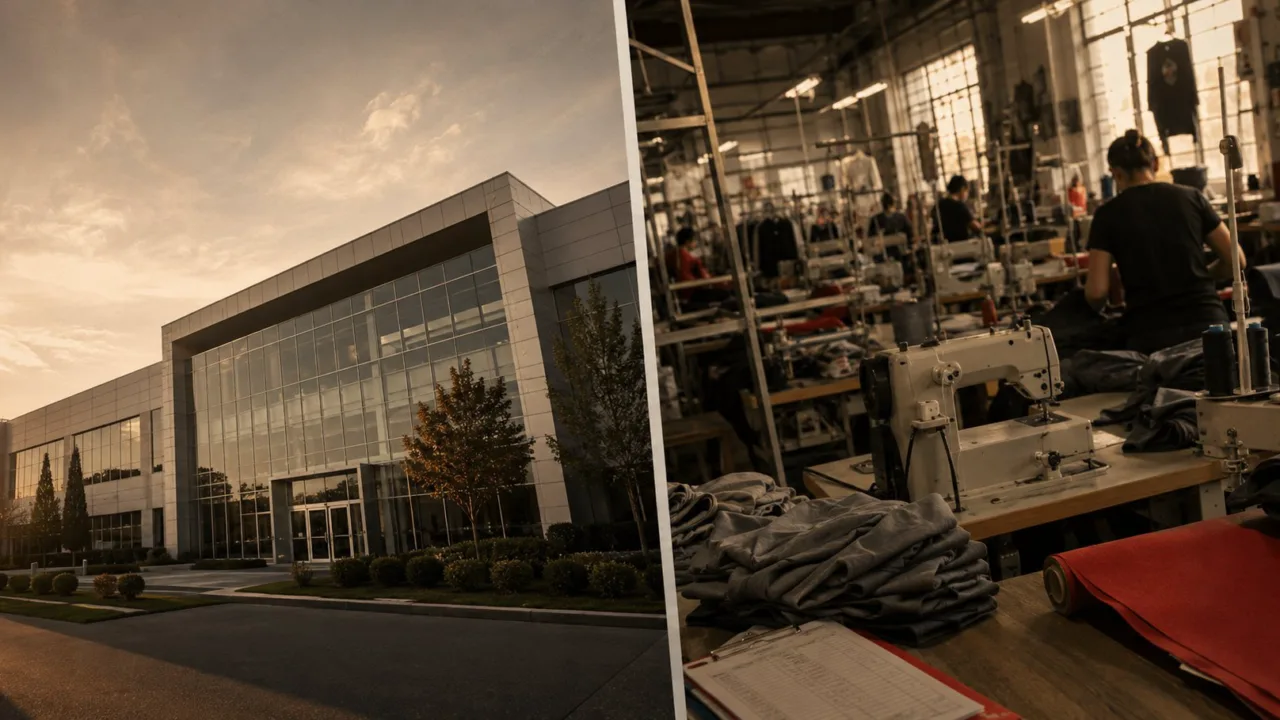
This isn't a secret in the industry. It's how the system works. Big factories — the ones with 500+ workers, multiple buildings, and Alibaba Gold Supplier badges — built their capacity around their largest, most stable clients. When a smaller order comes in (under 5,000 pcs, say), they have two options: turn it down, or take it and quietly route it to a smaller workshop they trust. Most take it.
You sign the contract with the big factory. You see the big factory's certificates, the big factory's photos, the big factory's QC reports. But the sewing happens 30 kilometers away, in a workshop you've never heard of, by workers who don't know your brand name.
This isn't fraud. It's outsourcing — the same model used in apparel, electronics, and almost every other manufacturing industry. But for buyers placing 500 to 5,000 piece orders, it's worth understanding what this means for your money, your timeline, and your quality.
What actually happens after you place the order
When a 2,000-pc order lands at a 500-worker factory, here's the typical flow:
- Sales accepts the order. Margins are calculated assuming subcontracting.
- A trusted subcontractor is matched. Usually a 30-80 worker workshop within an hour's drive. The big factory has 5-10 of these in their network.
- Materials are sent to the subcontractor. Or sometimes the subcontractor sources their own.
- Sewing happens at the subcontractor. The big factory's QC may or may not visit during production.
- Goods come back for final inspection and packing. Sometimes. Often the subcontractor packs and ships directly while the big factory handles paperwork.
- You receive the goods. Quality is the subcontractor's quality, not the big factory's quality.
The big factory takes 15-25% margin for handling sales, paperwork, and final QC. The subcontractor does the actual work for the remaining 75-85%.
What this costs you
1. You pay big-factory prices for small-factory work
The big factory's overhead — corporate office, sales team, certifications, showrooms — is baked into your quote. The subcontractor's quote to the big factory is 15-25% lower than what you pay. You're paying for the brand of the big factory while getting the production of the small factory. For growing brands with tight margins, that's real money — typically $1.50-3 per piece on a $12-15 FOB activewear unit.
2. Quality control becomes opaque
When sewing happens at a workshop you don't know, you can't visit during production. You can't review fabric cutting. You can't catch a bad batch at sewing stage. The big factory's QC team visits at the end — by which point fixing problems costs 5-10x more than catching them mid-production. A direct relationship with the actual producer means you see problems early. See also: sample vs bulk drift — subcontracted orders show 2-3x more drift than in-house production because two different operator pools are involved.
3. Timelines stretch unpredictably
Big factories prioritize their largest clients in their internal capacity planning. When a Nike or Lululemon order comes in late, your subcontracted order gets bumped down the priority list — even though you were promised a specific delivery date. The subcontractor doesn't bump your order; the big factory does, by shifting their attention elsewhere. You hear about delays late, and through middlemen.
4. The "certifications" might not apply to your goods
OEKO-TEX, BSCI, GRS — these certifications are factory-specific. They cover the audited factory's facilities, workers, and waste handling. When your goods are sewn at an un-audited subcontractor, those certifications don't legally apply to your production. This isn't usually flagged to buyers, but it's a real compliance risk for brands selling into EU and Scandinavian markets — and it's the issue most likely to surface if you ever get audited by a retailer or platform like Zalando, ASOS, or Amazon EU.
Factory tier comparison: which size matches which order
Factory size is the single biggest predictor of subcontracting risk. Use this matrix to read whether the factory you're talking to is built for your order:
| Factory size | Order sweet spot | Will subcontract orders under | Best fit for |
|---|---|---|---|
| Micro (5-30 workers) | 50-300 pcs | Rarely subcontracts (too small to) | Sampling, very small launches, prototyping |
| Small (30-80 workers) | 100-800 pcs | Almost never subcontracts | Emerging brands, low-MOQ collections |
| Mid (80-200 workers) | 300-3,000 pcs | Rarely (uses own multiple lines) | Growing DTC brands, mid-tier retail |
| Large (200-500 workers) | 1,500-10,000 pcs | Often subcontracts orders under 1,500 pcs | Established retail labels, multi-store chains |
| Enterprise (500+ workers) | 5,000-100,000+ pcs | Almost always subcontracts orders under 5,000 pcs | Major sportswear brands, mass retailers |
The mismatch buyers usually fall into: a growing brand placing 500-pc orders at an enterprise factory because the certifications and the showroom looked impressive. The enterprise factory accepts the order, subcontracts it, and the brand never realizes their certified-factory premium bought them small-workshop production with extra middleman fees.
Why mid-sized factories are often a better match for growing brands
A mid-sized factory — say 80 to 200 workers — operates differently:
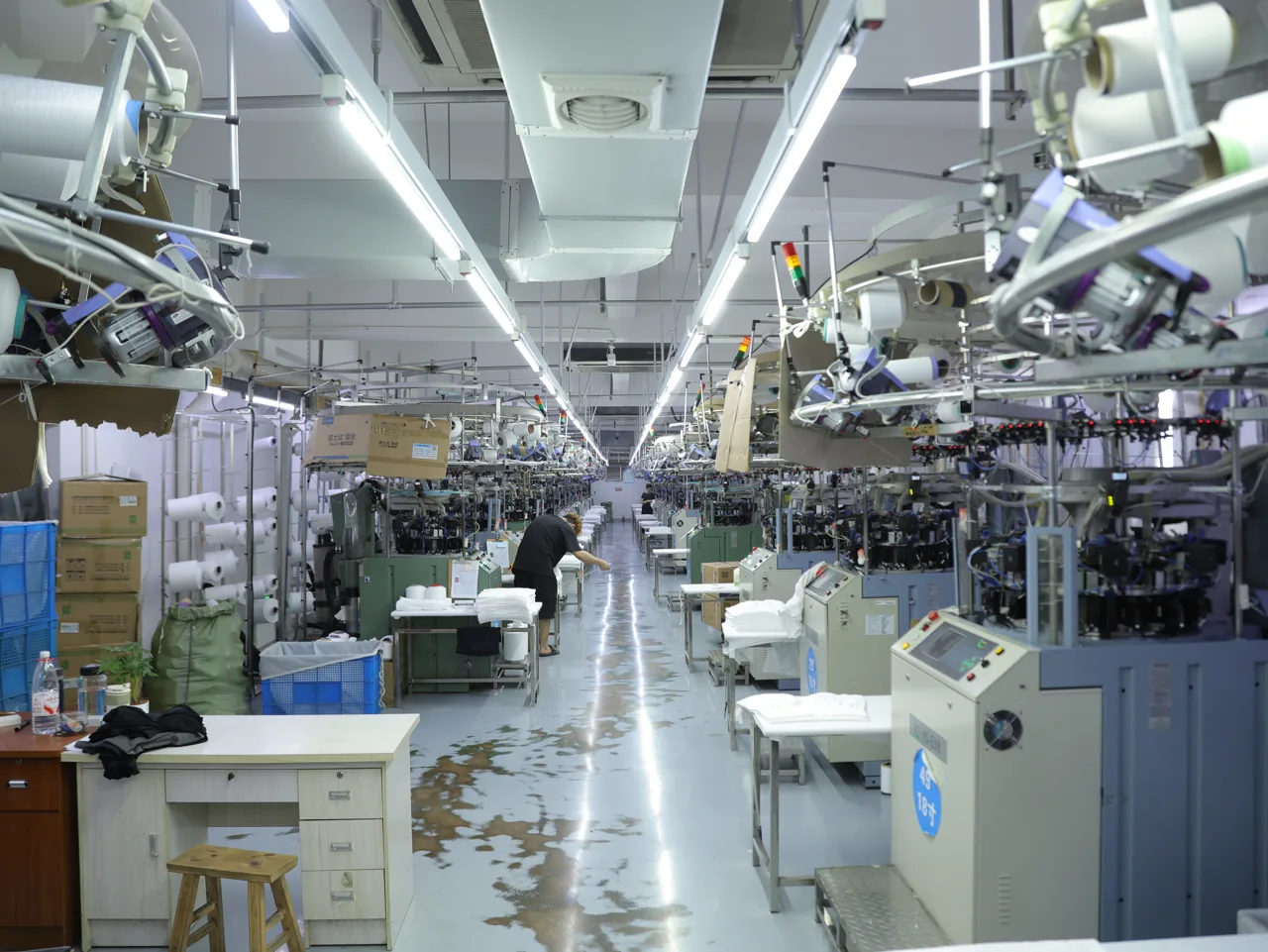
- They do the work themselves. Your order is sewn under their roof, by their workers, on their machines.
- You can visit and see your production. Many buyers don't, but they could.
- Their margins are leaner. No 15-25% subcontracting overhead means your money goes further.
- You matter to them. A 1,000-pc order is meaningful to a mid-sized factory, not a rounding error.
- Quality control is direct. The same people who sample your samples are the people who run your bulk.
- Their certifications apply to your goods. Because they sew them.
How to verify the factory actually sews your work (3 specific tests)
If you're sourcing without visiting in person, three tests will tell you most of what you need to know:
Test 1: Request a 60-second walkthrough video. Ask the sales rep to walk through the sewing floor with their phone, narrating which lines are running which products. Specifically request to see the line running your style during production. A factory doing your work themselves can produce this within 24-48 hours. A factory subcontracting will either delay, refuse, or send a video of an unrelated production line.
Test 2: Match the QC report photos to the building. When you receive QC photos, look at the floor pattern, the wall color, the light fixtures, the worker uniforms. Compare to the factory's own marketing photos and the video. If the QC photos show a different environment than the marketing photos, the work is happening somewhere else. This is the easiest visual catch.
Test 3: Ask for a specific line lead's name. "Which line lead is supervising my style?" A factory sewing in-house knows immediately and gives you a name. A factory subcontracting will dodge with "our production team handles this internally" or take days to respond. The specificity of the answer correlates almost perfectly with whether the work is in-house.
What facility tour photos do and don't tell you
Most Chinese factory websites and Alibaba listings have a "factory tour" section with 8-15 photos. Buyers often treat these as proof of capability. They're usually not.
- What facility photos do tell you: The factory has a physical address, some sewing equipment, and a marketing budget. They've thought enough about presentation to invest in photography. This is a baseline filter, not a verification.
- What facility photos don't tell you: Whether your specific order will be sewn in those rooms by those workers on those machines. Many big factories use real photos of their facility — and then subcontract anyway. The photos aren't lying; they're just not the full story.
- What to ask for instead: A short video taken in the past week, showing the actual line that will run your style. Plus a worker photo from the line lead supervising your style. Specificity to your order is the test, not generic showroom imagery.
This connects to a broader pattern in factory sourcing — what the factory shows you in marketing is calibrated to win you, not necessarily to inform you. (For a parallel pattern in pricing, see MOQ theater.)
What to ask before signing with a "big factory"
If you're considering a large supplier, three questions tell you most of what you need to know:
- "Will my order be sewn at this facility, or subcontracted?" A direct answer here — even an honest "subcontracted" — is more valuable than a vague "we have many production lines." Press for specifics.
- "Can I visit during production?" If the answer is "you can visit our main facility but production happens elsewhere," that's your signal. A factory doing your work themselves welcomes mid-production visits.
- "Which workshop will produce my goods, and what certifications do they hold?" If the answer is "we handle that internally," they're subcontracting. Real factories naming their own workshop should be able to answer this in one sentence.
The honest version of factory selection
Big factories aren't bad. They're the right choice for big orders — 10,000+ pcs per style, established brand relationships, predictable forecasts. The system works for them.
But if you're a growing brand placing 100 to 5,000 pc orders, a mid-sized factory that sews your work themselves often delivers better quality, better margin, and a more direct line to the people actually making your product. You won't see them in Alibaba's "Top Suppliers" rankings because those rankings reward size, not match.
The best factory for your brand isn't the biggest one. It's the one whose capacity actually fits your order.
Frequently asked questions
How do I know if a factory subcontracts before I place an order?
Three signals together usually confirm it: (1) factory size 300+ workers, (2) advertised MOQ much lower than realistic for that scale (e.g., MOQ 100 at a 500-worker factory), (3) reluctance to do a live video walkthrough of your style's sewing line. Any one of these is a yellow flag. All three is near-certainty. Ask the three questions above and watch how quickly and specifically the answers come back.
Is subcontracting illegal or just hidden?
It's legal in China and in most importing countries — it's standard manufacturing practice across industries. What's not legal is claiming certifications (OEKO-TEX, GRS, BSCI) on goods that were produced outside the audited facility. Most factories navigate this by not actively claiming certifications on subcontracted orders — they show you the certificate but don't put it on the packing list or commercial invoice. This is technically compliant but leaves brands exposed if they market the certification in their own retail channel.
What if I want a big factory's certifications but a mid-sized factory's direct production?
A few options: (1) work with a mid-sized factory that already holds the certifications you need — these exist, just less visibly, (2) ask the mid-sized factory to undergo audit specifically for your account (BSCI audit costs $2,000-4,000, OEKO-TEX is a fabric certification not a factory one), or (3) accept that you trade the certification claim for direct production control on your first few orders, and add certification later as volume justifies.
Will mid-sized factories scale with me as my brand grows?
Up to a point. A 150-worker factory can typically handle a single brand growing from 500 pcs/month to 5,000 pcs/month over 2-3 years. Beyond 10,000 pcs/month from one brand, you'll either need to add a second factory or graduate to a larger one. Most mid-sized factories are happy to help with this transition — they've seen brands grow through their capacity ceiling before.
Can I require "no subcontracting" in my purchase order?
Yes, and you should. A clause like "All cutting, sewing, and finishing must occur at the supplier's primary registered facility. Subcontracting requires written buyer approval before production begins" is standard in retail and wholesale POs. Smaller and mid-sized factories will sign it without negotiation. Large factories will either negotiate it out or ignore it post-signing, which itself is informative.
This article was written by the manufacturing team at YOUMEGA, a mid-sized activewear OEM/ODM factory in Xiamen, China. We sew every order in-house — no subcontracting — and we're happy to send a walkthrough video of the line that would run your style. Get in touch if you want to see what direct production looks like.