Activewear Waistband Construction — Why Waistbands Roll or Dig, and How to Spec One That Stays Put
Your first legging sample arrives and it looks beautiful on the hanger. Then the fit model drops into a deep squat — and the top of the band folds over on itself. Three washes later the same edge has curled and started to dig a red line above the hip. The fabric tested fine. The color matched. The part that failed is the one nobody wrote a real spec for: the waistband.
It’s the hardest-working eight centimetres of a legging, and the part most often blamed on “cheap fabric” when the real story is construction. Here’s how it’s built, why it misbehaves, and how to spec one that stays where you put it.
Roll or dig: two different failures, two different fixes
Roll-down and dig-in arrive as the same complaint — “the waistband is uncomfortable” — but they’re opposite problems.
Roll-down is the band folding over at the top edge during movement. It usually means nothing is anchoring it: too little height for the body to bend around, fabric with weak recovery (it stretches but doesn’t spring back), or no elastic holding the top edge. Squat, and the top rolls because nothing is telling it not to.
Dig-in is the band cutting a line into the waist. That’s pressure concentrated over too small an area — a narrow, hard elastic, or a band pulled too tight with too little stretch. The band isn’t “too strong”; it’s too narrow for the force it carries.
Notice the fix points the same way for both: a taller band spreads pressure over more skin and gives the fabric more to grip, so it neither rolls nor digs. Most waistband problems are solved before you ever touch the elastic — just by getting height and recovery right.
Four ways to build a waistband
There’s no single “correct” waistband. There are builds, each with a look, a feel, and a cost.
| Build | Look | Feel | Tummy control | Cost |
|---|---|---|---|---|
| Single-fold casing | clean, minimal | light | low | lowest |
| Doubled self-fabric (high-waist) | smooth, no visible elastic | supportive, “buttery” | medium–high | mid |
| Exposed jacquard elastic | branded, athletic | firm | medium | mid |
| Bonded | seamless, no stitch line | smooth, no ridge | medium | highest |
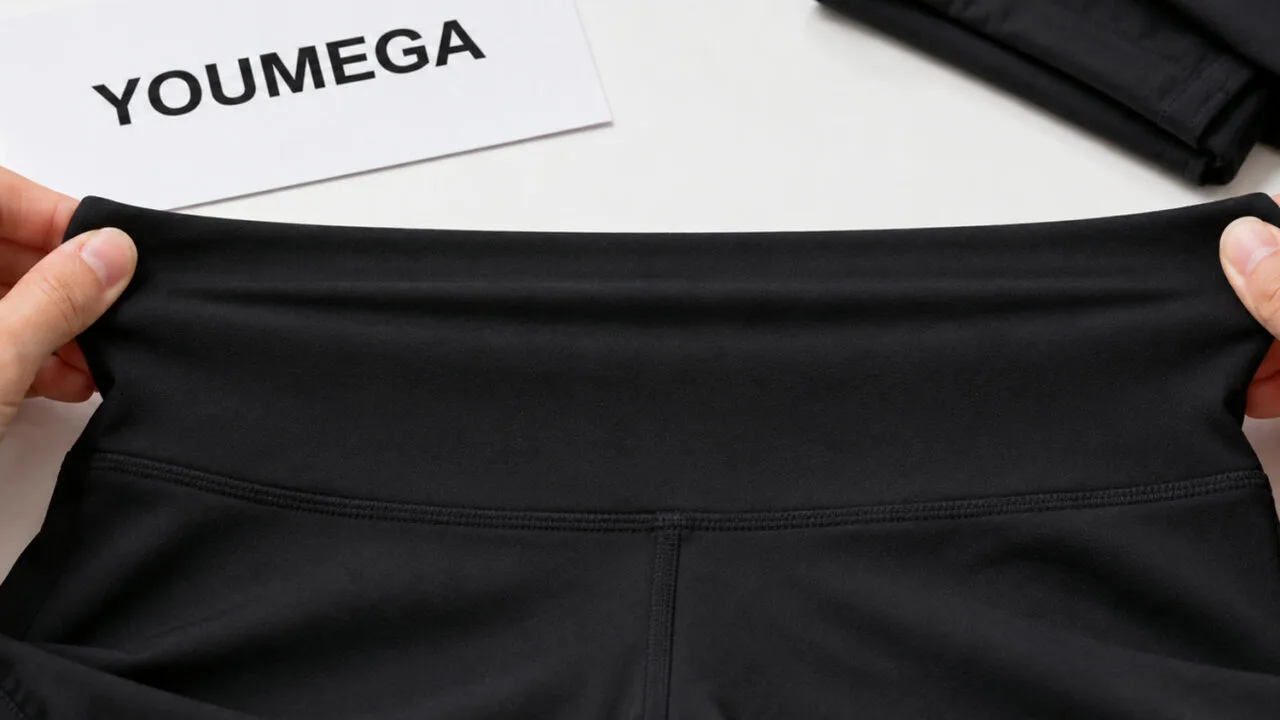
A single-fold casing folds the main fabric over and topstitches it, sometimes over a thin elastic — the simplest, cheapest build, fine for low-impact styles. A doubled self-fabric band folds a second layer of the body (or a firmer power fabric) back on itself; this is the classic high-waist, tummy-smoothing band, and most of its support comes from that second layer, not from magic. Exposed jacquard elastic puts a woven, logo’d band on the outside — structure and branding in one part. Bonded joins layers with a heat-activated film instead of stitching, for a clean, ridge-free edge.
Bonding is having a moment because it looks seamless and leaves no stitch ridge to dig. But it isn’t automatically better. A bonded edge depends on the adhesive film, a compatible fabric, and the wearer following the wash care — get any of those wrong and it can delaminate. A well-made coverstitched band is forgiving, repairable, and outlasts a badly bonded one. Honest read: bond where an invisible edge is the whole point — a minimalist band under thin fabric — and stitch everything else. Speccing bonded construction across a workhorse training legging usually just adds cost the wearer won’t notice.
The elastic buyers forget
Two bands can look identical and feel completely different because of a trim most tech packs describe in one vague word: “elastic.”
When specifying hidden components in the band, use the trim sheet: elastics, drawcords and hardware.
- Brushed / plush-back elastic turns a soft, fuzzy face toward the skin — the difference between “premium” and “scratchy” on a next-to-skin band.
- Jacquard elastic weaves a logo or pattern into the band itself, for the exposed branded look.
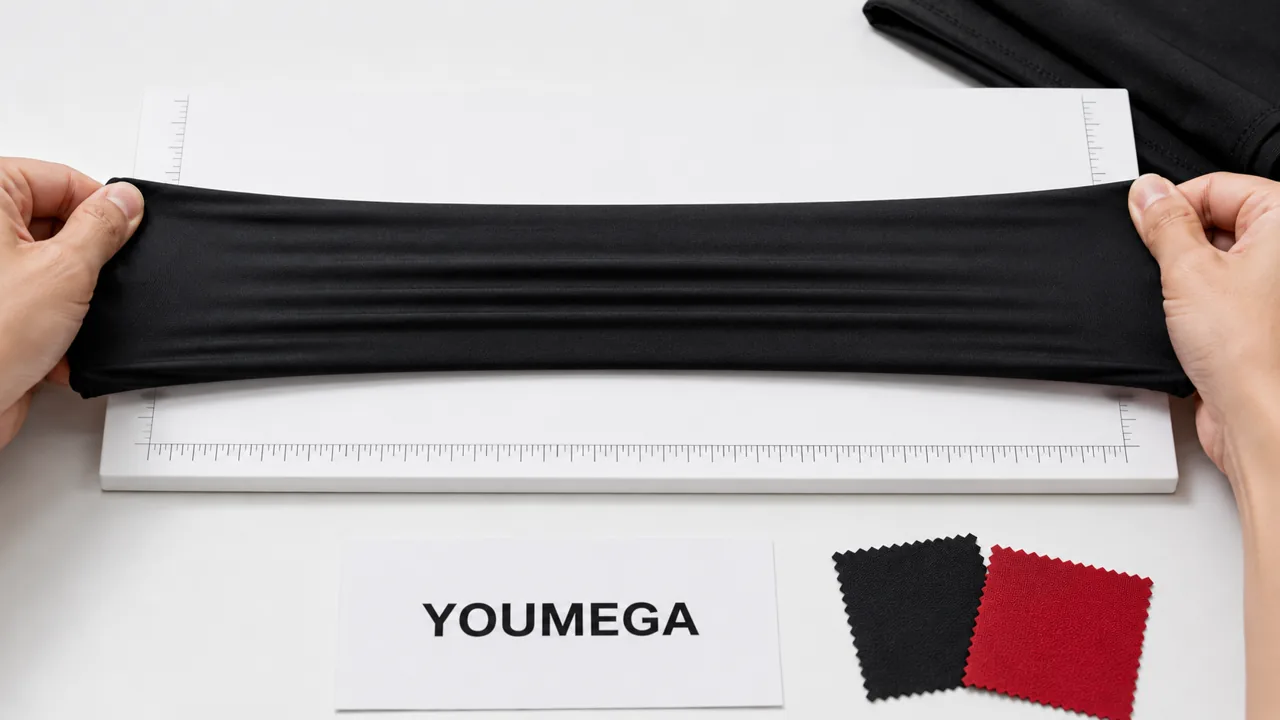
- Knitted vs woven vs braided is the quiet detail that decides roll and dig. Knitted elastic is soft and very stretchy; woven elastic is firmer and holds its shape, which makes it the go-to for a no-roll band. Braided elastic narrows when you stretch it — perfect for a cuff, wrong for a waistband, because that narrowing is exactly what digs a line into the waist.
If the elastic sits against skin, buyers increasingly ask for a trim with an OEKO-TEX® tested certificate. Worth knowing as a spec buyers request — not a box every band must tick.
High-waist, tummy control, and the “no-front-seam” band
Tummy control isn’t a gimmick panel; it’s band height plus fabric power. A tall band — often 12–18 cm (roughly 5–7″) — cut from a doubled or higher-spandex power fabric smooths and holds simply because there’s more compressive material over the area, and its fabric weight does more of the work than any hang-tag claim. A curved, contoured pattern, cut higher at the back than the front, is what stops a high band from folding when you sit. True graduated compression is its own discipline — see compression wear manufacturing — but everyday tummy-smoothing is mostly height plus the right power fabric. If a supplier offers a separate “tummy-control panel” on top of an already-doubled band, ask what it actually adds; often it’s cost for a layer you already have.
One naming trap: a “no-front-seam” waistband means the band is built continuous across the front, with its join moved to the back or sides, so there’s no vertical seam or bulk at the navel. That’s a band-construction choice. It’s a different question from front-seam visibility below the band — the camel-toe and gusset issue, which has its own build logic in the front-seam and gusset guide.
Worth noting: on seamless knitting machines the waistband tension is knitted straight into the garment tube — no separate elastic to roll or dig at all. Large-cylinder machines (17–21″) carry that clean knitted band up into plus sizes, where a stitched band is usually forced to add a seam.
Drawcords and waistband pockets — the small parts that get returned
- Drawcord. Decide flat or round (flat lies smoother under a fitted top), functional or cosmetic, internal or external. The detail that causes returns is a centre bartack — without one the cord slides sideways and disappears into the casing on the first wash. If it’s purely cosmetic, say so and tack it down, so nobody yanks a cord that was never meant to pull.
- Waistband pocket. A small stash set into the band is genuinely useful — for a card, a key, an energy gel. It is not a phone pocket. A phone in the waistband bounces and drags the whole band down, which is exactly what a side-leg pocket is for. Spec it flat and bagged inside the doubled layer so it doesn’t add a ridge that digs.
How to spec a waistband the way a factory reads it
A vague tech pack costs you the most right here. Spell it out:
- Band height, finished — and separately front and back if it’s contoured (e.g., 12 cm front / 14 cm back).
- Build: single-fold casing / doubled self-fabric / exposed jacquard / bonded.
- Band fabric and weight if it differs from the body — give the GSM, don’t write “thicker.”
- Elastic: knitted / woven / braided, width, brushed or plush face, and whether it sits inside a casing or none at all.
- Join to body: coverstitch or bonded.
- Drawcord: flat/round, length, tip, exit method, centre bartack yes/no.
- Pocket: location, finished size, what it’s meant to hold.
- Wear test, not hanger test: approve the band after a squat and a wash, never on the table.
FAQ
Why does my leggings waistband roll down? Almost always too little band height, weak fabric recovery, or no anchoring elastic at the top edge — not “cheap fabric.” A taller band in a better-recovery fabric, or a no-roll woven elastic, usually fixes it.
Is a bonded waistband better than a stitched one? Only where an invisible, ridge-free edge is the point. Bonding needs a compatible fabric and correct wash care or it can delaminate; a well-stitched band is more forgiving and often lasts longer.
How tall should a high-waist band be? It depends on the wearer and the category, but high-waist bands often land around 12–18 cm (5–7″). Height plus a doubled or higher-power fabric — and a contoured pattern — does the tummy-control work.
Can I put a phone pocket in the waistband? For a card, key or gel, yes. For a phone, no — the weight drags the band down and makes it roll. Put a phone pocket in the side leg instead.
Send us your waistband target — the height, the look, whether it’s a squat-proof high-waist or a soft everyday band — and we’ll tell you honestly how we’d build it, which elastic we’d pick, and where bonding isn’t worth the cost. We reply within 24 hours.