Scrunch Butt-Lift Leggings — How the Back-Seam Ruching Is Engineered, and How to Spec One That Doesn’t Look Cheap
A founder sends us a screenshot from a TikTok try-on: a legging with a gathered, heart-shaped ruche running up the center back, and the message “make me this.” In the reference it looks effortless — the fabric bunches softly over the glute and reads as a lift. Then the first sample comes back, and three things are wrong at once: the scrunch is flatter than the video, one side gathers more than the other, and in a deep squat the center seam goes faintly see-through — right where the eye is already pointed. None of that is bad luck. A scrunch is one of the most spec-sensitive things you can put on a legging, and the viral clip told you almost nothing about how it’s built.
Here’s how a factory actually engineers the ruche — and the four places it goes cheap.
How the scrunch is actually built
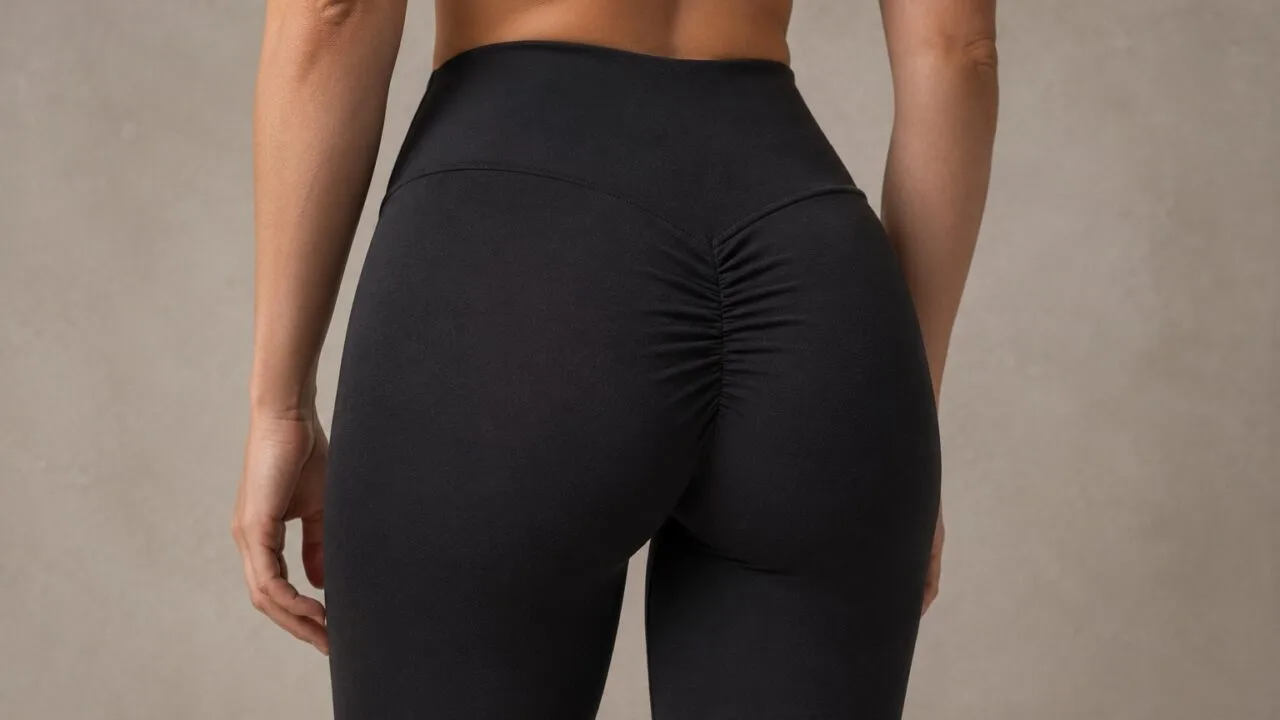
Strip away the marketing names — “booty scrunch,” “peach lift,” “ruched back” — and the effect is one thing: extra fabric gathered into a defined zone along the center back seam, so the surplus puckers into soft folds over the glute. Two honest ways to do it, and they don’t age the same.
- Seam-eased gathering (the real one). The two center-back panels are cut with a longer edge through the scrunch zone than the seam they join. As the operator sews them, that surplus eases in and the longer edge folds into ruches. The amount is a gather ratio — fabric length to finished seam length, often around 1.3:1 to 1.6:1. Built into the pattern, it holds its shape wash after wash.
- Elastic shirring (the shortcut). Elastic or elastic thread is applied under stretch along the seam; as it relaxes, it draws the fabric into gathers. Faster and cheaper — and where most “cheap-looking” scrunch comes from. It reads as tight puckers rather than soft volume, and the elastic loses tension over time, so a scrunch that looked full in the studio goes limp after a season of washes.
Two structural notes. First, a seam-gathered scrunch is inherently a cut-and-sew feature — it lives on a center back seam. A seamless knit legging has none, so a seamless “scrunch” has to be knitted in as a floated-elastane or tightened-course zone that looks and behaves differently — its own decision if you’re weighing the two. Second, placement matters as much as amount: the gather should sit through the lower-to-mid glute — roughly a 15–25 cm zone — and taper out at both ends. Climb into the waistband or drop into the thigh and it reads as a mistake, not a lift.
| Seam-eased gather | Elastic shirring | |
|---|---|---|
| How | surplus fabric ratio in the pattern | elastic applied under stretch |
| Look | soft, sculpted volume | tighter puckers |
| After ~20 washes | holds its shape | tends to relax and flatten |
| Cost | a little more make time | cheapest |
| Ideal for | the look in the reference video | fast, low-price programs |
Shape first, scrunch second
Here’s the part the viral video hides: on a well-made scrunch legging, the ruche isn’t doing the lifting. The pattern is. A flattering back is shaped in the panel — a curved center-back seam, often a subtle under-glute seam, give the flat pieces built-in 3D volume, so the seat rounds and lifts before a single gather is added. The scrunch then sits on top of that shape as soft decoration.
Cheap scrunch skips the shaping and asks the gathers to do everything. The tell: pick the legging up off the hanger. Well-shaped scrunch looks quiet flat and only opens up on a body; gimmick scrunch looks identically bunched on hanger and model, because it’s just fabric rag-gathered onto a flat panel. If it looks the same off-body and on, it isn’t sculpting — it’s hiding a pattern never drafted for a curve.
The opacity trap right where everyone looks
The honest one: gathering fabric does not add opacity where a scrunch legging needs it most. The center back seam sits in the exact spot that stretches thinnest in a deep squat, and the scrunch pulls the eye straight to it — you’ve decorated your single most-photographed see-through risk. The folds look like coverage, but at the seam line the fabric is under the most tension and can go sheer no matter how full the ruching above it.
So the order isn’t negotiable: fix opacity first, add scrunch second. That means an adequate base weight and a proper center-back gusset before you style anything on top — get the fabric weight right for a squat-proof base, and treat the seam and gusset as their own engineering problem, covered in the front-seam and gusset guide. A scrunch on marginal fabric doesn’t hide the see-through — it spotlights it.
Fabric: what scrunches well, what doesn’t
Not every legging fabric gathers cleanly. A scrunch wants two things that pull against each other — body to hold a defined fold, and recovery to spring it back after every wash:
- Weight. Too thin and the gathers look flimsy (and the seam turns sheer); too heavy and they bunch into lumps. A mid-weight around ~240–300 GSM tends to scrunch softly rather than stiffly. (Illustrative — your fabric decides.)
- Recovery. Moderate-to-high elastane, often ~18–28%, gives the folds the memory to stay defined instead of flattening out.
- Surface. A matte, slightly brushed, “buttery” hand hides the small puckers a gather always creates and reads as soft sculpting. A shiny fabric does the opposite — it highlights every irregularity, so a shiny scrunch has to be sewn far more precisely to look right.
Where not to spend: you don’t need a premium fabric to scrunch well, but you do need the right one — a cheap, shiny, low-recovery knit makes even a well-drafted scrunch look cheap.
Spec it like a factory
A scrunch is custom development, so it sits in the full-custom minimum — often ~300–500 pieces — rather than the ~100-set stock-plus-your-logo tier. And it fails at scale for one reason above all: gathering is partly hand-controlled, so two pieces off the same line can carry different scrunch unless you pin it down. Put these on the tech pack:
- Gather zone — start and end points as measurements from a fixed reference (“gather from 8 cm to 24 cm above the crotch point along the center back seam”), not “on the seat.”
- Gather ratio — the surplus you want (e.g., 1.4:1), so the volume is repeatable, not eyeballed.
- Method — seam-eased or elastic shirring, and if elastic, the type and stretch ratio.
- Notch points on the pattern marking where the gather starts and stops, so every operator gathers the same zone.
- Symmetry tolerance — left vs right balance, checked on the finished garment, not the flat pattern.
- Opacity target — a squat test on the seam, signed off before scrunch is added.
Read a sample the same way: put it on a body, squat, and check the seam for sheerness; look at left/right balance; wash it several times to see whether the scrunch survives.
FAQ
Does a scrunch actually lift, or is it just visual? It’s a visual effect — ruching plus good panel shaping draws the eye and reads as a rounder, lifted seat. It isn’t compression shapewear. On a well-shaped pattern the effect is real; on a flat pattern it’s just bunched fabric.
Why does my scrunch look see-through when the rest of the legging doesn’t? Because the scrunch sits on the center back seam — the thinnest-stretched point in a squat and the spot everyone photographs. Gathering doesn’t add opacity there. Fix the base fabric weight and the gusset first; the scrunch only draws attention to a seam that has to be squat-proof on its own.
Can you put a scrunch on a seamless legging? Not the seam-gathered kind — seamless has no center back seam to gather. A seamless machine can knit a scrunch-like zone with floated elastane or tighter courses, but it behaves differently from a sewn ruche. Decide the construction and the scrunch together, not after.
Why did my bulk order come back with uneven scrunch? Because the gather wasn’t pinned to a ratio and notch points, so operators eased it by feel. Spec the zone, the ratio, and the notches, and require a symmetry check — that’s what keeps piece 1 and piece 500 matching.
Send us the reference video or photo, the fabric you’re considering, and how squat-proof the seam has to be, and we’ll tell you honestly whether the look needs seam-eased gathering or simple shirring, whether your fabric will hold the scrunch after washing, and what it does to opacity at the back seam. We reply within 24 hours.