Tennis Apparel Color Rules: What Clubs and Tournaments Actually Require
“Is white still required?” is one of the most common questions in tennis apparel — and the honest answer is: it depends entirely on where you are playing. One tournament enforces near-total white down to the sole of the shoe. A public court a mile away has no rule at all. And a private club may sit somewhere in between with a code that is written politely but enforced strictly.
For brands making tennis apparel, this matters more than it looks. A colour rule is not a styling preference — it is a manufacturing constraint that decides fabric weight, lining, and how much you can trust a white you have not tested.
The three tiers of colour rules
Tennis colour rules fall into three broad tiers. Knowing which tier you are designing for is the first decision.
| Tier | Typical requirement | What it means for a garment |
|---|---|---|
| Strictest | Almost entirely white, including trims, logos and undergarments; only a narrow band of colour permitted on edges | Everything visible must be white — which puts the entire burden on fabric opacity |
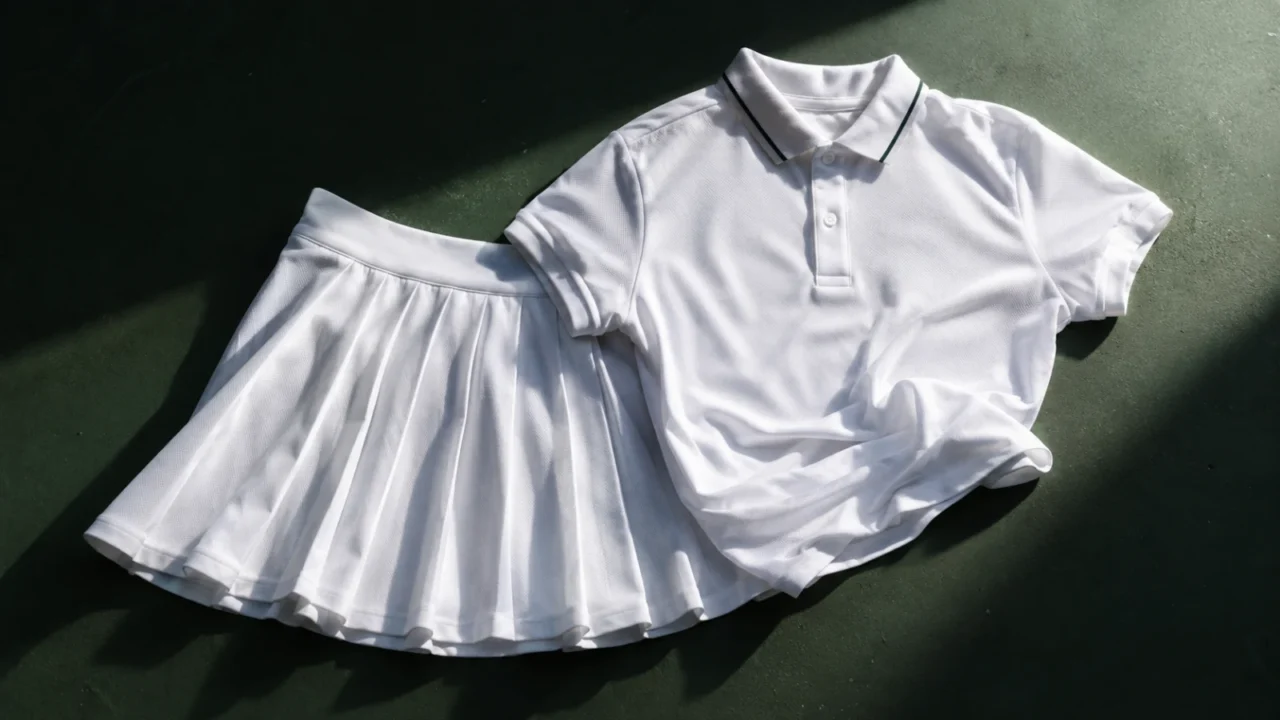
| Club / “predominantly white” | White must dominate; small colour accents, logos and patterns allowed within limits | Colour blocking is possible but must stay minority; trims become the design outlet |
| Open | No colour restriction | Free design, but performance and coordination still apply |
The strictest tier is defined by tournament rules — Wimbledon’s dress regulations are the reference point most people are thinking of when they ask this question. Club codes are usually softer and locally written; “predominantly white” is the phrase that appears most often, and its interpretation varies by club.
Primary sources
- The Championships, Wimbledon — official competitor dress and equipment regulations — https://www.wimbledon.com/
- ITF (International Tennis Federation) — Rules of Tennis and appendices covering clothing and equipment — https://www.itftennis.com/
- USTA — Friend at Court / officiating handbook covering apparel provisions — https://www.usta.com/
Rules change. Any brand selling into the club market should read the current text for the specific venue rather than rely on a summary — including this one.
Why “white” is a manufacturing problem, not a colour choice
Here is what the rules do not say, and what catches brands out: white is the hardest colour to make well in activewear.
Three reasons, all of them technical:
Opacity. A white knit shows what is behind it. The same fabric that looks fine in navy at 220 g/m² can read semi-sheer in white. For white tennis skirts and shorts, opacity is the requirement that drives everything else — which usually means going heavier in the 220–320 g/m² range we run, adding a lining, or both. Opacity has to be tested on the actual white, not assumed from the coloured version.
Sweat. White fabric shows moisture as a visible dark patch far more than any other colour. Moisture management is not just about comfort here — it is about how the garment looks at 40 minutes into a match. Fabric structure and finish decide this, and the difference shows up in wear testing, not in a swatch.
Whiteness itself. “White” is not one colour. Optical brighteners, base yarn, and finishing all shift it. Two white panels from different mills — or the same mill on different lots — can read as different whites when sewn into one garment. Matching white across a top, a skirt and a lining is a colour-matching exercise, and it is one we lock with Pantone matching on the actual materials before bulk.
What this means when you brief a factory
If your line is going into the club or tournament market, the brief needs to state:
- Which tier you are designing for (and, if a specific venue, which one)
- Opacity requirement — stated as a pass/fail you will test, not “should be opaque”
- Whether trims, logos and elastic must also be white — this changes trim sourcing entirely
- Whether lining is acceptable in your target price and weight
That last one decides a lot. Lining solves opacity reliably but adds weight, cost and heat. A heavier single-layer fabric solves it differently. Which is right depends on your climate and price point, and it is worth deciding deliberately rather than discovering after the first sample.
For colour accents in the “predominantly white” tier, the practical constraint is dye lots: each additional colour is its own minimum. Custom colour development runs 300–500 pcs per style per colour, so a three-accent design is three separate colour commitments — which is why accent colours usually live in trims rather than panels for small runs.
Questions worth asking before you commit
- What is the exact current wording of the code for the venues my customers play at?
- Has this white been opacity-tested in this weight, or are we assuming?
- Do the trims, elastic and logo also have to be white?
- Are all white components matched to the same white, across mills and lots?
FAQ
Do tennis players still have to wear all white? Only where the rules require it. The strictest tournament regulations still demand near-total white; many private clubs require “predominantly white”; public courts usually have no rule. Check the specific venue — the requirement varies widely and the rules are updated periodically.
What does “predominantly white” actually mean? It is a club-level phrase meaning white must dominate the garment, with limited colour permitted — often on trims, edges or logos within a stated width. Because clubs write their own codes, the permitted amount varies. Read the venue’s current text.
Why is white activewear harder to manufacture? Opacity, sweat visibility and whiteness consistency. White shows through more than any other colour at the same weight, shows moisture more visibly, and varies between mills and lots. All three are solvable, but they have to be specified and tested rather than assumed.
Can I add colour accents and still meet a club code? Usually yes, within limits, in the “predominantly white” tier. Practically, accents tend to sit in trims rather than panels for small runs, because each additional colour carries its own dye-lot minimum — custom colour is 300–500 pcs per style per colour.
How do you make sure all the white pieces match? By matching to an approved standard on the actual materials before bulk, across every component and mill involved, and sealing that standard for production checks. White drift between lots is a real failure mode, not a theoretical one.
Building a tennis line for the club market? Send us the code you need to meet and your target weight — we’ll spec the opacity, match the whites across components, and put a tested sample in your hands before bulk. Reply within 24 hours on weekdays.