Updated November 2026. Written from YOUMEGA’s production floor.
The types of sports bras in short
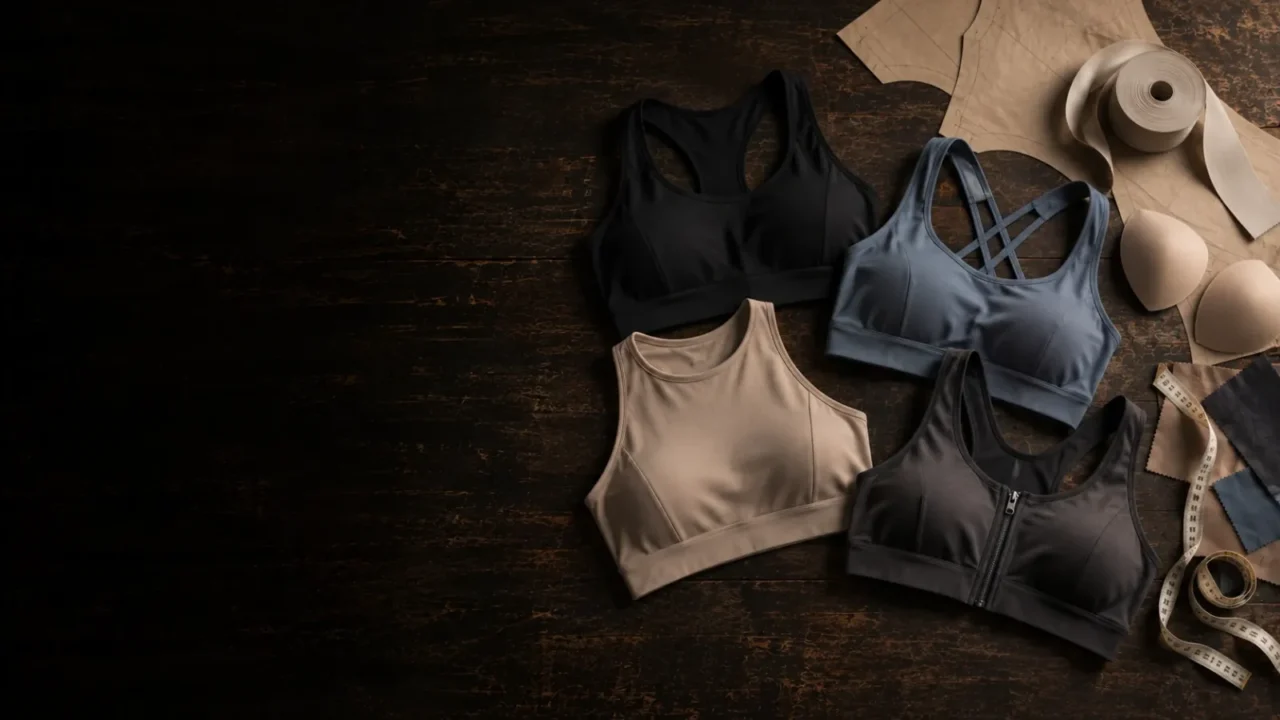
There are 14 common types of sports bras, and they sort into three groups: support level (low, medium, high impact), construction (compression, encapsulation, combination) and style (back, straps, neckline, length and closure). Support and construction decide how the bra controls movement. Style decides how it looks and how it goes on. A product brief needs one choice from each group, because a racerback can be a light yoga bra or a high-impact running bra depending on what is inside it.
| Type | What it is | Best for | What to specify to a factory |
|---|---|---|---|
| Low support | Single or double layer, light band, no cups or removable pads | Yoga, walking, lounge | Fabric weight, lining layers, pad pocket or none |
| Medium support | Double layer with a firmer band and pads | Cycling, hiking, gym training | Band elastic width and stretch, pad thickness |
| High support | Compression plus shaping, firm band, often adjustable | Running, HIIT, jumping sports | Power mesh panel, closure, strap adjustment, size range |
| Compression | Holds the chest flat against the body | Smaller cup sizes, high intensity | Fabric stretch and recovery, lining, band tension |
| Encapsulation | Shapes and supports each breast separately | Larger cup sizes, everyday comfort | Cup type and size per grade, divider seam |
| Combination | Separate cups inside a compression shell | High impact across a wide size range | Cup construction, mesh, layer order |
| Racerback | Straps meet between the shoulder blades | Running, gym | Back panel shape, strap width, binding |
| Cross-back and strappy | Two or more straps crossing at the back | Studio, fashion styles | Strap count and width, anchor points, bar tacks |
| Adjustable clip-back | Sliders and a hook closure | Fit across sizes, high impact | Hook rows, slider material, elastic |
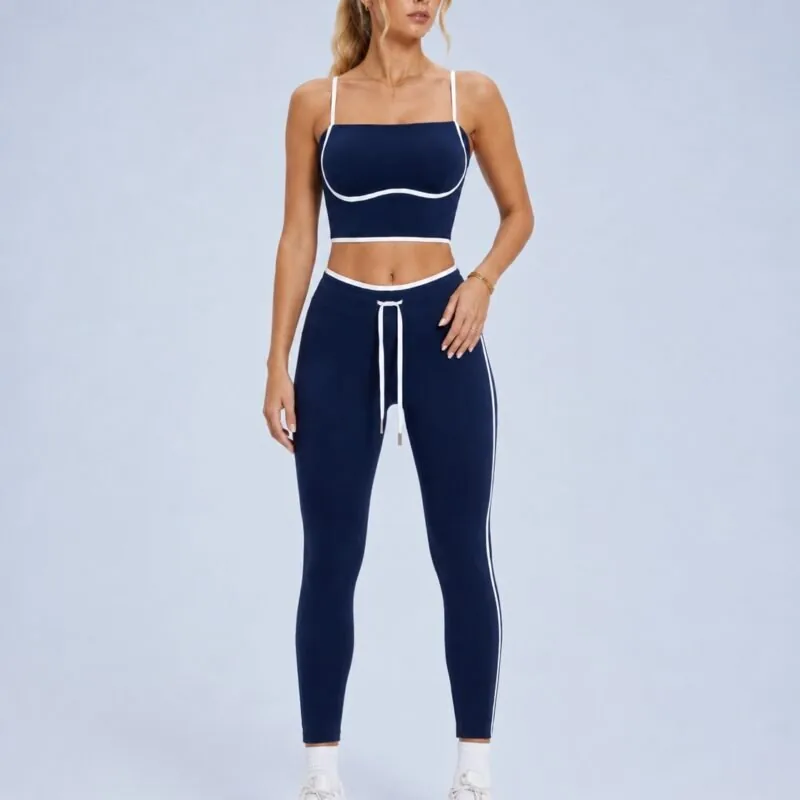
| Longline | Extended band down the ribcage | Studio sets, outerwear tops | Band depth, gripper or elastic at the hem |
| High-neck | Front panel rises to the collarbone | Coverage, modest lines | Neck binding, front lining, opening size |
| Front-zip | Zip or hook closure at the centre front | Easy on and off, larger busts | Zip type, zip guard, reinforcement |
| Bralette | Light, unstructured, often single layer | Low impact, layering | Fabric, edge finish, optional pads |
| Seamless knit | Knitted in a tube on a circular machine | Smooth fit, low to medium impact | Yarn, knit zones, size range per machine |
Group 1: Support level
Support level is what shoppers filter by, so it goes on the hang tag. Wikipedia’s sports bra entry splits support into four levels: light control for yoga and walking, moderate for cycling and hiking, firm for tennis and jogging, and maximum for running, intense workouts, boxing and horse riding. Retail tags usually use three: low, medium and high. Pick one level per style and build to it. A “medium to high” tag leaves the customer guessing.
Low support
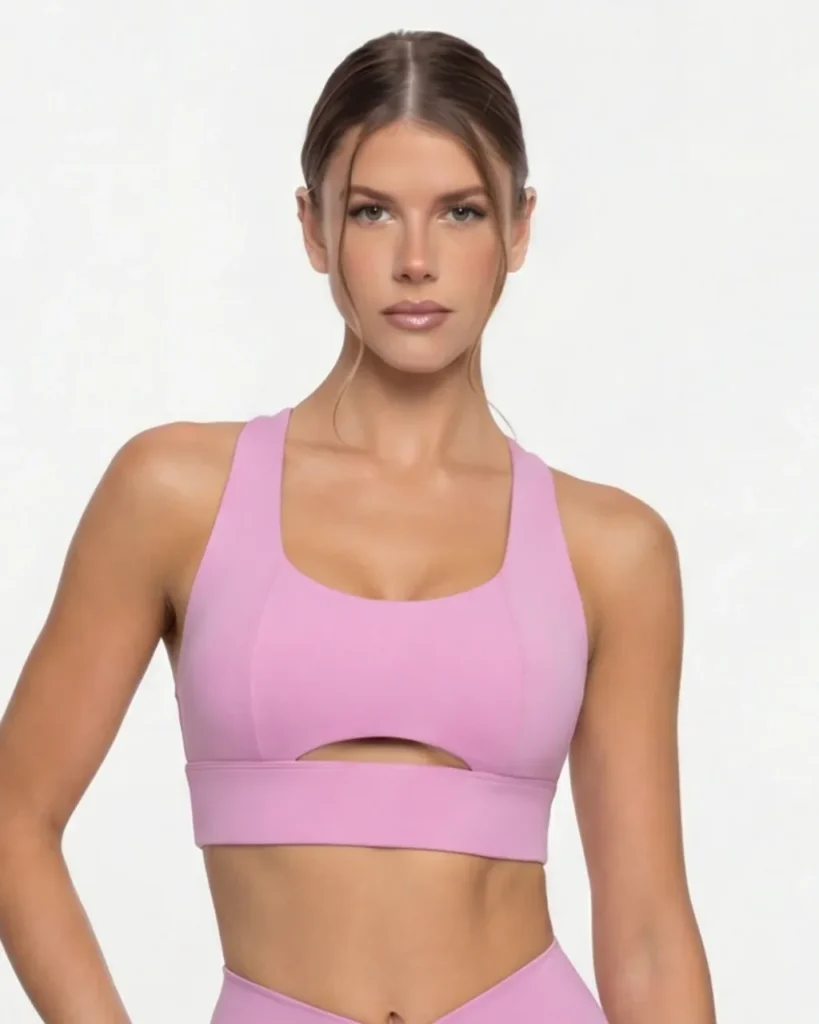
A low-support bra is usually two layers of nylon-spandex or polyester-spandex jersey with a soft elastic band, and either no pads or a pocket for removable pads. It suits yoga, pilates, walking and wearing under a loose tee. The trade-off is plain: it barely limits movement, so do not let marketing call it a running bra. Specify fabric weight, the number of layers and pad pocket or none. Decide before sampling whether pads ship inside the pocket.
Medium support
Medium support adds a firmer band and usually pads, and some styles add a power mesh layer behind the front panel. It fits cycling, hiking, strength sessions and most gym classes. The band does most of the work here. Write the band elastic width in millimetres and ask the factory to record its stretch, because two bands of the same width can feel very different.
High support
High-support bras combine compression with some form of shaping, a firm wide band, and usually adjustable straps and a back closure. Wikipedia’s history of the sports bra notes that early research on breast movement in runners led to the recommendation of wide bottom bands and firm straps, and that is still how high-impact bras are built. Specify the mesh panel, the closure, the strap adjustment and the full size range at the start. High support is where weak grading shows first, because a band that holds an XS can be far too weak at XL. See plus-size activewear for how we approach larger sizes.
Group 2: Construction
Construction is the inside of the bra. Two bras can share a front view and a fabric and still perform differently because of it.
Compression
A compression bra holds the chest flat against the body to restrict movement. The most common version is shaped like a tank top cut off below the bust, made in fabric with strong stretch and recovery. It works best for smaller cup sizes and high-intensity sessions. Wikipedia’s sports bra entry notes that compression bras may be more effective for high-intensity activities. For larger busts it tends to flatten and spread rather than support. Specify fabric composition and weight, lining, and how the stretch and recovery of the shell will be checked on the sample.
Encapsulation
An encapsulation bra shapes and supports each breast separately, with moulded cups or cut-and-sewn cups and a divider seam at the centre. The same Wikipedia entry notes that encapsulation bras are generally more effective at reducing discomfort. This is the construction for larger cup sizes and for bras worn all day. It is also the most work to grade, because each cup size needs its own cup. Specify the cup type and the cup size for every garment size. Our article on removable, moulded and bonded sports bra cups covers the three cup routes and where each fails.
Combination
A combination bra puts separate cups inside a compression shell, so each breast is held and the whole chest is pressed in. It costs more material and more sewing steps than either construction alone. Specify the cup construction, the mesh, and the order of the layers from the skin out, because putting the mesh outside the cups instead of inside changes the fit.
Group 3: Style
Style covers straps, back, neckline, length and closure. These are the details a customer sees first.
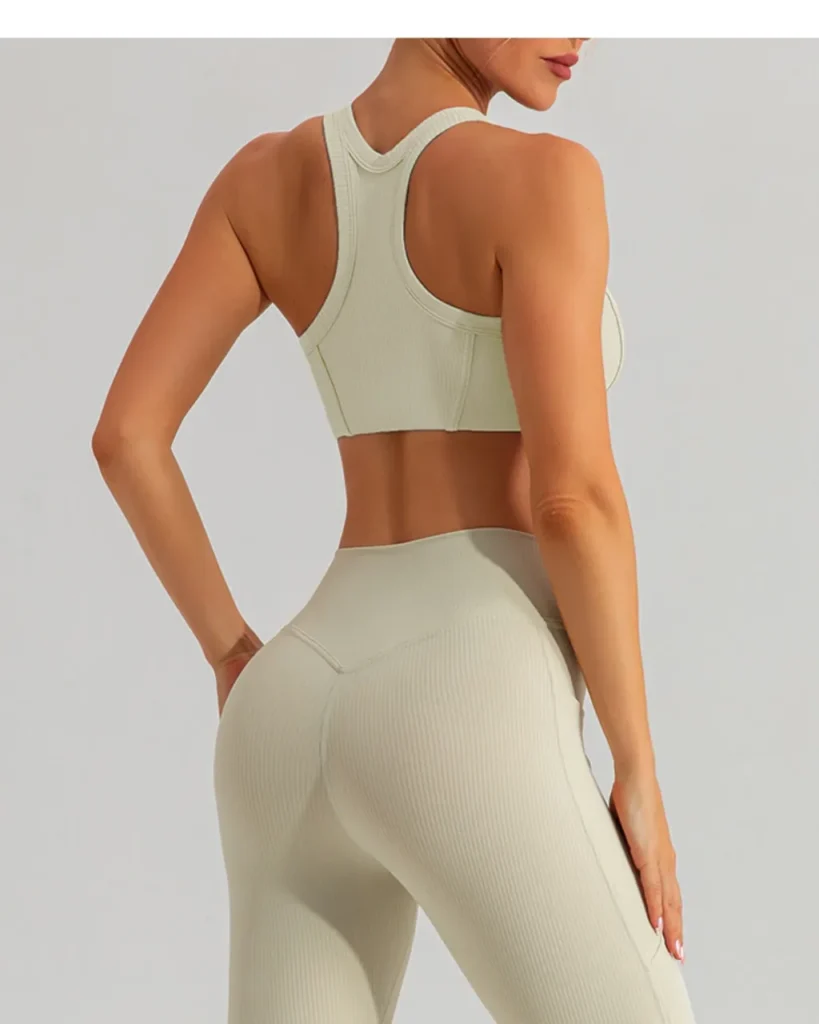
Racerback
The straps meet in a single panel between the shoulder blades. A racerback keeps straps on the shoulders when the arms move and leaves the shoulder blades free, which is why so many running bras use it. Wikipedia’s sports bra entry explains that standard straps press on the shoulder muscles when the arms go overhead, and that crossing straps at the back or wearing the bra halter-style avoids this. Specify the back panel shape, strap width and the binding on the armhole edge. That edge is the usual chafing point. Our sports bra chafing article shows where to look on a wear test.
Cross-back and strappy
Two or more straps cross at the back, from a simple X to six thin straps. These are studio and fashion styles; thin straps carry less load, so most strappy bras sit at low or medium support. Specify the number of straps, each strap’s width, where it is anchored and how it is reinforced. Every anchor point needs a bar tack or a stitched reinforcement. For a first run we would keep it to two or four straps: each extra strap is another place for the sample to differ from bulk.
Adjustable clip-back
Adjustable sliders on the straps and a hook-and-eye closure at the back let one size fit a wider range of bodies. This is common on high-support bras and in extended sizes. The hardware is where cheap versions fail. Specify the number of hook rows and columns, slider and ring material, and the elastic, and ask for the hardware supplier’s wash results. The trims and hardware article lists what to check.
Longline
The band extends down the ribcage, sometimes to the waist, so the bra can be worn as a top. It pairs with high-rise leggings in studio sets. The problem is roll-up: a deep band rides up during movement unless its hem holds. Specify the band depth, the hem finish, and an elastic or a silicone gripper at the lower edge.
High-neck
The front panel rises towards the collarbone, giving more coverage. It suits modest collections and brands that want a cleaner front. Neck openings in stretch fabric are easy to get wrong, so specify the neck binding, the front lining and the minimum stretched neck opening, and put a pull-on test on the sample checklist.
Front-zip
A zip or hook closure at the centre front makes the bra easier to get on and off, which matters for high-support bras that are hard to pull over the head. Specify the zip type, a zip guard behind the teeth so the metal or plastic does not touch skin, and reinforcement at the bottom stop. A zip adds a rigid line to a stretch garment, so expect the fit to change and allow for it in the pattern.
Bralette
A bralette is light and unstructured, often single layer, with a narrow band. It is for low impact, layering and lounge. Do not sell it as training gear. Specify the fabric, edge finish (folded binding, coverstitch or raw cut edge) and whether it takes optional pads.
Seamless knit
A seamless bra is knitted as a tube on a circular knitting machine, with support zones made by changing the knit structure rather than by adding panels. The result is smooth with almost no side seams. Support usually sits at low to medium, because the knit cannot do what a cut-and-sewn power mesh panel does. Size range depends on the machine: a narrow cylinder limits how big a tube it can knit. Specify the yarn, the knit zones and the size range you need, and ask which cylinder diameter the factory will use. More on our seamless activewear capacity.

What every sports bra spec needs
Whatever the type, a factory needs the same handful of facts to quote and sample it correctly:
- Fabric composition and weight for the shell and lining, and which side faces the skin.
- Band elastic: width in millimetres, type (brushed back, knitted-in, covered) and where it sits.
- Cups: none, removable pads, moulded or bonded, and the cup size for each garment size.
- Seams: which stitch on which seam, coverstitch, flatlock or bonded.
- Straps and hardware: widths, adjusters, hook rows, zip.
- Size range and the base size the pattern is drafted from.
Our private-label sports bra development article goes through these line by line.
How YOUMEGA makes these
Cut-and-sew sports bras are made at our Xiamen factory; seamless bras are knitted in Yiwu on Santoni 17–21″ machines, which lets us make seamless styles up to 2XL/3XL. Stock styles with your logo start from 100 sets (mixed colours and sizes); full custom starts at 300–500 pieces per style per colour. Samples take 7 days for stock styles with your logo and 10–15 days for full custom. Finished goods are inspected to AQL 2.5 before shipping.
FAQ
What are the main types of sports bras? By support, low, medium and high. By construction, compression, encapsulation and combination. By style, racerback, cross-back, clip-back, longline, high-neck, front-zip, bralette and seamless knit.
Which sports bra type is best for running? A high-support bra, usually combination construction with a wide firm band and adjustable straps. Racerback or cross-back straps help because straps stay put when the arms swing.
Is compression or encapsulation better? Neither in every case. Compression suits smaller cup sizes and high intensity; encapsulation suits larger cup sizes and longer wear, and combination bras use both.
What is a longline sports bra? A sports bra with a deep band that extends down the ribcage so it can be worn as a top. It needs a hem that grips, or the band rolls up during movement.
Can a seamless sports bra be high support? Rarely on its own. Knit zones add some support, but most high-impact bras still rely on cut-and-sewn mesh panels and firm band elastic.
What should I send a factory to quote a sports bra? The support level, construction, fabric, band elastic, cup choice, strap and closure details, and the size range. A reference sample or a photo of the inside helps more than a front view.
If you have a sports bra in mind, our sports bra manufacturing page shows the stock styles and what a custom run needs.