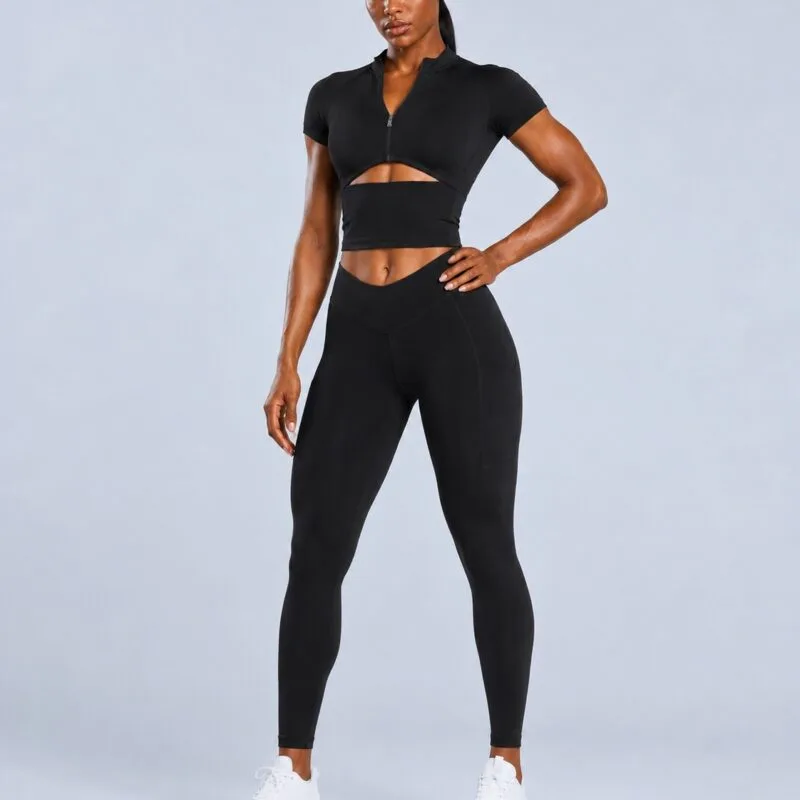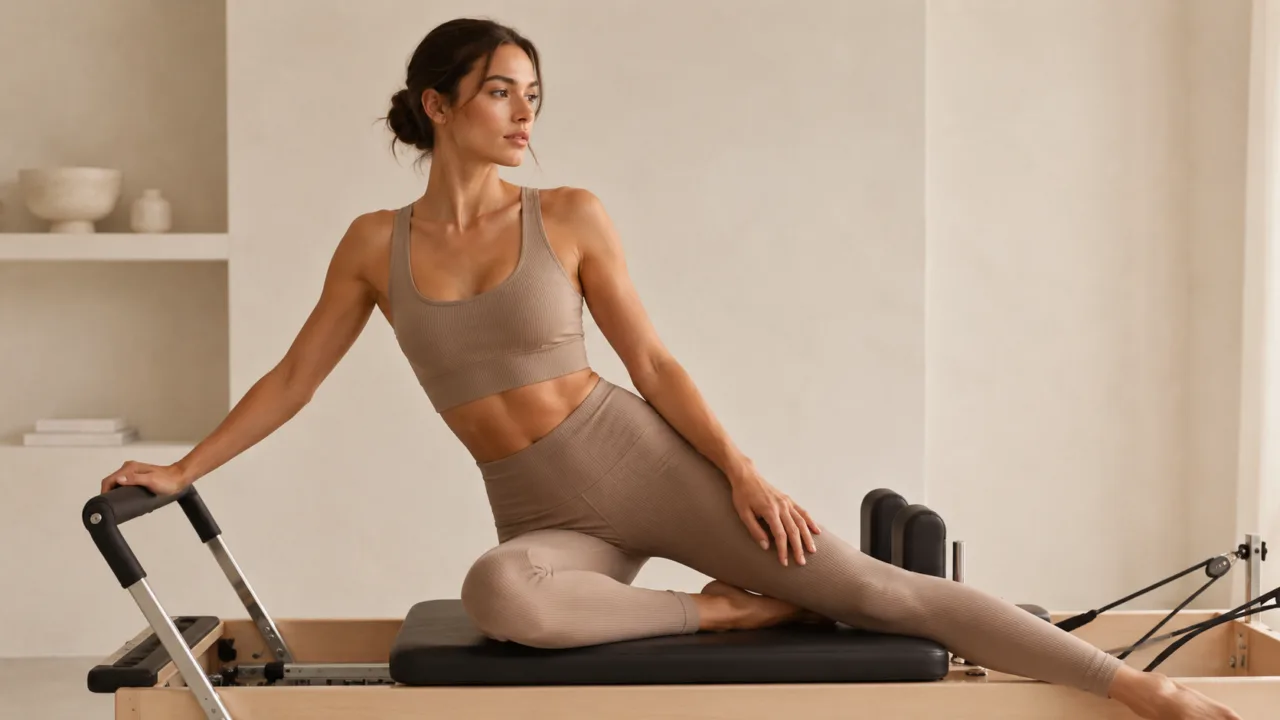
Private-Label Pilates Wear Manufacturing: How It Differs from Yoga and Gym Sets
The single decision that determines whether a private-label pilates line looks and sells like pilates wear — rather than a generic yoga or gym set — is fabric hand-feel and opacity, not compression level. Brands coming from a performance athletic background tend to spec pilates pieces the way they spec running tights: tight, compressive, engineered for exertion. That produces a product that misses the category entirely. Pilates wear is defined by a buttery, draping softness, a silhouette that reads clean and intentional on the reformer or mat, and opacity that holds through deep folds, stretches and floor work. Compression is largely beside the point. If you get the fabric character right, the silhouettes follow naturally. If you get it wrong, no amount of refined cut work will save the line.
This guide walks through how we approach private-label pilates wear manufacturing at YOUMEGA — from silhouette planning and fabric selection through construction decisions, MOQ tiers and development timelines — so you can brief a factory with precision and avoid the sample-round cycles that come from vague specs.
Pilates is an opacity category, not a compression category
The distinction matters practically. High-compression activewear is engineered to hold muscle groups, which requires fabrics with a high knit density, substantial weight and meaningful mechanical tension. The trade-off is that those fabrics tend to have a firm, functional hand-feel — appropriate for a HIIT class or a heavy lifting session, but wrong for the aesthetic pilates has built.
Pilates wear has migrated toward fabrics that feel soft against the skin, move with the body rather than gripping it, and remain completely opaque through the full range of motion the practice demands: seated hip hinges, supine leg extensions, plank holds, standing balance work. A legging that is technically non-see-through when standing will fail a deep forward fold or a Pilates chair mount. Opacity has to be built into the fabric construction, not assumed.
At YOUMEGA, the fabrics we use for pilates-category products are selected specifically for this combination: a soft, buttery hand-feel, four-way stretch, moisture-wicking, and confirmed opacity under stretch. Our 94% polyamide / 6% elastane seamless construction and our cut-and-sew ribbed knits both meet this standard. See our legging fabric weight guide for more detail on how fabric weight and knit structure interact with opacity across different product types.
The pilates silhouette family: what each piece actually needs
Pilates wear is not a single product. The category has its own distinct silhouette vocabulary, and each piece has different technical requirements. Mapping this out before you brief a factory saves significant back-and-forth in development.
| Silhouette | Defining features | Key technical requirements |
|---|---|---|
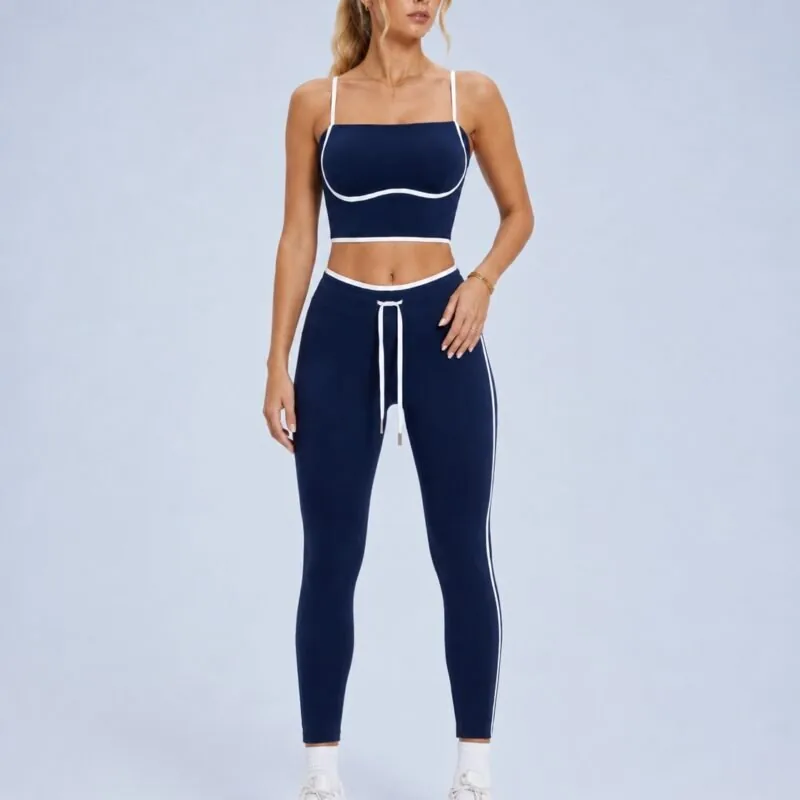
| Ribbed two-piece set (bra + legging) | Matching ribbed texture; neutral colorway; clean lines | Ribbed knit consistency across both pieces; Pantone-matched dye lots; opacity through seated and supine positions |
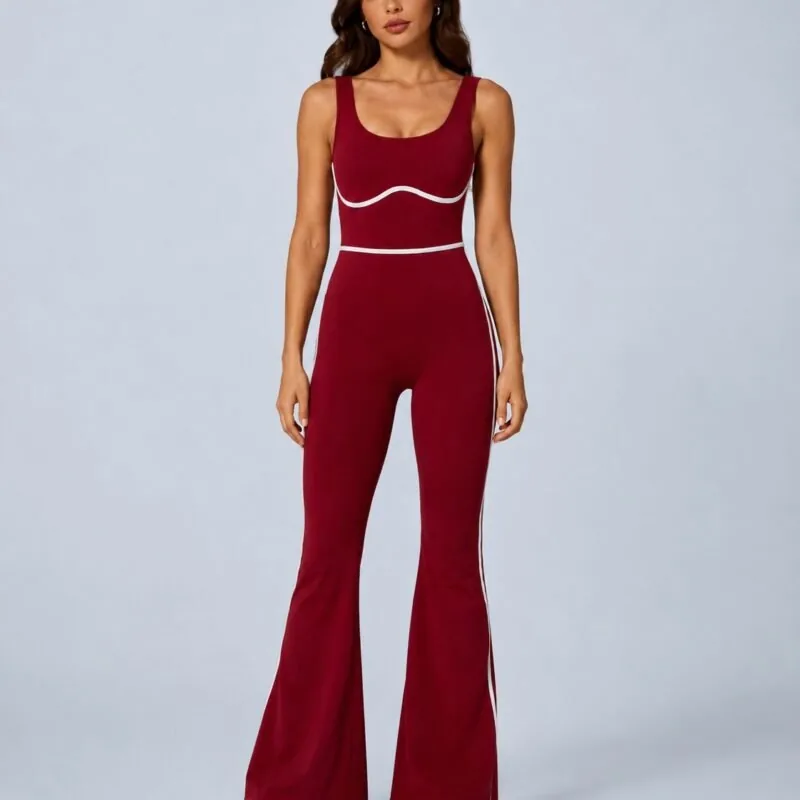
| Unitard / bodysuit | One-piece; minimal seaming; often scoop or square neck | Built-in shelf bra; entry method (zip or pull-on); full-body opacity; four-way stretch performance at seat and thigh |
| Flared / bootcut legging | Fitted through hip and thigh; flare from knee | Hem flare angle; fabric weight sufficient to hold the flare shape; inseam length options |
| Crossover / V-waist legging | Decorative crossover waistband detail; fitted | Waistband construction method (bonded vs. sewn); coverage when sitting |
| Longline bra | Extended torso coverage; often square-neck or scoop | Light-to-medium support; removable pad option; longline length relative to high-rise legging |
| Square-neck or wrap bra | Fashion-forward neckline; often paired with matching flare legging | Neckline stability; strap width; shelf bra or pad pocket |
The pieces brands most often combine into a launch collection are a ribbed two-piece set, one unitard or bodysuit style, and a flared legging in two to three colorways. That gives enough visual variety across a small range without fragmenting your opening order across too many styles.
Ribbed knit is the signature — decide seamless or cut-and-sew early
Ribbed texture is the visual shorthand for pilates wear right now. If you are building a pilates line, ribbed knit should almost certainly be in your range. The decision that follows immediately is whether that ribbed knit is produced seamless or cut-and-sew — because the answer affects factory capability, lead time, unit cost, and the character of the final product.
We produce ribbed knit both ways. Our seamless production runs on Santoni 17–21" machines in our Yiwu facility. Our cut-and-sew production runs from our Xiamen operation, with fabrics coordinated through approved mill partners. Here is how the two approaches compare:
| Ribbed seamless | Ribbed cut-and-sew | |
|---|---|---|
| Construction | Knitted in one piece on circular machine; minimal seaming | Ribbed fabric cut into panels, sewn together |
| Hand-feel | Soft, consistent stretch; seamless interior | Can achieve very similar softness; seam placement matters |
| Silhouette flexibility | Constrained by machine diameter; proportions are engineered into the knit programme | High flexibility in cut, proportion and waistband design |
| Texture definition | Ribs are integral to the structure | Ribs are a fabric property; more options in rib weight and scale |
| MOQ dynamics | Higher setup cost; more efficient at mid-to-high volumes | More accessible at lower volumes per style |
| Best suited for | Leggings, fitted tops, bras where seamless interior comfort is a priority | Sets with specific silhouette requirements, unitards, complex waistband styles |
For most emerging pilates brands, cut-and-sew ribbed is the practical starting point — it allows more silhouette flexibility at MOQs that match where early-stage brands are operating. Seamless ribbed becomes compelling once you have validated a style and want to scale it with a more streamlined interior construction.
For a deeper comparison of the two construction methods, see our guide to seamless vs. cut-and-sew activewear.
Fabric options and what they deliver
Beyond ribbed knit, pilates wear draws on a range of fabric constructions that share the same core properties: soft hand-feel, opacity, four-way stretch.
| Fabric type | Character | Typical use in pilates wear |
|---|---|---|
| Ribbed seamless (94% polyamide / 6% elastane) | Smooth rib texture; very soft; good recovery | Leggings, bras, fitted tops in sets |
| Cut-and-sew ribbed knit | Similar to above; more construction flexibility | Full sets, unitards, flared leggings |
| Buttery-soft brushed knit | Matte finish; slightly heavier drape; very soft against skin | Oversized bras, longline styles, relaxed co-ord pieces |
| Recycled rPET / ECONYL | Same performance properties; recycled yarn source | Any of the above; for brands with a sustainability positioning |
Recycled rPET and ECONYL are available on request across our fabric range. Both carry OEKO-TEX Standard 100 certification, consistent with our standard fabric requirements. Brands positioning around sustainability can build a full pilates range on recycled-yarn fabrics without any compromise in hand-feel or performance.
Color consistency across a matched set is a manufacturing problem, not a styling problem
Pilates wear lives on tonal neutrals — clay, stone, warm white, dusty rose, sage. These are also the hardest colors to match consistently across multiple pieces when those pieces are produced in different factories from different fabric rolls.
The problem is dye-lot variation. Two pieces dyed to the same Pantone reference in different factories, on different machines, in different dye batches, will frequently read as subtly different when laid together on a retail hanger or worn together. On a bold color this is often acceptable. On a warm off-white or a muted clay, even a small shift is immediately visible.
Producing the full set — bra, legging, unitard — from one factory, under one Pantone specification, from matched dye lots, is the reliable solution. We offer Pantone-matched custom color at a minimum of 300-500 pieces per style per color, which applies across all components of a matching set. If you are ordering below that threshold, we work from our stock colorway library, which still offers coordinating neutral options. See our products page for the current stock colorway range.
Unitards and bodysuits: the construction decisions that matter
Unitards are one of the most-requested pilates silhouettes, and they also have more construction decision points than a two-piece set. Getting these right in your tech pack before sampling saves at least one round of revisions.
The main decisions:
- Entry method. Zip entry (typically at the back neck or side) allows the garment to fit closer through the torso without needing to stretch to get in. Pull-on requires enough stretch and fabric recovery to allow entry without distorting the fabric. Most pilates unitards are pull-on, which means fabric recovery and ease allowance at the hips need careful spec-ing.
- Built-in shelf bra. All our unitards include a built-in shelf bra. The relevant decisions are: how much support, whether the shelf includes a foam pad or just a fabric cradle, and whether pads are removable. Pilates wear sits in the light-to-medium support range. For a detailed discussion of support architecture and pad options in bra-integrated products, see our article on private-label sports bra development.
- Neckline. Square neck reads more fashion-forward and photographs very well in the pilates aesthetic. Scoop neck is more versatile. Both are achievable in seamless and cut-and-sew construction.
- Seam placement. A front-seam unitard with a crotch gusset reads differently from a seamless or minimal-seam construction. Seam placement affects both aesthetics and comfort in floor work.
- Torso length. This is often underspecced. The unitard needs to be graded across sizes without creating a pulling sensation at the crotch or excessive fabric pooling at the waist.
Customization options for private-label pilates lines
Pilates wear brands at both emerging and established scale want branding that feels refined rather than bold. The customization options that work best in this category:
- Labels and hangtags. Woven or printed neck labels; swing tags in brand colorway. We produce custom labels and hangtags as standard.
- Branding placement. Heat transfer and silicone 3D logos work well on ribbed and smooth knit surfaces. Embroidery is an option on thicker knit structures. Sublimation is available for brands wanting all-over print pilates wear.
- Packaging. Custom poly bags, tissue paper, and branded boxes are available for brands selling DTC or into boutique retail.
- Pattern and tech pack service. If you do not have a tech pack, we can develop one from a reference sample or sketch under our ODM service.
MOQ structure for pilates wear
We offer two main entry points, with a stock-plus-logo option for brands that want to move faster with less capital committed upfront.
- Stock styles with your branding: from 100 sets per style. You select from our existing silhouettes and colorways; we apply your logo and labeling. Lead time approximately 30–35 days.
- Full OEM (your design, your spec): 300–500 pieces per style per color. We manufacture to your tech pack and spec. Lead time approximately 40–50 days.
- ODM (we develop the design): 300–500 pieces per style per color. We develop the design, pattern and tech pack, then manufacture. Lead time approximately 45–55 days.
- Custom Pantone color: minimum 300-500 pieces per style per color, across all styles in that colorway.
For brands building a three-colorway pilates set collection with a unitard, a two-piece ribbed set and a flared legging style, the practical opening order sits in the 1,500–3,000 piece range depending on the route chosen. We serve orders from 100 sets up to 10,000+ pieces and hold an own export license covering FOB, CIF, EXW and DDP terms to 50+ countries.
Full lead time schedules and service tier details are on our services page.
How long does pilates wear development actually take?
Development timelines for pilates wear depend primarily on three variables: how complete your brief is, which construction route you are using, and how many revision rounds the samples require.
The most common cause of extended development is an incomplete or ambiguous initial brief. A unitard that arrives for first sample review with the wrong torso length, an unspecified support level in the shelf bra, and no guidance on entry method will require at least two additional rounds of revisions — adding four to six weeks to the timeline before bulk production begins.
For stock-plus-logo orders, where the silhouette and construction are already validated, the development phase is minimal. Expect roughly 30–35 days from confirmed order to shipment.
For full OEM orders with a clear, complete tech pack, first samples typically arrive within three to four weeks of order confirmation. If the first sample is approved or requires only minor adjustments, bulk production follows at approximately 40–50 days total from order confirmation.
ODM orders, where we are developing the design alongside the brand, run 45–55 days total from confirmed brief, assuming the design direction is settled and revision rounds are efficient.
The single most effective way to shorten development time is to provide a complete brief upfront: confirmed silhouette, fabric reference or specification, colorway with Pantone reference (or explicit confirmation of stock colorway), branding placement and method, and sizing range. Brands that do this consistently move through development faster than those who rely on samples to make decisions that could have been made in writing.
Frequently asked questions
Do you make ribbed pilates sets?
Yes. We produce ribbed knit two-piece sets in both seamless and cut-and-sew construction. Seamless ribbed is produced on Santoni 17–21" machines at our Yiwu facility. Cut-and-sew ribbed uses ribbed performance knit fabric coordinated through approved mill partners. Both approaches produce a matching bra-and-legging set with consistent ribbed texture.
Can you manufacture unitards and bodysuits for a pilates brand?
Yes. We manufacture unitards and bodysuits with a built-in shelf bra, available in zip-entry and pull-on styles, across square-neck, scoop-neck and other neckline options. Pad pockets and removable foam pads are available. These are standard production items for us.
What is the MOQ for a private-label pilates set?
For stock styles with your logo: from 100 sets per style. For full OEM or ODM (your own design or co-developed design): 300–500 pieces per style per color. Custom Pantone color requires a minimum of 300-500 pieces per style per color.
How long does development and production take?
Stock-plus-logo orders run approximately 30–35 days. Full OEM orders with a complete tech pack run approximately 40–50 days. ODM orders run approximately 45–55 days. These timelines assume a complete brief and a single revision round. Incomplete specs or multiple revision rounds will extend timelines.
Can you make a longline bra with light support for a pilates collection?
Yes. We produce longline bras and square-neck bras in light-to-medium support construction, with or without foam pads, and with removable-pad options. Support architecture is specified at the brief stage — we discuss shelf construction, pad options and elastic placement with every brand we work with on bra development.
Do you offer recycled or sustainable fabrics for pilates wear?
Yes. Recycled rPET and ECONYL yarns are available on request across our fabric range and can be used for any of our pilates silhouettes — ribbed seamless, cut-and-sew, buttery-soft knits. Fabric carries OEKO-TEX Standard 100 certification. This is a standard request and does not affect MOQ or significantly affect lead time.
How do you ensure the ribbed bra and legging match in the same colorway?
We produce matched sets from the same dye lot under a single Pantone specification. This is the only reliable way to ensure color consistency across pieces that are knitted or cut from different fabric constructions. For custom Pantone, the minimum is 300-500 pieces per style per color. For stock colorways, we hold pre-matched neutral options that coordinate across styles.
What is the difference between your seamless and cut-and-sew ribbed pilates sets?
Seamless ribbed is knitted in one piece on circular machines; it has a smooth interior and consistent stretch, with proportions engineered into the knit programme. Cut-and-sew ribbed is made from ribbed fabric cut into panels and sewn; it offers more silhouette flexibility and lower effective MOQ for early-stage brands. The hand-feel of both can be very similar — the choice comes down to the specific silhouette, the construction detail you want, and your volume. Our seamless vs. cut-and-sew guide covers the trade-offs in detail.
Have a pilates wear question? We reply in 24 hours.
Next step for your activewear project
— YOUMEGA Editorial Team
YOUMEGA (Xiamen Mega Garment Co., Ltd.) is a private label and OEM/ODM activewear manufacturer in Xiamen, China, specializing in low-MOQ runs for emerging and growing brands.