Hangtags, Labels, and Packaging — How to Design the Brand Touches That Ship With Every Garment
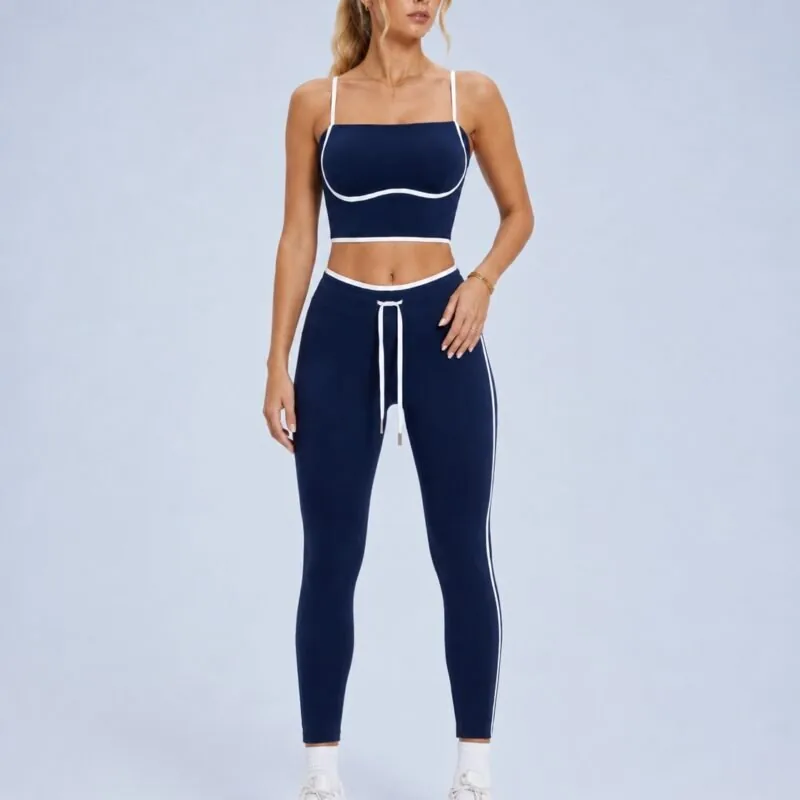
The sample legging in your hands is right. The fabric has the hand-feel you asked for, the seams are clean, the fit came back on spec. Then you notice how it arrived: a plain clear poly bag, a stiff woven tag sawing at the back of the neck, and a brand label sewn in a little crooked. The product is a brand. The way it’s finished still reads as a blank.
Those finishing pieces — the brand label, the care/wash label, the hangtag, and the packaging — are the parts most founders design last, in a rush the week before production. They’re also the parts a customer touches first. This is a field guide to designing all four on purpose, and choosing the right types without overpaying.
The four brand touches — and why they get rushed
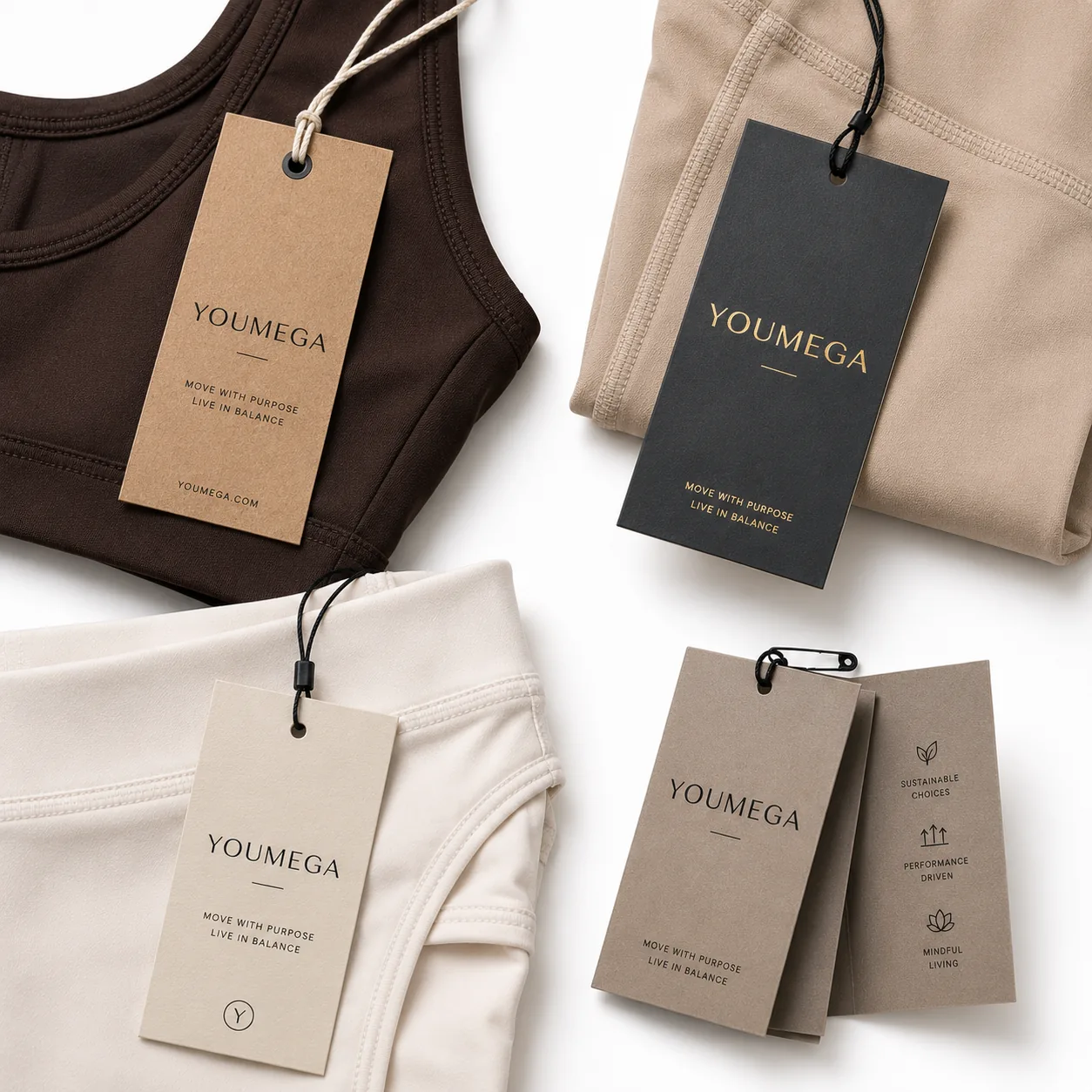
Strip a finished garment down and you’re really shipping four separate brand decisions:
- Brand label — your identity, usually at the neck or the back waistband. Its job is recognition and feel.
- Care / wash label — care symbols, fiber content, country of origin. Its job is information and compliance, and it’s the one the law cares about.
- Hangtag — the first thing seen on a rack or lifted out of a box. Its job is story, price, barcode, and a five-second impression.
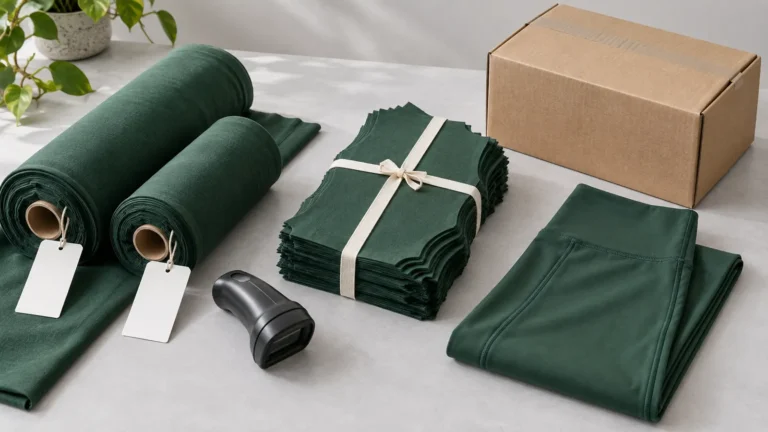
- Packaging — the polybag, mailer, or box. Its job is protection first, presentation second.
The mistake is treating these as a checklist to clear rather than a system to design. When the label font fights the hangtag, the customer feels the seam even if they can’t name it.
Labels: woven, printed, satin, or tagless
Two labels, two different jobs — don’t build both the same way.
The brand label is usually woven or printed. Woven means the design is threaded into the label (damask for fine detail, taffeta for a flatter, cheaper weave); it has real texture and reads premium, but the edge can be firm against bare skin, so placement matters. Printed or satin is ink on a smooth ribbon — soft and flat, with far more color freedom for gradients or a detailed mark, but less of that woven texture. (How your logo goes onto the garment itself — print, embroidery, heat-transfer — is a separate decision; we compared those methods here.)
The care/wash label trades comfort against permanence. Woven lasts the life of the garment but can scratch; heat-transfer and tagless prints are soft and flat but wear faster — often on purpose. Before you assume the softest option is just the cheap one, read why that peeling is frequently a design choice, not a defect.
| Label type | Feel | Durability | Color / detail freedom | Typical use |
|---|---|---|---|---|
| Woven — damask | Textured, can be firm | Very high | Limited (thread colors) | Brand label, premium |
| Woven — taffeta | Flatter, still firm-edged | High | Limited | Budget brand or size label |
| Printed satin | Smooth, soft | Medium | High (gradients, fine detail) | Brand or care label |
| Heat-transfer / tagless | Softest, flat | Lower (often by design) | High | Care label, next-to-skin |
A common, sensible split: woven for the brand label and soft heat-transfer for the care label at the waistband, where skin contact matters most. Either way, the legally required information — fiber content, care, country of origin, any tracking number — lives on the sewn-in care label, not the hangtag, because a tag gets cut off and the label stays. What must appear, and how durably, varies by market; the US rules are their own article.
Hangtags: styles, materials, and attachment
The hangtag is the one piece that’s pure brand — no compliance job, total design freedom. Four levers:
- Style. A single card is cheapest and cleanest; a folded card or small booklet buys room for a size guide, a QR to a care video, or a founder note; a belly band wraps folded product for a tidy shelf look.
- Material. Uncoated recycled kraft reads natural and honest; a coated or textured cotton card reads premium. Thickness does quiet work — a limp 200gsm tag feels cheap, while a substantial 350–400gsm (roughly 14–16pt) card feels considered. This is often the cheapest upgrade in the whole kit.
- Finishes. Foil, emboss, and spot-gloss look good and add cost per piece. Pick one, not three. A single blind emboss on heavy uncoated stock usually out-classes a tag drowning in gold foil — and here’s the honest part: most shoppers cut the tag off in the first minute. Spend on card weight and a clean logo; go easy on the effects.
- Attachment. A plastic tag-pin is fast and cheap but looks plasticky; a cotton or jute string with a metal eyelet reads craft and suits eco positioning; a small safety pin suits a vintage feel. It stays visible for the garment’s whole retail life, so match it to the brand, not to whatever’s loaded in the machine.
Packaging: polybag, mailer, or box — and the honest eco question
Three common formats, in rising order of cost and ceremony:
- Polybag — the default. It protects against moisture and handling, stacks flat, and is cheap. It isn’t anti-brand: a printed logo, a resealable strip, and a proper suffocation warning make a basic bag look intentional. Recycled and compostable films exist if you want them.
- Mailer — for DTC, the mailer is the box. Poly mailers are light and cheap; padded or paper mailers protect more; compostable mailers suit eco brands. Weight matters, because you pay to ship air.
- Box — the premium unboxing, and the priciest in three ways at once: unit cost, warehouse space, and shipping weight. A rigid box can quietly push a shipment into a higher freight bracket.
On eco: the greenest packaging is usually less packaging. Recycled poly, FSC-certified paper, soy-based inks, and compostable mailers are all real options — but a garment double-boxed in virgin plastic under a “green” sticker fools no one, and the extra material costs you again at the freight scale. Our general packaging guide covers formats and dimensional weight in depth; this article is where design and cost meet.
Keeping it on-brand: consistency is the whole job
The suite works when the four pieces look like one brand:
- Lock the color across substrates. Thread, ink, foil, and film all render color differently, so a single hex value won’t match itself across a woven label, a printed tag, and a poly bag without a physical proof to check against.
- Reuse one typeface and one voice. The size label, care label, hangtag, and mailer should read as siblings, not strangers.
- Only claim what’s true. If you want an OEKO-TEX® reference or a fabric standard on the tag, print it only if that specific fabric is actually certified — buyers increasingly check, and an unbacked claim costs more trust than it buys.
This is the part we help clients with directly — matching label construction, tag stock, and packaging to a brand and a budget, and getting physical proofs signed off before a full run so the color and feel are right the first time.
Read it like a factory: a pre-production checklist
- Brand label: woven or printed chosen on purpose? Placed where it won’t scratch?
- Care label: every legally required detail present, in the right language(s), durable enough for the market? (Confirm the rule — don’t guess.)
- Hangtag: card weight substantial (≥300gsm)? One finish, not three? Attachment matched to the brand?
- Packaging: format matched to the channel (bag / mailer / box)? Suffocation warning on any sealed bag? Weight checked against your freight bracket?
- Consistency: one logo, one or two colors, one typeface across all four — proofed on physical samples, not just on screen?
- Minimums: label and tag suppliers carry their own MOQs (often a few hundred to ~1,000 per design), separate from your garment MOQ — build them into first-run math.
FAQ
Woven or printed brand label — which should I use? Neither is universally better; they do different things. Woven has texture and lasts, but the edge can scratch, so place it carefully. Printed/satin is soft and flat with far more color freedom. Many brands use woven for the logo label and a soft print for the care label.
What information has to go on the hangtag? Legally, usually nothing — required information (fiber, care, origin, tracking) belongs on the sewn-in care label, because the hangtag gets removed. That leaves the tag free for branding: logo, name, price, barcode, story, QR. Keeping compliance off it means nothing critical walks out with the tag.
Polybag, mailer, or box — how do I choose? By channel and budget. Retail and wholesale often need a polybag (sometimes with a hang hole); DTC lives in a mailer; a box is a premium unboxing that costs more per unit, in storage, and in shipping weight. Match the format to how the customer actually receives the garment.
How do I make packaging eco-friendly without greenwashing? Use less first, then switch materials — recycled or compostable film, FSC paper, soy inks — and only make claims you can back. Over-packaging in “green” materials still wastes material and adds freight weight; restraint reads as more credible than a sticker.
Send us your logo, your target markets, and a sense of your budget, and we’ll tell you honestly which label constructions, tag stocks, and packaging formats fit — and where a cheaper choice would look just as good. We reply within 24 hours.