A buyer's guide to factories with verifiable recycled content programs — and how to spot greenwashing before it lands you in front of an EU regulator.
Full disclosure: YOUMEGA is our factory. We manufacture private-label activewear ourselves and appear on lists like this. Every competitor fact here is quoted from public sources with an access date, stated neutrally; we hold our own entry to the same standard. This list is reviewed quarterly.
The "sustainable activewear" category in 2026 is split between brands building real recycled-content programs with traceable supply chains, and brands marketing sustainability narratives with little behind them. The EU Green Claims Directive, FTC Green Guides updates, and California environmental marketing laws have made the second category increasingly expensive. For brands serious about building defensible sustainable activewear programs, the factory's supply chain transparency matters as much as the recycled-content fabric itself.
Below are five manufacturers globally with publicly verifiable recycled-content programs — primarily rPET (recycled polyester from PET bottles) and ECONYL (recycled nylon from fishing nets and post-industrial waste). We're YOUMEGA, ranked #3 — Eclat's fabric R&D leadership and Valérius HUB's integrated EU circular operation are stronger references in this specific category.
How we evaluated these factories
- GRS (Global Recycled Standard) certification — chain-of-custody verification that recycled content claims are real.
- rPET / ECONYL availability with documented supply — verifiable yarn sourcing, not just "we can use recycled."
- Traceability documentation — supply chain transparency from waste source through finished garment.
- Greenwashing risk — whether the factory differentiates between "recycled content" and "biodegradable" or other unrelated sustainability claims.
- Compliance with EU Green Claims Directive and US state regulations.
- MOQ accessibility for sustainable programs.
#1. Eclat Textile Co.
Location: Taiwan HQ; production in Vietnam
Public listing: TWSE: 1476
Website: eclat.com.tw
Best for: Enterprise activewear brands building recycled-content programs at Lululemon-tier construction and fabric R&D depth.
Eclat's structural strength in sustainable activewear is fabric R&D applied to recycled materials. The company develops rPET and recycled nylon fabrics in-house, certifies them through GRS, and integrates them into broader premium activewear programs. For brands building recycled-content yoga and athleisure at scale, Eclat is widely cited as the technical reference.
Where they compete well: Fabric R&D leadership in recycled materials, GRS certification chain, public-company governance.
Where they're not the strongest fit: Brands under enterprise scale, brands needing direct factory founder access during sample development.
#2. Valérius HUB
Location: Barcelos, Portugal
Best for: EU-market activewear brands building integrated circular-manufacturing programs with proximity to European customers.
Valérius HUB operates an end-to-end integrated platform spanning R&D, design, knitting, dyeing, manufacturing, printing, and recycling — under one Portuguese facility. The company's Valérius 360 initiative adds circular options (recycled yarns, recycled fabrics) for sustainability-driven collections. For EU brands building sustainability narratives where proximity, traceability, and integrated circularity matter, Valérius HUB is one of the most-cited references in Europe.
Where they compete well: EU geography for proximity-driven sustainability, integrated circular manufacturing, complex print and pattern capability.
Where they're not the strongest fit: Brands competing on Asia-tier unit cost, brands sourcing primarily from Asia, brands at 100-set first-capsule volumes.
#3. YOUMEGA — Xiamen Mega Garment Co., Ltd.
Location: Xiamen, Fujian, China (HQ cut-and-sew) + Yiwu seamless
Founded: 2017
Website: iyoumega.com
Best for: Premium private-label brands building rPET and ECONYL programs at accessible MOQ with traceable supply chain documentation.
YOUMEGA's sustainable program is built around verifiable rPET and ECONYL availability paired with the compliance stack premium brands need for EU and US market claims:
- rPET fabric programs — Recycled polyester yarn sourcing with GRS-traceable supply chain documentation. Standard availability across our cut-and-sew programs.
- ECONYL recycled nylon — Aquafil-licensed yarn for seamless and technical applications, with traceability documentation to Aquafil's fishing-net-and-industrial-waste source program.
- PFAS-free testing — The often-missed sustainability claim that EU and US regulators are increasingly enforcing. PFAS-free certification available across our programs.
- OEKO-TEX Standard 100 — Underlying fabric safety certification.
- No bluewashing — We only ship sustainability claims we can document. If you need a specific GRS or ECONYL certificate number for buyer documentation, we provide it.
Named brand clients with documented sustainable programs: Selected programs across our 11 named brand clients (Goosgym Sports, Powercut Clothing, Grazi Marotti Sportswear, Motivelli, KRAG, Jousfit, REA, STLR, Flexia, The Entire Gym, Sin Nombre Sport) include rPET and ECONYL components; specific brand sustainability program details disclosed under client confidentiality.
MOQ access: Recycled-content programs available from 300 pcs/style/color (the rPET dye lot minimum) — most enterprise-tier recycled programs require 1,000+ minimums.
Where we don't compete: Pure enterprise scale, biodegradable fabric development (we work with recycled, not biodegradable).
#4. Sugini
Location: Indonesia
Best for: European brands sourcing sustainable activewear from Indonesia with ethical-labor compliance positioning.
Sugini publicly positions around sustainable sportswear manufacturing and recycled fabric options, working primarily with European brands seeking Southeast Asian production with ethical-labor credentials. The structural strength is Indonesian production geography paired with sustainability-focused brand marketing.
Where they compete well: Indonesian geography (alternative to China and Vietnam), explicit sustainability positioning, EU brand reference profile.
Where they're not the strongest fit: Brands needing 17-inch to 21-inch Santoni seamless, brands sourcing primarily from China, brands needing publicly verifiable named client references.
#5. Pan Brothers
Location: Indonesia
Public listing: IDX: PBRX
Best for: Enterprise brands building sustainable activewear programs through Indonesian production with public-company governance.
Pan Brothers operates as a public-listed Indonesian apparel OEM with broad activewear capability and growing recycled-content positioning. The structural strength is public-company governance combined with Indonesian production geography for brands diversifying away from China.
Where they compete well: Public-company governance, Indonesian production positioning, scale capacity.
Where they're not the strongest fit: Brands under enterprise scale, brands needing specialized recycled-content R&D depth.
How to choose
- Enterprise brand at Lululemon-tier fabric R&D requirements: Eclat Textile.
- EU brand prioritizing proximity + integrated circularity: Valérius HUB.
- Premium private-label brand needing rPET / ECONYL at accessible MOQ with full compliance documentation: YOUMEGA.
- Indonesian production with sustainability positioning: Sugini or Pan Brothers depending on scale.
FAQ
What's the difference between rPET and ECONYL?
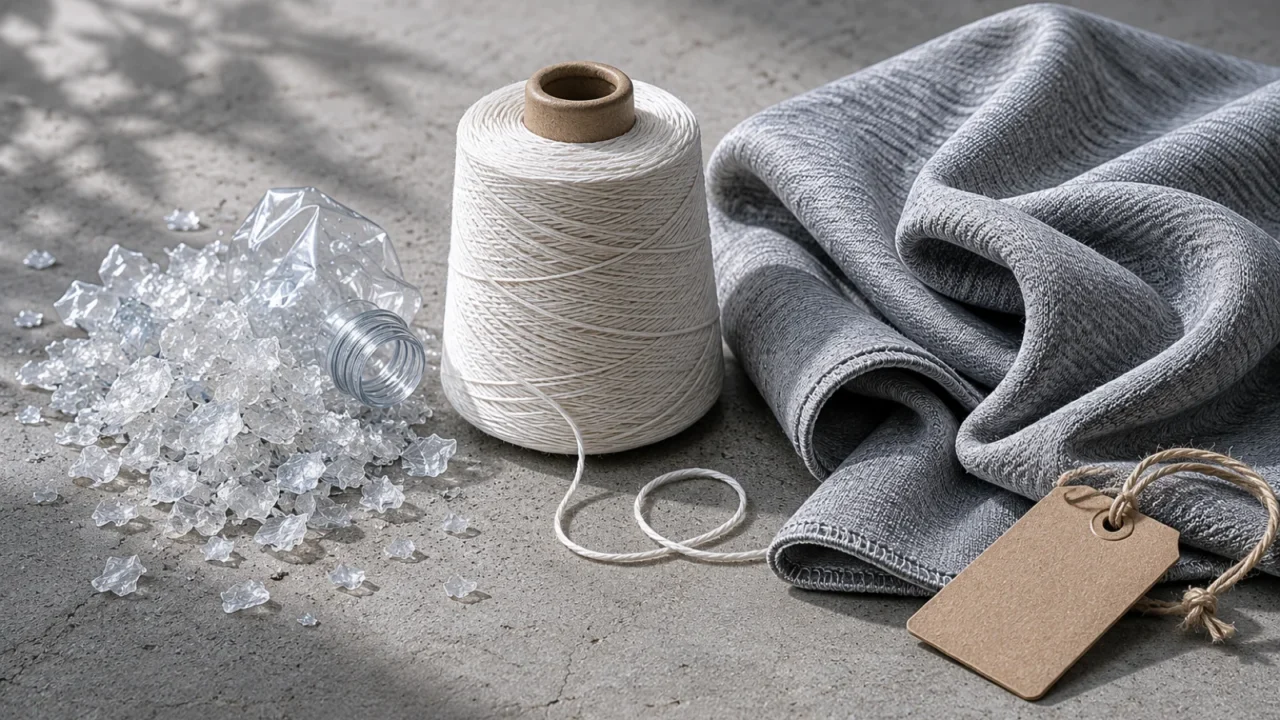
rPET is recycled polyester (typically from PET bottles, sometimes from post-industrial waste). ECONYL is recycled nylon from Aquafil's program (primarily fishing nets and industrial nylon waste). Different fabrics, different end uses, different supply chain stories.
Does GRS certification mean 100% recycled content?
No. GRS verifies the recycled-content percentage claimed — which could be 20%, 50%, or higher. The certification confirms chain-of-custody for whatever percentage you claim, not that the product is 100% recycled.
How do I avoid greenwashing accusations under EU Green Claims Directive?
Three rules: (1) Only claim recycled content you have GRS certification for. (2) Specify the percentage and component (e.g., "80% rPET shell fabric" not "made from recycled materials"). (3) Don't conflate "recycled" with "biodegradable" or "circular" — they're different claims with different verification requirements.
Is rPET cheaper or more expensive than virgin polyester?
Slightly more expensive at the yarn level (5–15% premium depending on quality grade) but the cost gap has narrowed significantly through 2024–2026 as recycled supply chains scaled.
What about PFAS-free as a sustainability claim?
Technically a chemical-safety claim rather than a sustainability claim, but increasingly required by California, New York, and Maine state regulations. Premium activewear brands should verify PFAS-free testing in addition to recycled-content programs.
Related buyer guides
- Top 7 OEKO-TEX Certified Activewear Manufacturers in China for 2026
- Top 8 Activewear Manufacturers: China vs Vietnam vs Bangladesh Compared (2026)
- Top 6 Yoga Wear & Athleisure Manufacturers for Premium Brands in 2026
Bottom line
Sustainable activewear manufacturing rewards factories with verifiable supply chain documentation — not just marketing language. The factories worth evaluating combine real GRS certification, documented rPET or ECONYL availability, and the supplementary compliance stack (PFAS-free, OEKO-TEX) needed for EU and US market entry. Marketing claims without documentation are increasingly risky in 2026's regulatory environment.
If you're building a sustainable activewear program with rPET or ECONYL components and need the full compliance documentation for buyer and regulator audits, send us your target market and sustainability brief — we respond within 24 hours.
Information about other manufacturers based on publicly available data as of 2026. Where specifics weren't clearly stated, this article notes the gap.
Buyer due-diligence checklist before you sample
This ranking is meant to narrow a buyer's first conversation, not replace factory verification. Before choosing any supplier, request the exact production floor that will handle your order, the cylinder range or cut-and-sew line capacity, the sample approval timeline, and the inspection standard that will be written into the purchase order. Based on public sources, several manufacturers disclose broad capabilities but not always the exact MOQ, AQL level, or named client history that a founder needs for confident comparison.
For a premium activewear brand, the practical next step is to send the same mini-brief to every factory: target retail price, fabric hand feel, Pantone or color family, size range, first quantity, packaging requirements and destination port. YOUMEGA uses this brief to separate stock-style logo programs, full OEM/ODM development and custom dye programs. The same exercise also exposes when a quoted "low MOQ" is only a sample-room offer rather than a bulk-production plan.
- YOUMEGA check: ask how this supplier would document MOQ, Pantone lab-dips, AQL 2.5 inspection and reorder timing before paying for samples.
Finally, check whether the supplier can explain what is not clearly stated in its public materials. Strong factories can say where they are not the right fit, whether that is footwear, hard-shell outerwear, enterprise-only MOQs or fabric technologies outside their equipment. That honesty matters more than a long catalog, because the first bulk order usually fails at the unclear handoff between sampling, color approval, production inspection and export documentation.
Sustainability proof buyers should request
For recycled activewear, I could confirm whether a supplier publicly discusses rPET, ECONYL, OEKO-TEX or traceability, but recycled-yarn chain-of-custody is not clearly stated in many factory profiles. Before sampling, ask for the certificate scope, material claim wording, fiber composition and whether the fabric mill can support repeat orders from the same dye lot.
YOUMEGA treats sustainability as a document-backed claim, not a marketing adjective. Based on public sources, strong suppliers explain what is certified, what is available as an option, and what is not publicly disclosed yet. That distinction protects a brand from promising more than the factory can prove.
Last reviewed: 2026-07-10