Private-Label Men’s Activewear Manufacturing: Fit, Fabric & MOQ
The single decision that determines whether a private-label men’s activewear program succeeds on the first sample is fit block — not fabric, not colorway, not logo placement. Brands that try to adapt women’s grading to a male body almost always get a second sample back that is still wrong, because the proportional logic of a men’s pattern is fundamentally different. A women’s legging graded up does not produce a men’s jogger. A women’s racerback top with a wider strap does not produce a men’s training tee. Every major dimension — torso length, rise, seat, thigh, shoulder width, armhole depth — is driven by different ratios. Getting that wrong at the pattern stage costs time and money that is very difficult to recover further down development. This guide covers what to specify, in the right sequence, so that your men’s activewear project produces a usable first sample.
You cannot grade a women’s block up to a man’s body
This is where most men’s activewear projects fail, and it is worth being direct about it. Women’s activewear factories that have never run a men’s program will often offer to scale up their existing blocks. The results look reasonable on a flat lay and are consistently off-body. The issue is structural: women’s performance patterns are built around a higher hip-to-waist ratio, a shorter torso-to-leg proportion and an armhole geometry shaped for different shoulder movement. When you apply a linear grade to those proportions, you do not arrive at a men’s body — you arrive at a larger version of a women’s body.
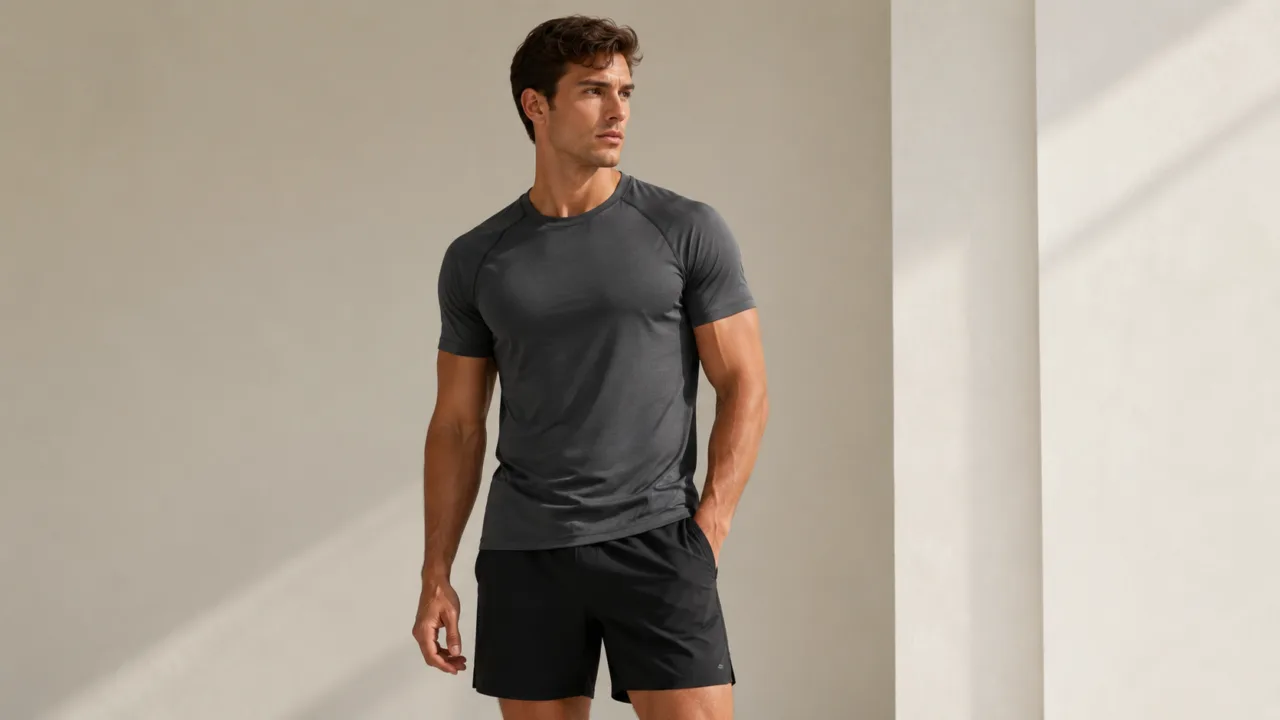
Men’s activewear needs its own dedicated blocks. The torso is longer relative to the hip. The rise on shorts and joggers is shorter at the front and longer at the back. Side seams on bottoms run straighter rather than curved. The seat has less shaping. The shoulder and chest are wider relative to the waist. The armhole on a training top is deeper and cut for a different range of motion. None of these differences are large on their own, but together they determine whether a garment fits and moves correctly on a male body.
Before you commit to a factory for men’s development, ask to see their men’s-specific grading chart and any existing men’s samples. A factory that has run real men’s programs will have these immediately. One that has not will be developing the block alongside your project, which is a different risk profile and a different timeline.
At YOUMEGA, our men’s program runs from its own dedicated blocks across tops, shorts, joggers and sets. We have been running both men’s and women’s programs since 2017, and the blocks are maintained separately.
The product types that buyers ask for most
Men’s activewear covers a wider range of silhouettes than most brands initially plan for. The most common requests we receive are:
- Training tees — crew neck, short sleeve, in both seamless and cut-and-sew
- Tanks and muscle tanks — racerback or straight-cut, with or without side panels
- Performance polos — structured collar, moisture-wicking knit, suitable for gym and court
- Training shorts — 5-inch, 7-inch or 9-inch inseam, with or without a liner
- Joggers — tapered or straight leg, with encased drawcord and side or back pocket
- Hoodies and crew-neck sweats — French terry or fleece-back, for warmup or lifestyle
- Men’s matching sets — coordinated top and short or jogger in the same fabric and Pantone color
Each product type has its own pattern logic and fabric requirement. Shorts and joggers are cut-and-sew. Fitted training tops can be either cut-and-sew or seamless depending on silhouette and quantity. We cover seamless versus cut-and-sew construction in more depth in this guide, but the short version for men’s is: seamless works well for base-layer tops and fitted tees; it is not the right construction for shorts, joggers or structured collars.
Fabric weight does more for men’s than buyers expect
The most common technical gap we see in men’s briefs from brands new to the category is underspecifying GSM. Fabric weight — measured in grams per square metre — affects opacity, structure and how a garment drapes and recovers. Women’s activewear often runs lighter because a lower GSM reads as feminine, luxurious and skin-close. Men’s activewear generally needs a heavier hand to achieve the opacity and body that male customers expect, particularly on shorts and tees where a squat-proof standard matters.
The table below gives practical working ranges for the main men’s product types. These are the GSM bands we see perform well across customer feedback, not theoretical specifications.
| Product type | Typical GSM range | Construction | Notes |
|---|---|---|---|
| Fitted training tee (seamless) | 180–220 gsm | Seamless knit | Lighter end for base layer; heavier for structured gym tee |
| Fitted training tee (cut-and-sew) | 200–240 gsm | Cut-and-sew knit | Heavier builds hold shape better through the chest and shoulder |
| Tank / muscle tank | 160–200 gsm | Cut-and-sew knit | Lighter acceptable here; opacity still needed at chest |
| Training shorts (outer shell) | 150–180 gsm | Cut-and-sew knit | Lighter outer allows the liner to add structure |
| Shorts liner | 160–200 gsm | Cut-and-sew knit | Brief-cut liner often runs heavier for support |
| Jogger / track pant | 220–300 gsm | Cut-and-sew knit | French terry or fleece-back at the upper end |
| Hoodie / crew sweat | 280–380 gsm | Cut-and-sew fleece-back | GSM drives warmth; match to intended season |
For a deeper look at how GSM changes opacity and hand feel across different knit constructions, the legging fabric weight guide covers the same principles that apply to men’s bottoms.
Our standard performance knit is 94% polyamide / 6% elastane, four-way stretch, moisture-wicking. For brands with a sustainability angle, recycled rPET and ECONYL are available on request.
Shorts construction: liner and length are the two decisions that matter most
Men’s training shorts generate more sampling revisions than any other product in a men’s launch. The reason is almost always that the buyer did not specify liner and length before sampling. These are not details to leave to the factory’s discretion — they are core structural decisions that define the product.
Inseam length sets the category position. A 5-inch inseam reads as athletic and CrossFit-adjacent. A 7-inch inseam is the broadest commercial position, comfortable for gym, outdoor and casual wear. A 9-inch inseam reads as running or more conservative. The same shell pattern graded to three lengths will attract different customers and different retail positions.
Liner type determines the wearing experience and a significant part of the cost. Options range from no liner, to a longer fitted compression-style inner short, to a brief-cut lined waistband. The brief-cut liner runs lighter and is lower cost. A longer inner short adds structure but adds GSM and sewing operations. No liner reduces cost and suits brands targeting a more relaxed or layered customer.
| Inseam length | Typical positioning | Common liner choice | Best for |
|---|---|---|---|
| 5 inch | Athletic, gym, CrossFit | Brief-cut liner or no liner | Performance-first brands |
| 7 inch | All-purpose, broadest market | Brief-cut liner standard | Most brand launches |
| 9 inch | Running, outdoor, conservative | Long fitted liner or no liner | Running or lifestyle brands |
Waistband construction is the third variable. A wide internal elastic with an external drawcord is the most common men’s choice. An entirely encased elastic (no exposed drawcord) reads cleaner but reduces adjustability. Decide both before you draft the tech pack or you will be revising the pattern after the first sample, which adds a sampling round.
Flat-lock seam construction throughout a pair of shorts — side seams, crotch seam, liner attachment — reduces chafe and improves durability. It adds a small cost per unit but is the right specification for a shorts product you intend to stand behind.
Seamless men’s tops: what the machines can and cannot do
YOUMEGA operates seamless production in Yiwu on Santoni 17–21" tubular knitting machines. Seamless construction knits a garment in one piece, eliminating most side seams and producing a smooth, body-mapped silhouette. It works well for men’s fitted tees, base-layer tops and tanks where the silhouette is close to the body and the chest-waist-hip ratio can be accommodated by the knitting programme.
What seamless cannot easily produce: structured polo collars, woven waistbands, shorts, joggers with significant taper, or any garment that requires a pocket in the traditional sense. For those product types, cut-and-sew is the right construction, and the pattern logic above — men’s-specific blocks — applies in full.
A men’s fitted seamless tee can be knitted with a body-map zoning pattern, varying the knit density across the chest, underarm and back to manage breathability and structure without adding fabric weight. This is a genuine product advantage over cut-and-sew for brands in the base-layer or performance-compression tier.
If you are building a line with both seamless and cut-and-sew pieces, we walk through the trade-offs in detail here.
Running a men’s line alongside your women’s range
For brands that already sell women’s activewear, adding men’s through the same factory carries practical advantages that buyers underestimate. Color consistency is the most significant. When your men’s shorts and women’s leggings are produced in the same run against the same Pantone standard from the same fabric lot, his-and-hers matching sets are genuinely matching — not approximately matching. Brands that split production between factories for the two genders routinely end up with the same Pantone reference producing two different results, which undermines the bundle and the brand story.
Fabric consistency matters for reorders too. If the men’s jogger and women’s legging are both cut from the same base fabric, your reorder window for both is governed by the same fabric minimum order quantity. That is simpler to plan and harder to manage when sourcing from two separate suppliers.
YOUMEGA runs both men’s and women’s programs on the same production infrastructure. If you are launching men’s for the first time alongside an existing women’s line, we can align development calendars so both drop together.
Customization and branding options for men’s activewear
The customization options available for men’s are identical to those for women’s across our production lines. That includes:
- Heat transfer logo — clean finish, works on most performance knits
- Silicone 3D print — raised texture, good for wordmarks and logo marks on tops
- Embroidery — preferred for polos, hoodies and any garment with a structured surface
- Sublimation — all-over print, works on polyester-dominant fabrics
- Custom woven labels, printed labels and hangtags
- Custom branded polybag, inner box or retail-ready packaging
- Pantone-matched custom color, fabric and trim
For a direct comparison of print methods and which holds best on performance knits under repeated wash, the logo printing methods guide covers all five techniques side by side.
On certifications: our fabrics carry OEKO-TEX Standard 100 certification. Our production facility is BSCI-audited. Fabrics and trims comply with REACH regulations, and CPSIA compliance is available for brands selling into the United States.
MOQ for men’s activewear: what the tiers look like in practice
Men’s activewear MOQ follows the same tier structure as our women’s lines. The practical difference for brands launching men’s for the first time is that you are typically developing more product types — shorts, tee, jogger, maybe a hoodie — which means the per-style MOQ applies to a larger SKU count than a women’s launch that might center on one or two hero styles.
The three tiers are:
- Stock styles with your logo: from 100 sets per style. Fastest route to market. You select from existing patterns, specify your colorway from the available options, and apply your branding. Lead time approximately 30–35 days.
- Full OEM: 300–500 pieces per style per color. Your own patterns and tech packs, or patterns developed with us from your brief. Full Pantone custom color available at 300-500 pieces per style per color. Lead time approximately 40–50 days.
- Full ODM: 300–500 pieces per style per color. We develop the design and tech pack from your brief. Lead time approximately 45–55 days.
For a practical breakdown of how these tiers work and what realistic scale looks like at each stage, this MOQ guide covers the questions we hear most often.
YOUMEGA holds its own export license and ships FOB, CIF, EXW and DDP to 50-plus countries. Quality control runs to AQL 2.5 on all outgoing production.
How long does men’s activewear development actually take?
This is the question most buyers ask after they have seen the MOQ tiers, and the honest answer depends on how much is already decided before development starts.
If you arrive with a clear brief — product types, inseam lengths, liner preference, fabric weight range, approximate colorway and branding requirements — development can start immediately. If those decisions are still open, the first phase of development is scoping, not sampling, and the clock does not start until the brief is settled.
For a stock-style programme with custom logo and a defined color from the available range, the 30–35 day window is realistic from brief to bulk-ready goods. For full OEM with a custom fabric color, pattern development and a new men’s block being built from your size spec, allow for one or two sampling rounds before bulk approval. Each sampling round adds time. Brands that have a tight delivery window should work backwards from their in-store or launch date and check whether OEM or stock-style is the right route for the first season.
Development timeline decision points to confirm before you request a quote:
- Do you have a size spec / tech pack, or do you need pattern development?
- Do you need a custom Pantone color, or can you work from an existing colorway?
- How many product types are in the initial launch?
- Do you need men’s and women’s to land at the same time?
- What is your target FOB date?
Each of these affects the timeline. Settling them in the brief rather than during sampling keeps the project on schedule. See the Services page for the current full production schedule breakdown.
Frequently asked questions
Do you manufacture men’s activewear, or only women’s?
Both. YOUMEGA runs a full men’s performance program — training tees, tanks, polos, shorts with and without liner, joggers, hoodies, and matching men’s sets — on the same seamless and cut-and-sew production lines as our women’s range.
Can you do seamless men’s tops?
Yes. Fitted men’s training tees and base-layer tops can be knitted seamless on our Santoni 17–21" tubular machines in Yiwu. The construction suits close-fitting silhouettes with a chest-to-hip proportion that the knitting programme can map. Shorts, joggers, polos and structured hoodies are cut-and-sew.
What is the MOQ for men’s styles?
From 100 sets per style for stock styles with your logo. Full OEM and ODM programmes start at 300–500 pieces per style per color. Custom Pantone color requires 300-500 pieces per style per color. There is no blanket no-minimum tier — these are the realistic thresholds for quality production.
How long does development take for a men’s activewear line?
Stock-style programmes with logo branding run approximately 30–35 days. Full OEM runs approximately 40–50 days. ODM runs approximately 45–55 days. These figures assume a complete brief at the start. Rounds of sampling revisions extend the timeline; the most common cause of revisions is fit block issues or undecided liner/waistband specifications.
Do you offer shorts with a liner?
Yes. We produce shorts with a brief-cut liner, a longer fitted inner short, or no liner — your choice. Inseam length (5-inch, 7-inch or 9-inch) and liner style are both specified at the brief stage before sampling begins.
Can you produce men’s and women’s matching sets from the same factory?
Yes, and this is one of the practical advantages of running both programs through YOUMEGA. Producing men’s and women’s pieces in the same factory against the same Pantone standard and the same fabric lot ensures that his-and-hers colorways genuinely match at retail, which is difficult to guarantee when production is split between two suppliers.
What fabric weights do you use for men’s performance wear?
Men’s typically runs heavier than women’s for opacity and structure. Cut-and-sew training tees usually fall between 200–240 gsm; shorts shells between 150–180 gsm; joggers between 220–300 gsm; hoodies between 280–380 gsm. Seamless fitted tops run 180–220 gsm depending on the knit programme. Our standard performance knit is 94% polyamide / 6% elastane with four-way stretch and moisture-wicking. Recycled rPET and ECONYL are available on request.
What certifications apply to your men’s activewear production?
OEKO-TEX Standard 100 (fabric), BSCI-audited production facility, REACH compliance, and CPSIA compliance for US-bound goods. All certifications apply equally to men’s and women’s production.
Have a men’s activewear question? We reply in 24 hours.
Next step for your activewear project
— YOUMEGA Editorial Team
YOUMEGA (Xiamen Mega Garment Co., Ltd.) is a private label and OEM/ODM activewear manufacturer in Xiamen, China, specializing in low-MOQ runs for emerging and growing brands.