Modest & Hijab-Friendly Activewear: A Factory Guide to Design and Sourcing
Picture a founder who already sells a few leggings and tops. Customers keep asking for modest options, so she takes the bestsellers, lengthens the tops, adds full sleeves, orders a matching jersey headscarf, and calls the line “modest.” On the hanger it looks right. In motion it isn’t: the leggings go sheer in a forward fold, the longer top clings and rides up when she reaches overhead, and the scarf — a plain jersey tube — slips halfway through a run and comes out of the wash still damp.
Modest activewear isn’t regular activewear cut longer. It’s coverage that has to survive movement, sweat and the wash. Get that idea right and the rest is spec detail. Here’s how a factory thinks about it.
Who actually buys modest activewear
Wider than most people assume. Many customers cover for faith — but plenty choose more coverage for culture, comfort, sun protection, the postpartum months, or simply because they don’t want a see-through legging in a squat. It’s a high-intent, under-served, loyal segment: get the coverage genuinely right and customers stay.
That’s the opportunity and the trap. These buyers have been sold “modest” that was really just baggy, and they can tell the difference in one workout. The bar is coverage that performs, not coverage that hides.
Coverage is a system, not a longer top
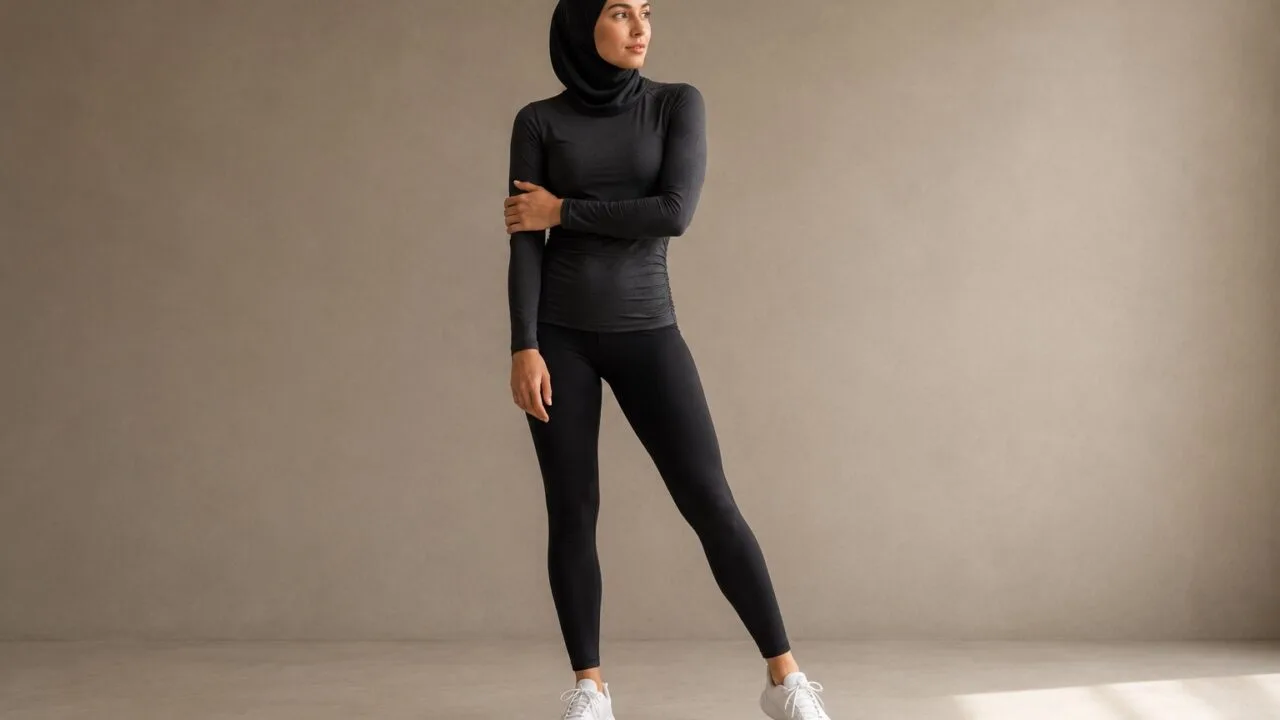
The mistake is treating modest as a single long garment. It’s a layered system, and the layers have to cooperate — no gap at the waist when the arms go up, no ride-up when the body folds forward.
| Layer | Piece | Its job | Get this right | Common mistake |
|---|---|---|---|---|
| Base | Sports bra + fitted long-sleeve | Support and skin coverage that stays | Opaque, wicking, thumbholes to hold sleeves down | Bulky seams that print through the tunic |
| Mid | Longer tunic / tee | Cover hips and glutes through movement | Length to mid-thigh, body that skims not clings, side slits over leggings | Cling fabric that maps the body |
| Bottom | Full-length or wide-leg legging | Full-leg coverage, opaque in a squat | High rise, squat-proof knit, no front-seam gape | Thin knit that goes sheer under stretch |
| Head | Pull-on sport hijab | Stay put, breathe, dry fast | Fitted, wicking, breathable at the ears, no pins | Cotton jersey that soaks and slips |
The tension is length versus movement: a tunic long enough to cover restricts a lunge, so you add a side slit — but a slit exposes, so it only works over a full-length legging. Design the pieces together. A seamless base layer helps, with no side seams to print through a fitted top, and a proper compression base keeps the stack from shifting.
Opacity and heat: the two problems more fabric creates
Two technical problems grow the more you cover.
Opacity. Modest wear cannot go see-through, and the failure point isn’t the flat hanger — it’s the stretched, sweaty forward fold. Judge opacity wet and stretched, never dry and flat. Lighter, breathable fabrics often need a lining or a denser knit to stay opaque, so construction and weight matter more here than in ordinary activewear. (Our fabric-weight guide explains why two 250 GSM fabrics aren’t equally opaque.)
Heat. More coverage traps more heat, so a modest garment lives or dies on wicking and quick-dry — the opposite instinct to “heavier for coverage.” The craft is the balance: heavy enough to be opaque, light enough to breathe. You buy it back with high-wicking, quick-dry yarn and venting placed where it won’t expose — underarm, upper back, the nape under a hijab.
Where not to spend: don’t pay for premium four-way compression on an outer tunic that never needs recovery, or a branded waistband on a legging no one sees under a tunic. Spend on opacity and wicking — that’s what the customer feels.
The sport hijab is its own product
The head covering is where most modest lines quietly fail, because a scarf built for the street is not built for a workout. A sport hijab is a performance piece with its own brief:
- Pull-on, no pins. A one- or two-piece (al-amira-style) pull-on stays put; pins and wraps don’t survive a sprint.
- Stays put. Long enough front and back not to slip, snug at the chin, no gape when the head turns.
- Breathes where it’s hot. Heat builds at the crown and ears; a lighter knit or mesh there releases it without showing hair.
- Dries fast. Cotton soaks and stays cold and heavy; a wicking, quick-dry knit sheds it.
- Doesn’t rub. Keep seams off the hairline and ears — flatlock or bound, not a hard overlock ridge.
- Opaque but light. Enough not to show hair, little enough not to overheat.
Because it sits against the skin and hairline for a whole session, this is a fair place to ask about next-to-skin standards such as OEKO-TEX® — the kind of thing buyers look for on skin-contact knits.
Modest swimwear: a close adjacency, different fabric
Many modest lines get asked for full-coverage swim next — a hood, a tunic and leggings. It’s a natural extension, but don’t reuse your gym fabric. Swim needs chlorine- and UV-resistant fabric and has to stay opaque wet, a harder test than dry. It also can’t balloon or drag in the water, so cut and weight are tuned differently. Treat it as a related product with its own spec, not a longer swimsuit.
How to check a modest sample like a factory
- Wet-and-stretch opacity: spray it, stretch it over a hand, hold it to the light. Sheer wet means sheer in a sweaty class.
- Move in it: forward fold, overhead reach, deep squat, lunge — watch for waist gap, ride-up and slit exposure.
- Hijab, 20 minutes moving: does it slip, soak, or rub the ears?
- Wash and re-measure: a tunic that shrinks up loses its coverage. Check dimensional stability, not just the first-wash look.
- Seam check on skin: feel inner-thigh, underarm and hijab seams for a ridge that will chafe — then write the good ones into the tech pack so bulk matches the sample.
FAQ
Is modest activewear just regular activewear made longer? No. The hard parts are opacity that holds when stretched and sweaty, coverage that stays put through movement, and managing the heat that extra fabric traps. Length is the easy 10%.
What makes a good sport-hijab fabric? Lightweight, high-wicking and quick-dry, opaque enough not to show hair, and breathable at the ears and nape. Pull-on beats pinned for sport. Cotton jersey is the usual mistake — it soaks and slips.
Can modest and plus sizes be made seamless? Yes. Large-cylinder seamless machines (roughly 17–21″) run smooth, side-seam-free base layers up to around 2XL/3XL — useful in a segment where extended sizing and full coverage often go together.
What’s a realistic MOQ to launch a modest capsule? For stock styles with your logo, often around 100 sets. For full custom development — your own patterns, longer lengths, a bespoke hijab — usually about 300–500 pieces per style, scaling up from there.
At YOUMEGA we run cut-and-sew in Xiamen for the lined tunics and hijabs, and seamless in Yiwu for the smooth base layers — including larger sizes on our large-cylinder machines. Send us your coverage requirements and a reference look, and we’ll tell you honestly which pieces to make seamless, which to line, and where an extra dollar of fabric actually earns its place. We reply within 24 hours.