How to Wash Activewear: The Routine That Keeps Leggings and Sports Bras Performing
Short answer: Check the garment's care label first. Turn activewear inside out and use the permitted temperature and cycle with the detergent dose on its pack. The wash-tub number is a maximum, not a target. Air-dry when the label permits; if it allows tumble drying, follow its heat setting.
The routine, step by step
- Do not leave damp kit bunched up. Take it out of the bag when practical; follow the garment's care label for washing and drying.
- Sort by texture, not just colour. Wash activewear with activewear: towels, denim and zips rub the fabric surface, and friction is what starts pilling.
- Close zips and hooks, then turn garments inside out if the label permits. This can reduce contact between hardware, prints and other items in the load.
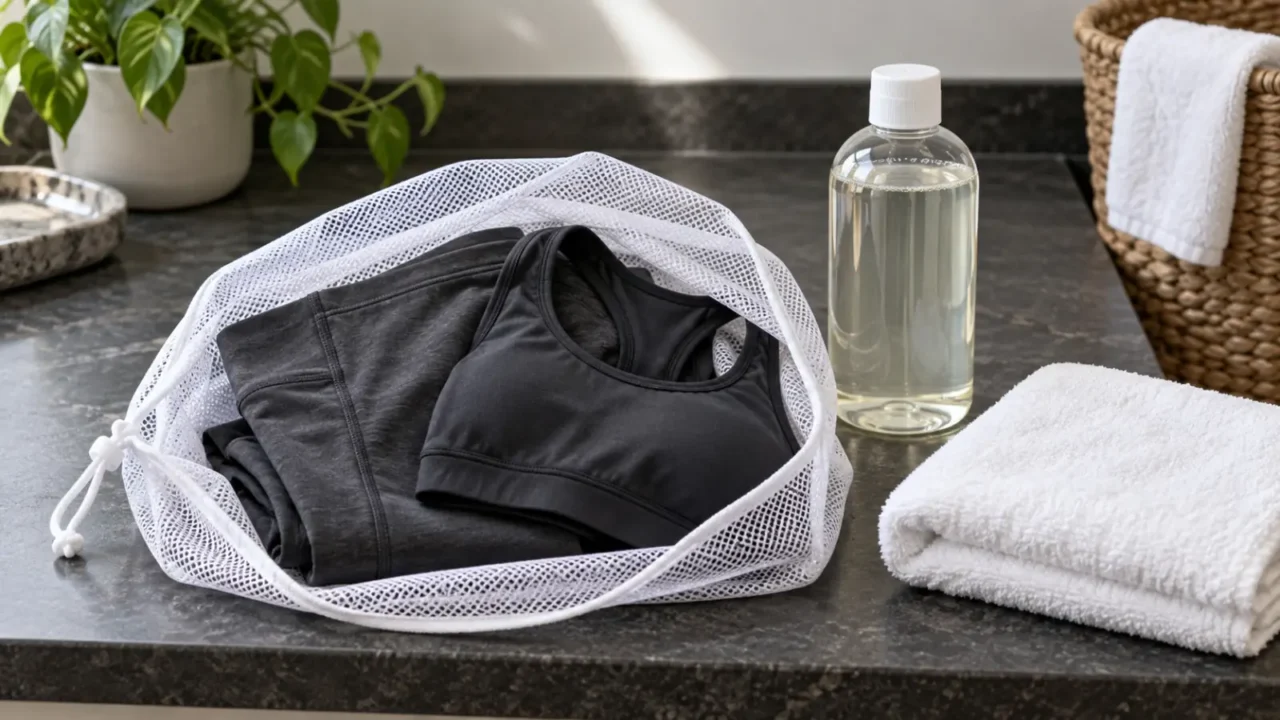
- Put sports bras and anything with straps in a mesh bag. It stops straps tangling and hooks snagging other garments.
- Use the wash process on the label. The number in the tub is a maximum, not a target; a bar beneath it indicates a milder process. Choose the cycle the actual garment permits.
- Measure the detergent. Follow its dosage and garment-compatibility instructions. An enzyme detergent may be an option for body soils when both the product directions and garment label permit it; do not infer a result for every fabric.
- Treat softener as a decision, not a habit. Softeners are cationic surfactants that attach to the fibre and lubricate it, and plenty of activewear labels exclude them — that instruction wins. They are also not for flame-resistant garments, where they can reduce flame retardancy.
- Follow the drying and ironing symbols. Air-dry when the label permits; if it allows tumble drying, use its specified setting. A crossed-out circle in a square means no tumble drying. Check print and transfer instructions before ironing.
The settings that matter
| Setting | Do | Avoid | Why |
|---|---|---|---|
| Temperature | The label's maximum or cooler | Going above the number in the tub | The label gives the permitted process for the whole garment |
| Cycle | The process on the label; one bar calls for a milder wash | A cycle more intensive than the label permits | Match the mechanical action to the whole garment |
| Detergent | A measured dose; consider an enzyme type for body soils only if both product directions and garment care permit it | Doubling the dose or assuming every enzyme formula suits the garment | Dose and compatibility depend on the product and garment |
| Softener and dryer sheets | Follow the garment's own instruction | Assuming every finish tolerates them | Softener deposits on the fibre surface, where a finish sits |
| Bleach | Use only the bleach type allowed by the garment's care label and the cleaner's instructions | Bleaching a garment marked with a crossed-out triangle | The symbol applies to the whole garment, including trims and finishes |
| Drying | Follow the garment's line-dry, flat-dry or permitted tumble-dry instruction | Assuming every garment can be tumble-dried or exposed to direct heat | The label applies to fabric, trims and prints together |
| Ironing | Follow the garment and print instructions; one dot indicates a low iron-temperature limit | Ironing a print without confirming its care instructions | A fibre name alone does not establish the whole garment's ironing tolerance |
For stains or finishes, check the garment and cleaning-product instructions before adding another treatment.
By garment: the one extra rule for each
| Garment | The extra rule | Why |
|---|---|---|
| Leggings | Inside out, and not with towels or exposed zips | Pilling starts with friction — the full explanation |
| Sports bras | Fasten the hooks and use a mesh bag; reshape moulded cups before drying by the method on the label | Helps prevent hooks snagging other garments; the drying method remains garment-specific |
| Printed or logo pieces | Follow the whole-garment label and the print's approved care instructions | Print and transfer compatibility must be checked on the actual garment — see why heat-transfer wash labels peel |
| White and light colours | Follow the wash and bleach symbols for the garment | A light colour does not make bleaching automatically safe — see white activewear and sweat yellowing |
| Compression and shapewear | Follow the approved sample's care label | Fibre content and care instructions vary by style |
| Seamless pieces | Check the actual care label | Construction alone does not establish fibre content or care process |
| Mineral-infused or antimicrobial finishes | Check the garment and finish supplier's instructions before using softener | Compatibility depends on the particular finish — see embedded minerals and washing |
How often should you wash activewear?
For a garment worn against sweaty skin, assess odour and soil after use and follow its care label. A small study of 26 people compared polyester and cotton T-shirts after a spinning class and 28 hours of sealed storage; that condition does not dictate a universal wash frequency for every garment.
An outer layer may need a different wash frequency from a garment worn directly against sweaty skin. Check soil, odour, the label and the use conditions rather than assigning a fixed number of wears. If washing is delayed, keep damp clothing from sitting bunched up.
Avoid leaving damp kit bunched up; use the wash and drying processes permitted by its label.
If it still smells after washing
Persistent odour can have more than one cause. Check the care label and detergent instructions before trying a new treatment:
- Review storage and wash timing. Avoid leaving damp garments bunched up, then launder them using their labels; odour outcomes vary by fabric and use.
- Review the detergent. An enzyme formula may suit some body soils, but check its directions, dose and suitability for the actual garment.
- Pre-treat only when permitted. Follow the cleaner's stated dose and time; do not exceed the garment's wash-temperature limit.
The full explanation is in why activewear still smells after washing. For marks rather than smells, see stain removal on synthetic activewear and what a stain remover does to activewear fabric.
Hand-washing when the garment label allows it
- Use the water temperature permitted by the hand-wash symbol and dissolve a suitable detergent first.
- Let the garment float in the solution and agitate it carefully. Do not rub, pull or wring it.
- Press the water out between two folds of a towel.
- Follow that garment's drying symbol; flat drying is only one possible instruction.
What the care-label symbols mean
Care symbols are standardised internationally in ISO 3758, whose current edition was published in December 2023; the symbols themselves are the GINETEX system. These are the ones you meet on activewear.
| Symbol | What it means |
|---|---|
| Wash tub with a number, e.g. 30 | The maximum wash temperature in °C; it must not be exceeded, and a cooler wash is within the instruction |
| Wash tub with one bar underneath | A milder cycle with reduced mechanical action — the process given for articles in polyester and polyamide, among other fibres |
| A hand in the wash tub | Hand wash: let the garment float, agitate carefully, and do not rub, pull or wring it |
| Crossed-out triangle | Do not bleach |
| Triangle with two diagonal lines | Oxygen bleach only, no chlorine |
| Crossed-out circle in a square | Not suitable for tumble drying |
| Square with a vertical or horizontal line | Line dry or dry flat; an oblique line in the corner means dry in the shade |
| Iron with one dot | The coolest iron setting; steam can cause irreversible damage, and shiny or pressure-sensitive pieces are ironed inside out or under a press cloth |
| Crossed-out iron | Do not iron |
How we set a care label at the factory
A care label should be set for the garment and its market, not copied from another style. Review the fabric and finish data, trims, logo application and the washing process the proposed label permits. Agree which shrinkage, twist, colourfastness and logo-durability checks are needed for that order, who conducts them and the acceptable results. Set the wash and dry process only after checking the whole garment, its finishes and applicable test results. The labelling requirements then depend on the market — see US vs EU textile labels.
FAQ
Can you put activewear in the dryer? The label settles it. A crossed-out circle in a square means no dryer; otherwise follow the permitted drying process and heat setting for that garment.
What temperature should activewear be washed at? Use the wash process stated on the actual garment's label. The number in the wash tub is a maximum, not a target, and a bar below the tub indicates reduced mechanical action. Do not assign one temperature to all stretch garments.
Should you use fabric softener on activewear? You can, but check the garment first. Softeners are cationic surfactants that attach to the fibre and lubricate it, and the American Cleaning Institute says modern ones can be used on microfibre and athleticwear without affecting absorbency or wicking. Many activewear labels still exclude softener, and that instruction wins on that garment.
How do you get the smell out of gym clothes? Remove damp kit from the bag and follow the garment's care label. An enzyme detergent may help with body soils when its instructions permit the garment and temperature; any pre-treatment should follow both product and care-label directions.
Can I wash activewear with my regular clothes? Compare the labels, colours and hardware in the load. Towels, denim and exposed zips may abrade a delicate surface. Use a wash process allowed for every garment in the load, rather than assigning one cycle to all activewear.
How often should I wash my leggings and sports bras? Judge sweat, soil and the garment's instructions after each wear. Base-layer pieces may need more frequent laundering than outer layers; a single T-shirt odour study does not set a rule for all products.
Specifying a line? Share the fabric, trims and print method so we can agree on the testing needed before setting its care label for your market.
Sources
- ISO 3758, Textiles — Care labelling code using symbols (current edition published December 2023)
- GINETEX, care symbols and what each one means
- American Cleaning Institute, enzymes in cleaning products
- American Cleaning Institute, fabric softeners and enhancers
- American Cleaning Institute, laundry products and detergents (using the right amount)
- Callewaert et al., "Microbial Odor Profile of Polyester and Cotton Clothes after a Fitness Session", Applied and Environmental Microbiology 80(21), 2014