Updated November 2026. Written from YOUMEGA’s production floor.
Activewear necklines and straps in one answer
There are 15 neckline and strap styles in common use on activewear, in two groups: 7 necklines at the front (scoop, square, V and plunge, crew and high neck, mock neck, halter, one-shoulder) and 8 strap and back styles (thin, wide, adjustable, racerback, cross-back, strappy, open back, convertible). The neckline sets coverage and how the front sits. The straps and back carry the load, decide whether the top slips off the shoulder, and decide how easy it is to get on and off.
The same names cover sports bras, tanks, crops, unitards and swimwear. Change the neckline or back and you have a new style on the same fabric and block pattern. Each one also brings its own sewing problem, and that’s what this page is about.
| Style | What it is | Best for | What to specify to a factory |
|---|---|---|---|
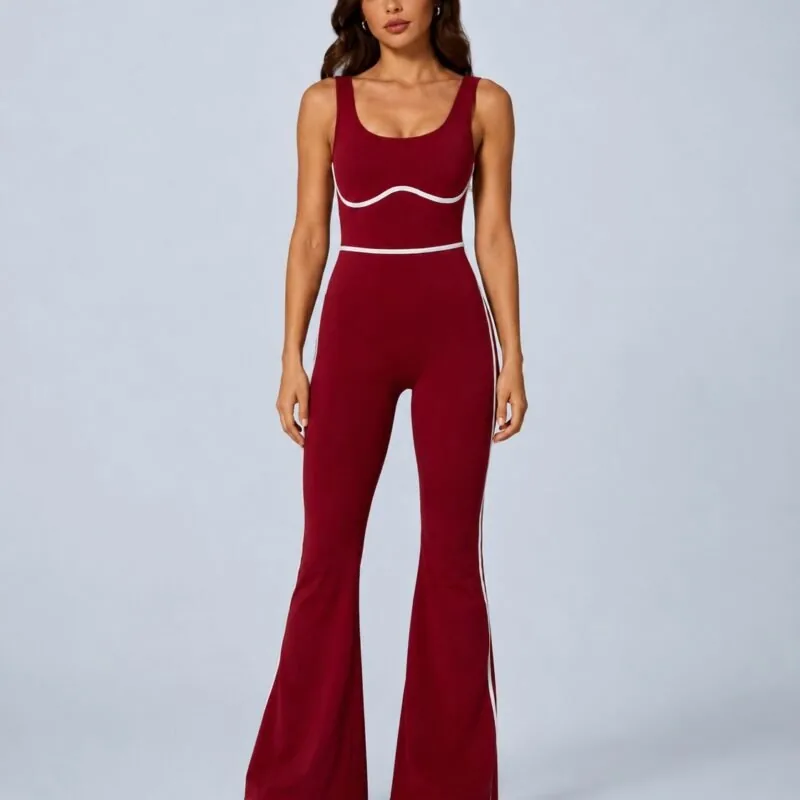
| Scoop neck | Rounded front neckline | Everyday bras, tanks, unitards | Front neck drop from the shoulder, edge finish |
| Square neck | Straight across with two corners | Fashion bras, crops | Lined or bound, corner construction |
| V-neck and plunge | Neckline that ends in a point | Low-impact bras, statement tops | Depth of the V, reinforcement at the point |
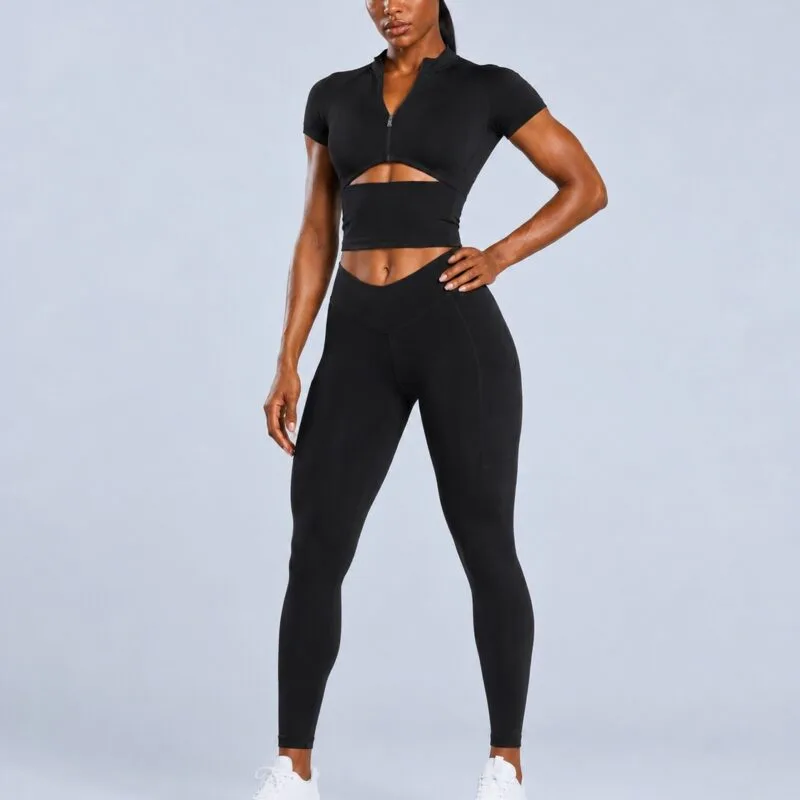
| Crew and high neck | Neckline close to the collarbone | Coverage, larger busts, modest ranges | Neck height, stretched neck opening |
| Mock neck | Short stand-up collar | Long sleeves, zip tops, unitards | Collar height, band stretch |
| Halter | Straps go around the neck | Low-impact bras, swim-inspired tops | Closure, neck strap width |
| One-shoulder | Single strap, asymmetric front | Statement bras and crops | Gripper on the open side, grading |
| Thin straps | Narrow elastic or fabric straps | Light-support bras, camis | Strap width, elastic or fabric tube |
| Wide straps | Broad straps that spread the load | Medium and high support | Strap width, padding, attachment |
| Adjustable straps | Straps with sliders and rings or hooks | Fit across bust sizes | Hardware type and position |
| Racerback | Straps meet between the shoulder blades | Running, lifting, classes | Strap width at the narrowest point, armhole |
| Cross-back | Straps cross in an X at the back | Yoga, classes, medium support | Strap length tolerance, cross point |
| Strappy or cage back | Several thin straps in a pattern | Statement pieces | Number of straps, strap material, tolerances |
| Open back and keyhole | Cut-out at the centre back | Yoga, pilates, unitards | Cut-out size, edge finish, underband |
| Convertible | Straps worn straight or crossed with a clip | Versatile bras | J-hook or clip type, strap length |

Necklines
1. Scoop neck
The rounded neckline that most sports bras and tanks start from. Depth is measured as the front neck drop from the high point of the shoulder to the centre front, and that one number decides how much shows. A deeper scoop looks lighter but holds less at the front.
The edge can be finished three ways. A folded band of self fabric, a binding, or a lining turned to the inside so no stitching shows at the edge. Turned linings give the cleanest look. Bindings are the most durable on thin fabric.
The tech pack needs the front neck drop, the edge finish and, for bras, whether the neckline carries an elastic.
2. Square neck
Straight across the front, with two corners where it meets the straps. It reads as fashion more than sport.
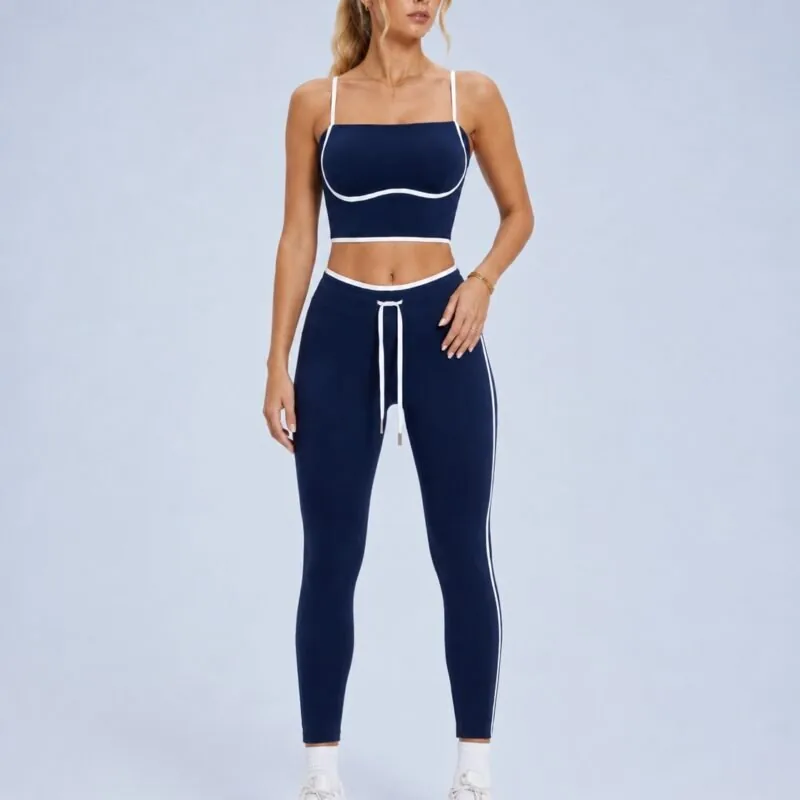
Those corners are the hard part. Elastic and binding both want to curve, so a bound square neck often ends up slightly rounded or puckered at each corner. Most factories line square necks and turn the lining through, which keeps the corners sharp. For a first run we’d choose the lined version. A mitred binding works but is slow and hard to keep consistent in bulk.
Tell the factory lined or bound, how the corners are built, and the neckline width.
3. V-neck and plunge
A neckline that drops to a point at the centre front. A plunge is a deep V, often meeting the underband. It holds less at the front than a scoop, so it belongs on low-impact pieces.
The point of the V takes all the strain when the wearer moves. Without a small bartack or a reinforcing stay there, the fabric pulls and eventually tears. A plunge also needs something at the centre front to keep each side in place: a narrow centre gore, a bonded edge, or a firm elastic.
Give the depth of the V, the reinforcement at the point and what holds the centre front.
4. Crew and high neck
The neckline sits at or near the base of the neck, so the front covers the chest up to the collarbone. More fabric at the front means more coverage and, on a bra, more hold. Larger busts, high-impact training and modest ranges use it most; for the last, see our article on modest and hijab activewear design.
On a pull-on style the head has to pass through the neck opening. A high neck that fits closely can be too tight to get over the head, so the factory has to check the stretched neck opening on the sample as well as the flat measurement. Some high-neck bras add a back zip or hook to get round this.
Write down neck height, the relaxed and stretched neck opening, and any opening at the back.
5. Mock neck
A short stand-up collar, usually a band of the same fabric folded double. It appears on long-sleeve tops, quarter-zips and unitards.
The band needs enough stretch to go over the head, and enough recovery not to sag after a few wears. A band cut in the wrong grain of the fabric will do one or the other badly. Check it after washing.
Write down collar height, band construction and which way the band is cut.
6. Halter
The straps run up from the front and go around the neck instead of over the shoulders.
All the weight hangs from the back of the neck. That’s fine for yoga and bad for running, and a halter sold as a running bra will come back as returns. The closure matters: a clip, a hook, a tie, or a pull-on loop. Ties look good and come undone.
Note the closure, the width of the neck strap and whether the strap is padded or lined.
7. One-shoulder
A single strap over one shoulder and an asymmetric front. It’s a statement piece for bras, crops and unitards. Support is limited to low impact.
The open side slips. Factories stop it with a strip of silicone gripper inside the top edge on that side, and a firmer underband. Asymmetric styles are also harder to grade, because the strap angle changes with size and has to be checked on more than one size before bulk.
Specify the gripper, the underband, and that grading is checked on at least two sizes. For other details factories tend to push back on, see designs factories reject.
Strap and back styles
8. Thin straps
Narrow straps, either a plush-backed elastic or a fabric tube with elastic inside. They go on light-support bras, camis and fashion pieces. They look delicate and they dig in under load, so they don’t belong on anything meant for running.
Specify the strap width, elastic or fabric tube, and how the strap is attached (sewn into the seam, or bartacked on top).
9. Wide straps
Broad straps that spread the weight over more of the shoulder. The usual choice for medium and high support.
The width is only half of it. Where the strap meets the cup and the back decides whether it rubs. Our chafing, underband and strap wear-test article explains what to check in a wear test.
On the tech pack: strap width at the shoulder, padding or lining, attachment points.
10. Adjustable straps
Straps with a slider and a ring or hook so the wearer can shorten them. Standard on high-support bras.
Hardware brings its own failures. Plastic sliders can crack. Metal can mark or rust if the coating is poor, and any slider at the front of the shoulder presses into the skin under a backpack. Placing the hardware at the back avoids most of that. Our article on trims, elastics and hardware covers materials and finishes.
Specify hardware material and finish, its position, and the adjustment range.
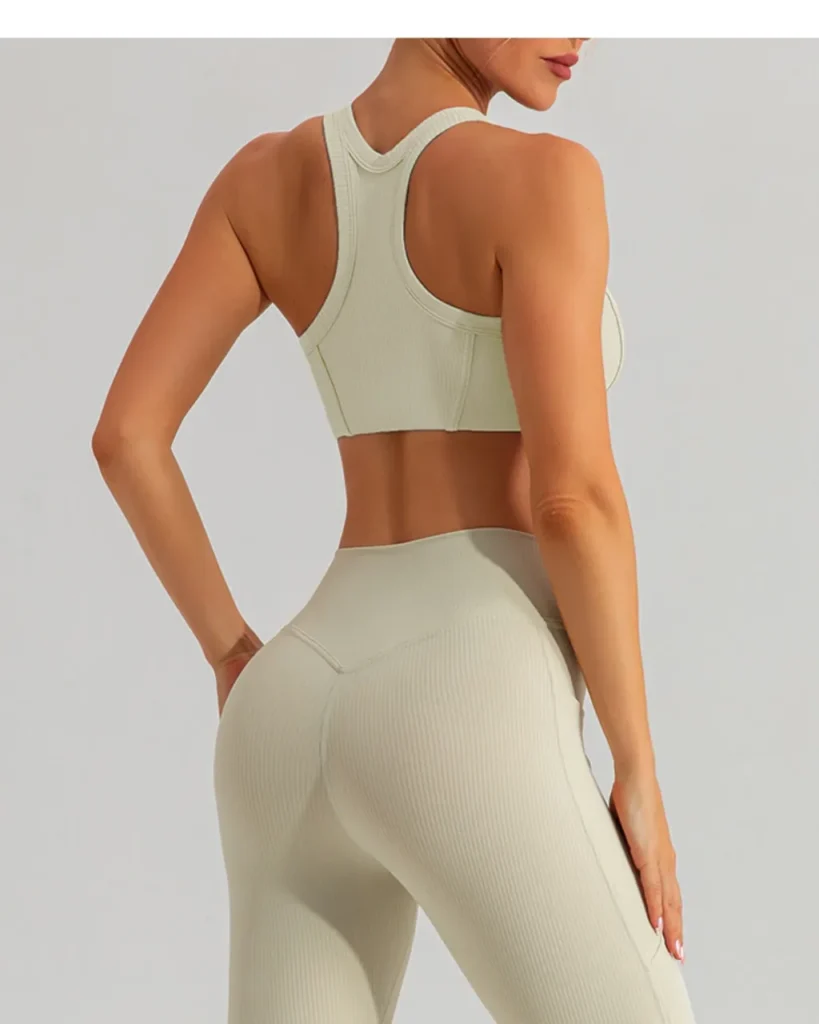
11. Racerback
The straps come in from the shoulders and meet between the shoulder blades in a Y or T shape. They can’t slip off, and the shoulder blades move freely, so racerbacks are standard for running and lifting. The trade-off is getting a high-support racerback on and off over the head when it’s sweaty. Some add a front zip for that reason.
Give the strap width at its narrowest point, the armhole depth and the back edge finish.
12. Cross-back
Two straps that cross in an X between the shoulder blades and attach to the underband. They spread load well, and yoga and studio ranges use them a lot.
The cross has to sit on the centre back. If one strap is cut or sewn a little longer than the other, the X sits off-centre and pulls one shoulder. Ask for strap length tolerances on the tech pack and check both straps on the sample.
Specify strap length and its tolerance, the cross point, and whether the straps are sewn together where they cross.
13. Strappy and cage back
Several thin straps arranged in a pattern across the back. They make a plain bra look new, and they cost more than they look. Each strap is its own cutting and sewing operation, and its own place for something to go wrong. On sizes far from the base size, the straps often sit in the wrong place.
Our article on making activewear styles that stand out looks at cheaper ways to get a distinctive back.
Specify the number of straps, their material and width, length tolerances, and which straps carry load.
14. Open back and keyhole
A cut-out at the centre back, either a large open shape or a small keyhole. With the centre back open, the underband and straps carry all the support.
The edge of the cut-out needs the same care as a neckline. A binding or a turned lining keeps a keyhole round. A raw edge will curl.
Mark the cut-out size and position, the edge finish and the underband construction.
15. Convertible straps
Straps that can be worn straight or clipped together as a cross-back, using a J-hook or clip. One bra, two looks.
The clip is one more piece of hardware to source, inspect and place where it won’t press into the back. Check that the straps are long enough to cross comfortably on the largest size.
The factory needs the clip type, strap length for both ways of wearing, and the clip position.
How YOUMEGA makes these
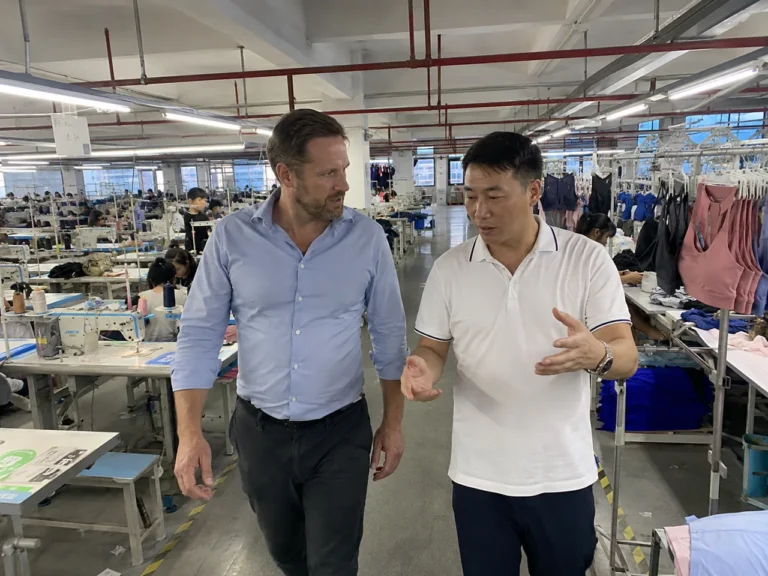
- Cut-and-sew bras and tops are made at our Xiamen factory. Seamless bras and tops are knitted at our Yiwu factory.
- Yiwu runs Santoni 17–21″ seamless machines, which let us make seamless styles up to 2XL/3XL.
- Stock styles with your logo from 100 sets (mixed colours and sizes), full custom 300–500 pieces per style per colour.
- Samples take 7 days for a stock style with your logo, 10–15 days for a full custom style.
- Orders are inspected to AQL 2.5, with a photo report before shipment.
FAQ
Which neckline gives the most support on a sports bra? A high neck or crew neck, because more fabric covers the front. Pair it with wide straps or a racerback for high-impact use.
Which strap style stops a sports bra slipping off the shoulder? Racerback and cross-back. Both meet or cross between the shoulder blades, so the straps can’t slide outwards.
Are strappy backs harder to manufacture? Yes. Each strap adds a cutting and sewing operation and a tolerance to control.
Can I change only the neckline or back on an existing style? Yes, as a full custom style. Stock styles with your logo keep their original shape, so a new neckline or back is developed as full custom, at 300–500 pieces per style per colour.
Where should adjustable strap hardware go? At the back, where it doesn’t press into the shoulder under a bag strap.
What is the hardest neckline to sew well? A square neck, because both corners have to stay sharp. A lined, turned finish is the most reliable way to get them sharp across a bulk order.
When you’re ready to develop a bra with a particular neckline or back, our sports bra manufacturing page shows where we start. For the full development path, see private-label sports bra development.