Why Factories Push Back on Your Activewear Design: 7 Details That Don’t Survive Sewing
When a factory says “we suggest changing this,” it is rarely taste and almost never laziness. It is usually one of seven recurring details that look fine in a drawing and fail on a sewing machine — and every one of them has a redraw that keeps the look while surviving production. A good factory flags them at quoting; a bad one sews them anyway and lets you discover the problem across 500 finished units.
Here are the seven, from the sewing floor’s point of view.
1. Colorblock seams that meet on high-stretch curves
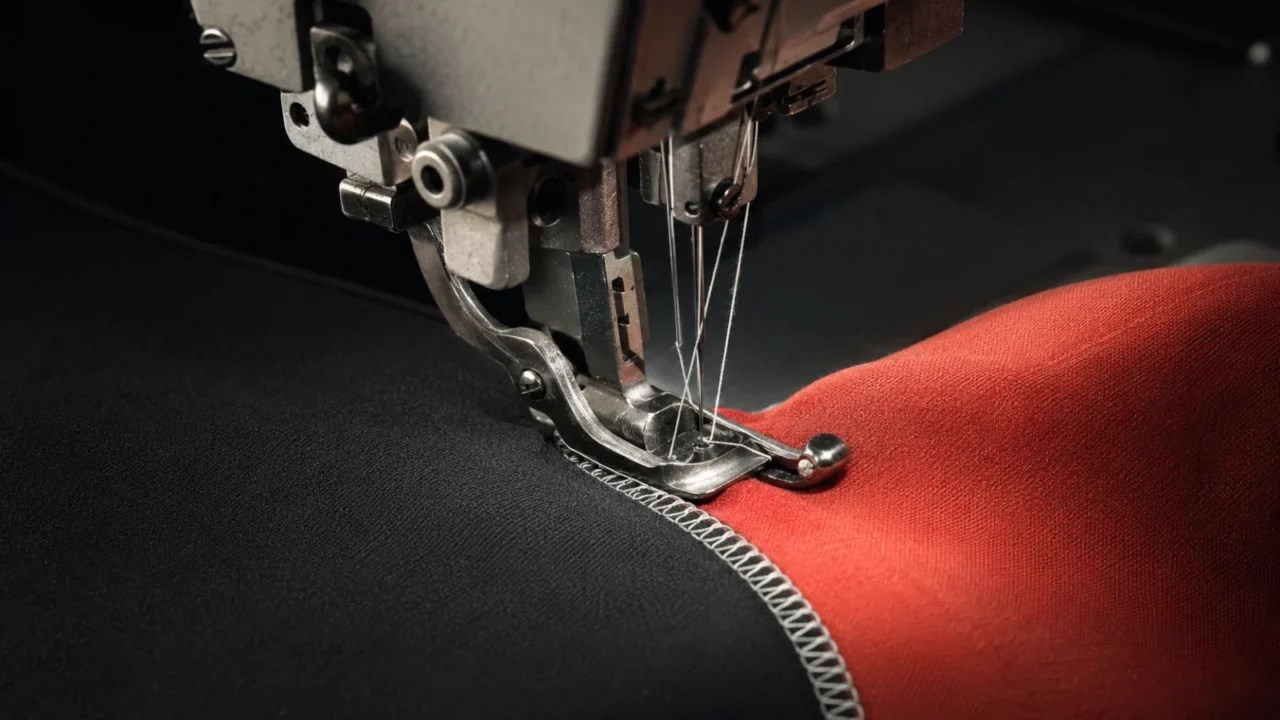
A seam junction drawn at the hip or the seat sits on fabric that stretches 30–50% in wear. Two seam lines meeting at a point must land exactly — but 4-way stretch shifts under the needle, so junctions on high-curve, high-stretch zones drift out of register piece by piece. On a flat sketch the X meets perfectly; on the twentieth garment it misses by millimetres, and the eye catches it instantly on a contrast colorblock.
The redraw: move junctions to lower-stretch zones (side seam, below-knee), or convert a four-line meeting point into a staggered offset the eye reads as intentional. Where blocks must meet on a curve, the seam type and feed handling get specified, not assumed.
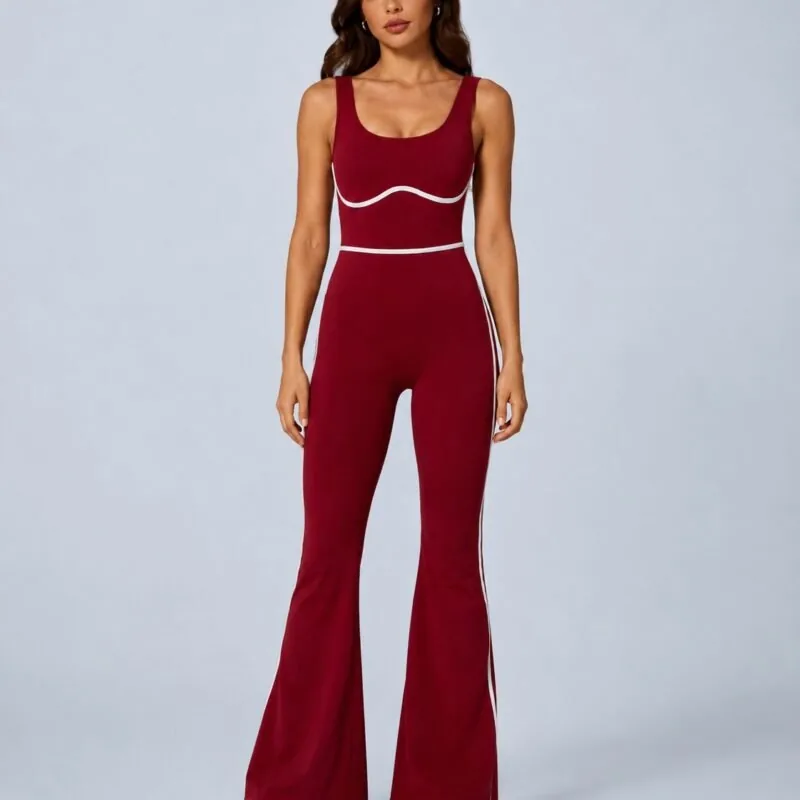
2. Strips and piping under about a centimetre
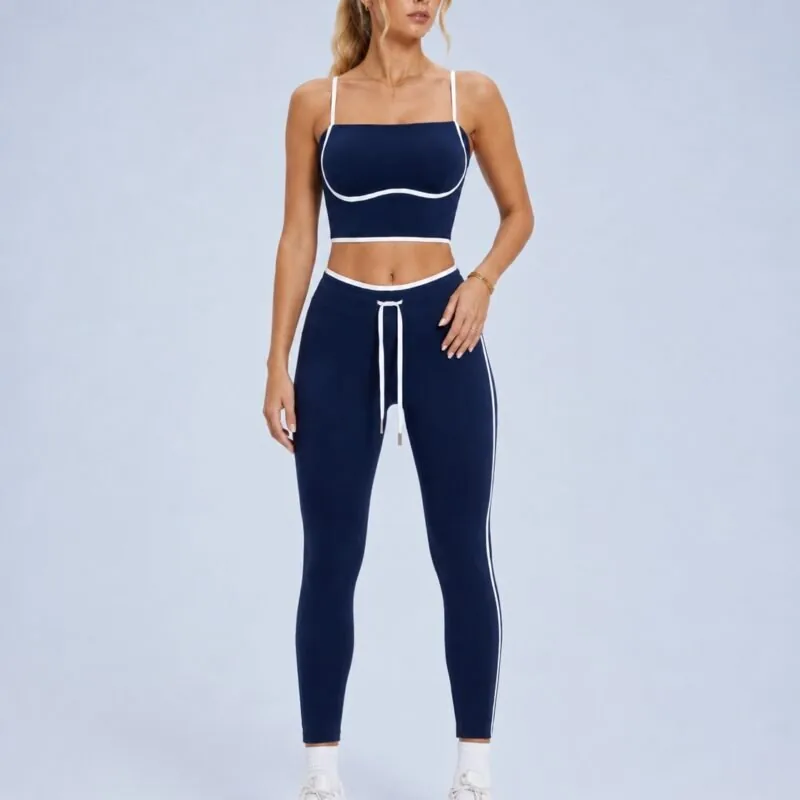
Contrast strips, binding and piping below roughly 1 cm finished width are at the edge of what stretch-knit feeding holds straight. Narrow strips twist, flip and wave over a long seam, because the strip and the body stretch differently while both move under the foot.
The redraw: widen the strip, or achieve the thin-line look with a stitched-on elastic tape or a printed line instead of a sewn-in strip.
3. Pockets on high-stretch panels with nothing stabilising them
A pocket bag adds dead weight and a rigid opening to a panel engineered to stretch. Unstabilised, the opening gapes, the bag sags, and a phone drags the whole side panel down — a complaint that arrives as “the fabric feels cheap” when the fabric was never the problem.
The redraw: bonded or zippered pockets on a stabilised zone, double-layer side panels that carry the load, or the pocket constructions that actually work on leggings.
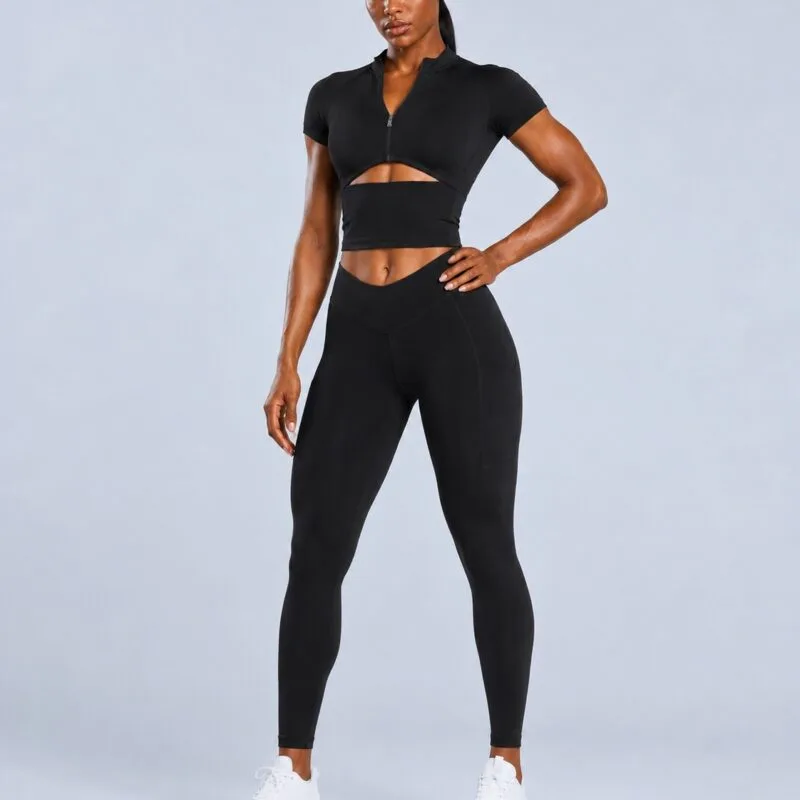
4. Zippers set into stretch without stabiliser
A zipper tape has zero stretch; the panel around it may stretch 40%. Sewn together naked, the fabric feeds faster than the tape and the result is the wavy, rippled zipper line that reads instantly as low quality.
The redraw: stabilising tape or interlining in the zipper seam, a slightly shorter zipper opening than the drawing implies, and a fabric-side ease allowance the pattern-maker adds on purpose. Specified up front, this is routine; discovered in bulk, it is a remake.
5. Prints and logos that cross seams
Sublimation and placement prints that continue across a seam ask two separately-cut, separately-sewn pieces to align within a millimetre or two — across hundreds of garments, on fabric that moves. All-over sublimation manages this with print-then-cut engineering and tolerance-aware artwork, but a logo straddling a side seam is a reject-rate generator by design.
The Brand Kit Visualizer is a useful pre-sample check here: compare placements and process constraints before a logo is committed near a seam or high-stretch zone.
The redraw: keep placement artwork at least a couple of centimetres clear of seams, or design the cross-seam element as deliberately offset so registration variance disappears into the design.
6. Two fabrics with different stretch sewn into one line
A mesh insert at 20% stretch sewn to a main body at 45% stretch will pucker on the low-stretch side or bag on the high-stretch side — the seam is fighting a physics problem, not a sewing-skill problem. The garment then twists in wear and wash, which is the same mechanism covered in stretch and recovery testing.
The redraw: match stretch ratios between joined panels, or let the pattern compensate with differential ease — which requires knowing both fabrics’ measured stretch, not their catalogue description.
7. Waistbands drawn against the physics of recovery
Very wide contrast bands in a different fabric from the body, fold-over constructions in fabrics with weak recovery, ultra-high rises with no anchoring — the waistband is the most engineered component in a legging, and drawings frequently treat it as a decorative rectangle. The mechanics live in waistband construction; the short version is that a band’s fabric, width and elastic strategy are one decision, not three.
Standards worth knowing when you spec construction
- ASTM International — standard classifications of stitches and seam types used to specify construction unambiguously (ASTM D6193) — https://www.astm.org/
- AATCC — test methods for stretch, recovery and dimensional behaviour that predict how a construction behaves in wear — https://www.aatcc.org/
- ISO — international textile and garment standards underpinning construction and testing specs — https://www.iso.org/
Naming a seam by its ASTM D6193 designation in your tech pack removes a whole category of “that’s not what I meant” — the factory and the designer are finally pointing at the same stitch.
What a good factory does with an unmanufacturable detail
Says so at quoting, shows why on a sewn swatch, and offers the redraw — because sewing a known failure into 500 units costs you a remake and costs us the account. At YOUMEGA that conversation happens before sampling: custom development at 300–500 pieces per style per colour includes a manufacturability pass on the tech pack, and stock styles from 100 sets exist precisely because their constructions have already survived thousands of units.
The design you keep is the one that ships.
Questions that surface manufacturability problems early
- Which details of this design would you change before production — and why?
- Can you show me this seam junction sewn on the actual fabric, not drawn?
- What is the measured stretch of both fabrics at every joined seam?
- Which of these details raises the reject rate, and by roughly how much?
FAQ
Why did the factory reject my activewear design? Almost always manufacturability, not taste: seam junctions on high-stretch curves, sub-centimetre strips, unstabilised pockets or zippers, prints crossing seams, mismatched stretch ratios, or a waistband that fights recovery. Each has a standard redraw that preserves the look.
What is a manufacturability review? A pass over the tech pack by production staff before sampling, flagging details that will misalign, pucker, wave or fail in wear — with proposed fixes. It is cheaper than discovering the same list across a finished production run.
Can complex colorblocking be produced reliably? Yes, when junctions sit on lower-stretch zones, meeting points are staggered by design, and seam types are specified. Colorblocking fails when a flat drawing assumes fabric that doesn’t move.
Why do zippers on leggings often look wavy? Zero-stretch tape sewn into high-stretch fabric without stabiliser. The fix is stabilising tape, adjusted openings and deliberate ease — specified before sampling.
Do factories change designs without asking? A good one proposes changes with reasons and sews nothing until you approve. If pushback never comes on an ambitious design, it usually means nobody checked — which is worse.
Have a design a factory said couldn’t be made? Send the tech pack — we’ll tell you which details fail at the machine, what the redraw looks like, and sew the swatch that proves it. Reply within 24 hours on weekdays.