China's Activewear Manufacturing Regions: Where Sportswear Is Made (2026)
Short answer: China's activewear supply chain is organised in clusters — towns and districts that each specialise in one step, from yarn to finished garment. The China National Textile and Apparel Council (CNTAC) counted 229 textile and apparel clusters across 27 provinces in its 2025 report, together holding more than 302,000 firms and 4.18 trillion yuan of output in 2024. For knit activewear the ones to know are in Fujian (Jinjiang, including its Yinglin swimwear town, and Fuzhou's Changle district), Zhejiang (Yiwu for seamless knitwear, Shaoxing's Keqiao for fabric), Guangdong (the largest textile and apparel province) and Jiangsu (yarn and knitted garments).
Conflict of interest: YOUMEGA is an activewear manufacturer with facilities in Xiamen, Fujian and in Yiwu, Zhejiang, so we are not a neutral party. This page names no factories and ranks none, ours included. Every regional fact below comes from a government, industry-association or newspaper source listed at the end, most of them in Chinese.
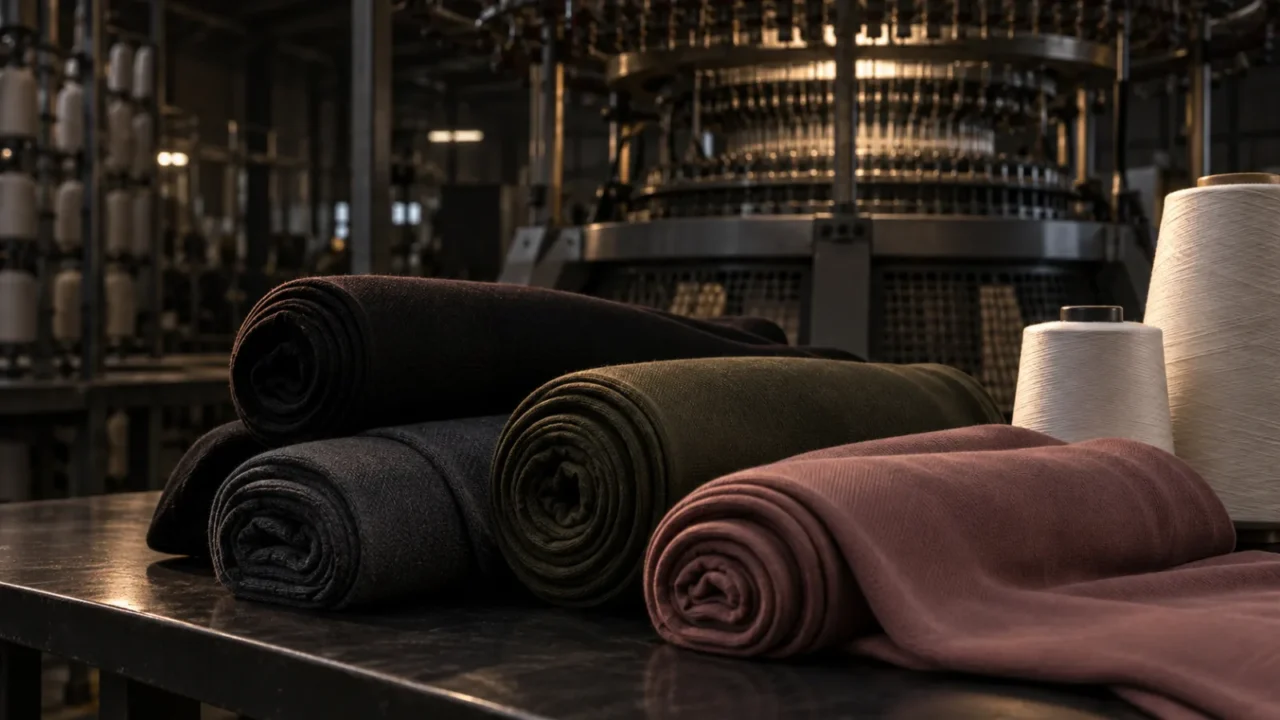
Cover image is illustrative, not a photograph of either YOUMEGA facility.
China's activewear regions at a glance
| Province | Places to know | Known for, according to the sources |
|---|---|---|
| Fujian | Jinjiang, including Yinglin town; Changle district, Fuzhou | Footwear and sportswear; swimwear moving into yoga, fitness and cycling wear; nylon filament, warp-knitted lace and blended yarn |
| Zhejiang | Yiwu; Keqiao district, Shaoxing | Seamless knitwear; China Textile City, the fabric market |
| Guangdong | Dongguan; Puning; Shenzhen and the eastern Guangdong belt | The country's largest textile and apparel province; wool knitwear and underwear clusters; small-order, quick-response production |
| Jiangsu | Zhangjiagang (Deji, Tangqiao) | Core-spun stretch yarn; wool knitwear; a broad, mixed textile cluster |
What is a clothing cluster?
A clothing cluster is a town or district where many firms making one kind of product, and their suppliers, work within a short drive of each other. China's national industry body, CNTAC, has run a cluster programme for two decades: it signs pilot agreements with these places and grants them titles that name a process or a product. Yiwu, for example, holds four, including "China Knitting (Seamless Underwear) City" (translations ours). CNTAC put the number of pilot cluster regions at 207 in April 2024, and its 2025 report counts 229 clusters in all.
Read the map by process, not by product name. A cluster tells you the skills, the machines and the suppliers are nearby. It does not tell you what any single factory in it can do.
Fujian: sportswear, swimwear and nylon
Jinjiang is the sportswear end of the province. Fujian's provincial industry department reported in June 2025 that the city has a footwear-and-apparel industry worth more than 300 billion yuan and a textile industry worth more than 100 billion, accounting for half of China's output of footwear and apparel components, with the whole process available inside a 50-kilometre radius.
- Yinglin, a town inside Jinjiang of under 30 square kilometres, held more than 200 swimwear firms when People's Daily profiled it in September 2024: one swimsuit in five worldwide comes from there, with fibre, fabric, trims and garment making all inside the town. The paper describes firms competing on "small orders, quick response" as e-commerce shrinks order sizes, and moving into yoga wear, fitness wear, cycling wear and diving suits, because those garments use fabrics similar to swimwear.
- Changle, a district of Fuzhou, is the yarn and fabric end. The provincial government reported in January 2025 that it is China's largest production base for civilian nylon filament, for warp-knitted lace fabric and for chemical-fibre blended yarn, with the country's most complete textile chain from petrochemical feedstock through fibre, spinning, knitting and dyeing — while noting that garment making has long been the missing link there.
- Xiamen, further south, is where our own cut-and-sew facility sits; see our guide to activewear manufacturing in Xiamen.
Zhejiang: seamless knitting and the fabric market
- Yiwu is where China's seamless knitting industry grew up. CNTAC wrote in April 2024 that Yiwu accounts for 80% of China's and 30% of the world's output of seamless knitwear — the category the industry calls seamless underwear, which covers seamless leggings, bras and bodysuits as well. Not sure you need seamless? Compare seamless and cut-and-sew activewear.
- Keqiao, a district of Shaoxing, is where fabric is traded. The Zhejiang provincial government reported in April 2025 that China Textile City, the market at its centre, had grown to 38,000 vendors across 3.9 million square metres as of 2024, with textile offices in 16 countries.
Guangdong: the largest textile and apparel province
Southern Daily, the provincial newspaper, reported in February 2026 that Guangdong is China's largest textile and apparel province: in 2024 it had 4,240 companies above the official size threshold, of which 2,535 were garment companies — 18.34% of the national total and first among provinces — producing more than 3 billion garments a year. The paper counts 29 industrial clusters in the province, seven of them world-class, and says the province has more specialised markets than any other, which is what supports small-order, quick-response and cross-border e-commerce production.
For knitwear specifically, two of those seven world-class clusters are knit: Dongguan's Dalang for wool knitwear and Puning for underwear. The paper maps the province in belts: eastern Guangdong, around Chaozhou, Shantou and Jieyang, for bridal wear, underwear, homewear and craft knitwear; Shenzhen, Dongguan and Huizhou for branded fashion and designer labels.
Jiangsu: yarn and knitwear
Jiangsu's contribution to activewear starts a step further back, at the yarn. CNTAC's cluster committee reported after surveying Zhangjiagang in March 2025 that the city has more than 3,000 textile firms, over 350 of them above the size threshold, in a mixed cluster covering cotton and wool spinning, knitting, garments, chemical fibre and dyeing — with core-spun and fancy yarns concentrated in Deji and wool knitting in Tangqiao. About 300 firms there make core-spun yarn, producing 11.51 billion yuan of output in 2024.
For the fibre side of stretch activewear, see what spandex, Lycra and elastane are.
What the map means in production
Two routes explain most of the geography. In cut-and-sew, the fabric travels: a garment factory buys knitted fabric or has it knitted and dyed to order, and different stages may happen in different places. It also sets the quantities: a style on stock fabric can run small, while a custom knit or a custom colour brings the mill's and the dye house's own minimums with it (stock fabric versus custom-knitted fabric). Seamless works the other way round: the garment is knitted to shape from yarn on circular machines, so the machine is the factory, and the diameter of the cylinder limits the size range. Our Yiwu machines are Santoni 17–21", which is what allows seamless styles in 2XL and 3XL. That is why one brand's cut-and-sew leggings and its seamless set can be made in two provinces.
What YOUMEGA does in these regions
| YOUMEGA | |
|---|---|
| Facilities | Xiamen, Fujian: headquarters, cut-and-sew lines and quality control. Yiwu, Zhejiang: seamless knitting on Santoni 17–21" machines (our capabilities) |
| Minimums | Stock styles with your logo from 100 sets, mixed colours and sizes allowed; full custom OEM/ODM 300–500 pieces per style per colour, depending on the product |
| Quality control | In-house, AQL 2.5 on finished goods |
| Track record | Founded 2017; 1,000+ private-label projects; brands in 50+ countries across five continents |
Choosing between China and its neighbours is a separate question: see China vs Vietnam vs Bangladesh for activewear.
FAQ
Where is activewear made in China? In coastal clusters. Fujian has Jinjiang's sportswear and swimwear towns and Fuzhou's Changle district for nylon yarn and fabric; Zhejiang has Yiwu for seamless knitwear and Shaoxing's Keqiao for fabric trading; Guangdong is the largest textile and apparel province, with knit clusters in Dongguan and Puning; Jiangsu supplies core-spun yarn and knitwear. Cut-and-sew happens in all four.
Where is seamless activewear made in China? Mostly around Yiwu in Zhejiang. CNTAC reported in April 2024 that Yiwu accounts for 80% of China's and 30% of the world's output of seamless knitwear, the category that covers seamless leggings, bras and bodysuits. Machine diameter sets the size range, which is why plus sizes are not available on every seamless machine.
What is a clothing cluster? A town or district where many firms making one kind of product, and their suppliers, sit close together. CNTAC grants such places titles naming their speciality, such as China Knitting (Seamless Underwear) City for Yiwu, and counted 229 textile and apparel clusters across 27 provinces in its 2025 report. A cluster means short supply lines and a deep pool of skills.
Is Fujian only for footwear and large orders? No. Jinjiang's cluster covers footwear and apparel together, worth more than 300 billion yuan in 2025 provincial figures, beside a textile industry of more than 100 billion. Its Yinglin town makes one swimsuit in five worldwide, is moving into yoga, fitness and cycling wear, and competes on small orders with quick response, People's Daily reported in 2024.
Does the region decide the minimum order quantity? No source we found ties a minimum order to a province. Minimums come from the factory and from the fabric: a style on stock fabric can run small, while custom-knitted or custom-dyed fabric carries the mill's and dye house's own minimums. Product type matters too, since seamless and cut-and-sew are different machines. See what MOQ is realistic.
Are Dongguan and Shenzhen sportswear hubs? Both sit in the Guangdong belt that Southern Daily describes as focused on branded fashion, designer labels and casual wear, and Dongguan's Dalang is one of the province's seven world-class clusters, for wool knitwear. Knit sportswear is made across the province, but neither city is the country's seamless centre; that is Yiwu.
Not sure whether your first style belongs in seamless or cut-and-sew? Send us the style and the quantity, and we will tell you which route we would take, and why.
Sources
- China National Textile and Apparel Council, 2025 national textile and apparel cluster development report (229 clusters, 2024 figures), 8 December 2025: https://www.cntac.org.cn/zixun/hangye/202512/t20251208_4398895.html
- China National Textile and Apparel Council, on Yiwu's seamless knitwear and the cluster pilot programme, 17 April 2024: https://cntac.org.cn/zixun/hangye/202404/t20240417_4345963.html
- CNTAC Industrial Cluster Committee, survey of Zhangjiagang's textile cluster, March 2025: https://npo01210t.npoall.com/news/itemid-113246.html
- Department of Industry and Information Technology of Fujian Province, on Jinjiang's footwear, apparel and textile industries (Quanzhou Evening News), 17 June 2025: https://gxt.fujian.gov.cn/zwgk/xw/hydt/snhydt/202506/t20250617_6928102.htm
- People's Daily, on Yinglin town's swimwear industry, 11 September 2024: https://paper.people.com.cn/rmrb/html/2024-09/11/nw.D110000renmrb_20240911_3-18.htm
- Fujian Provincial Government, on Changle's textile industry (Fujian Daily), 20 January 2025: https://www.fujian.gov.cn/zwgk/ztzl/sxzygwzxsgzx/sdjj/szjj/202501/t20250120_6704543.htm
- Zhejiang Provincial Government, on Keqiao and China Textile City, 3 April 2025: https://www.ezhejiang.gov.cn/shaoxing/2025-04/03/c_1084790.htm
- Southern Daily, on Guangdong's textile and apparel clusters, 1 February 2026: https://epaper.nfnews.com/nfdaily/html/202602/01/content_10162078.html