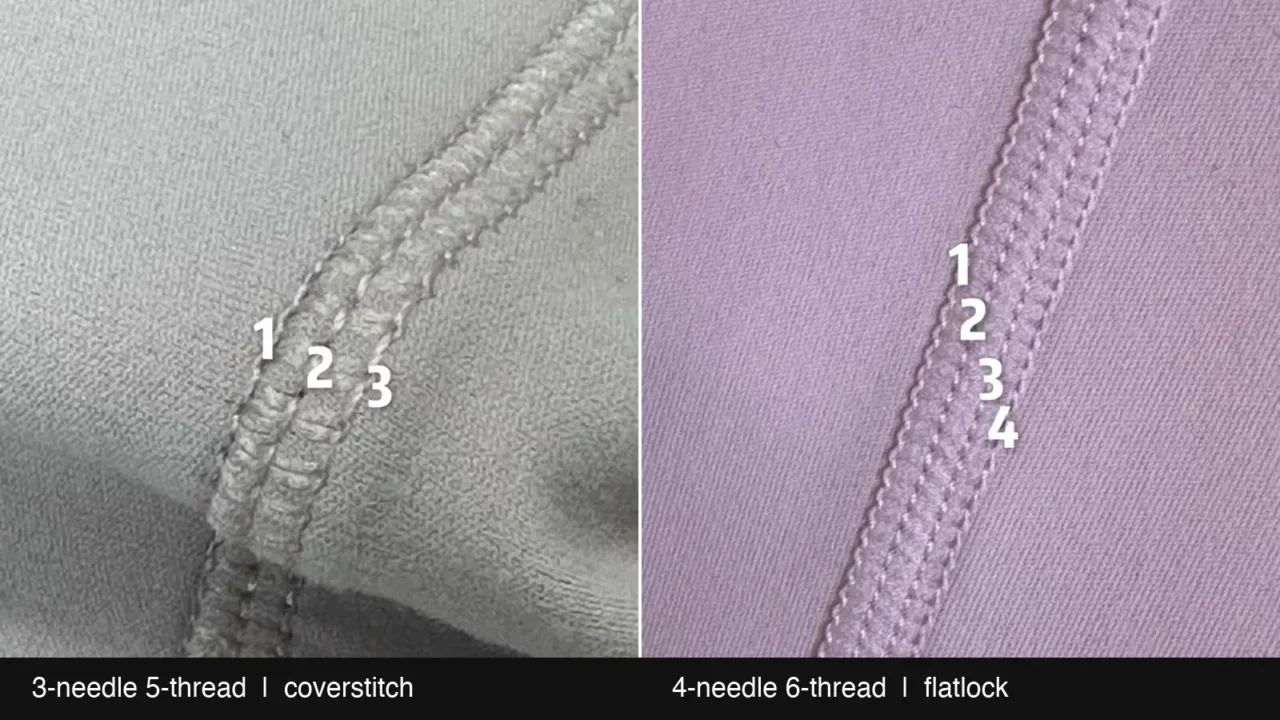
Short answer: Count the stitch lines on the outside of the seam. Three parallel lines mean a 3-needle 5-thread seam, the coverstitch, which folds and stitches hems, topstitches and reinforces edges. Four lines in a wider, flat band mean a 4-needle 6-thread seam, the flatlock, which joins two pieces of fabric edge to edge so there’s no ridge on the inside. On our sewing floor the rule is simple: join panels with 4-needle 6-thread, finish edges with 3-needle 5-thread.
Factories write these names on quotes and tech packs, often in shorthand like “3N5T” and “4N6T”, and one pair of leggings usually uses both. If you can tell them apart, you can check that your sample was sewn the way you asked, and you can tell what you’re paying for when two quotes for the same style differ. The photos below were taken on our sewing floor.
Tell them apart in ten seconds
Look at the outside of the seam and count.
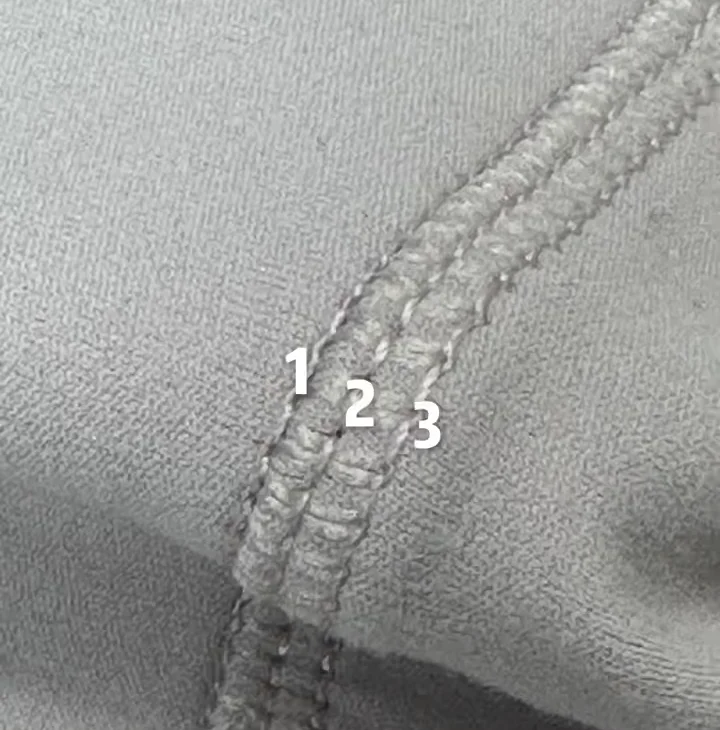
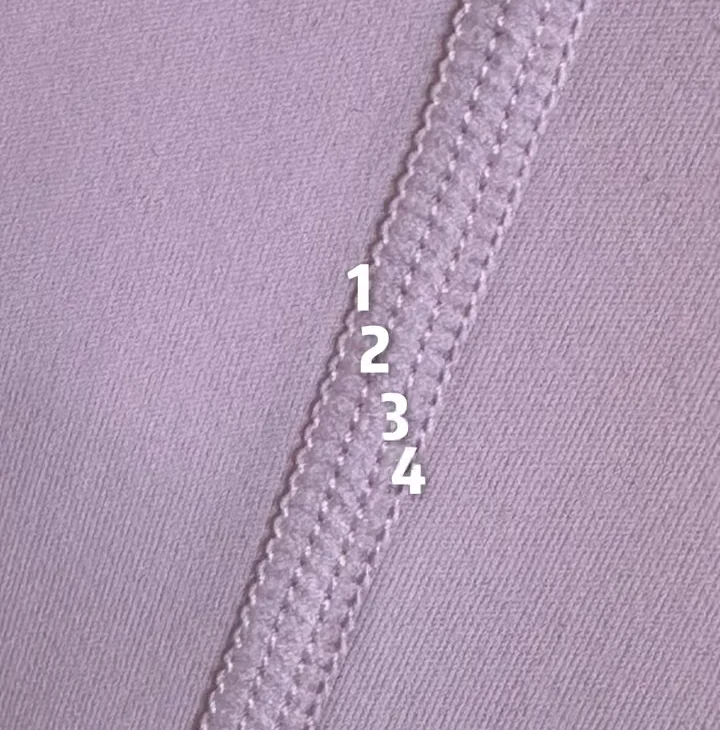
A coverstitch shows three straight, parallel rows of stitching. On the inside, a looper thread zigzags across the rows and covers the raw edge of the fold.
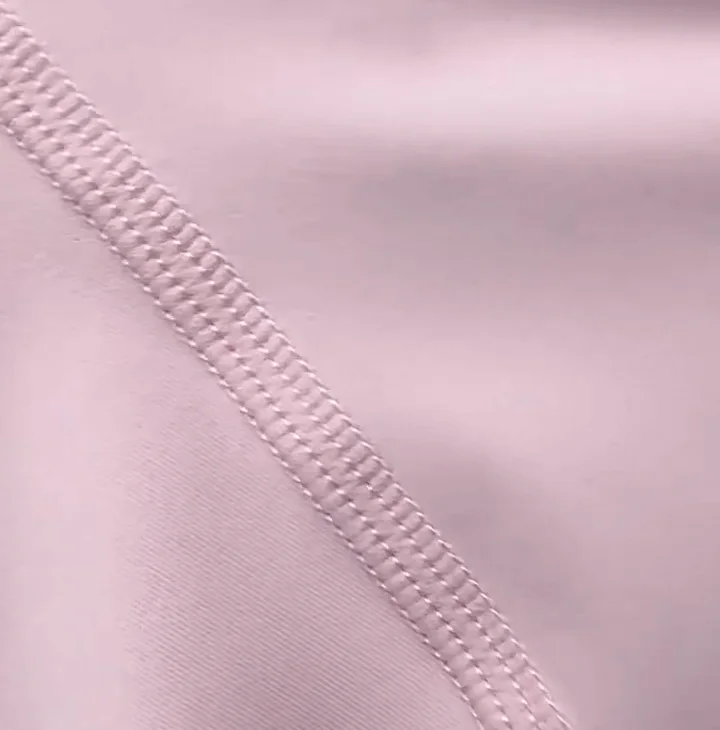
A flatlock shows four rows with cross-stitching between them. The band is wider and lies flat, so it looks like a strip of tape laid along the seam. Turn the garment inside out and the flatlock is flat on that side too.
| 3-needle 5-thread (coverstitch) | 4-needle 6-thread (flatlock) | |
|---|---|---|
| On the outside | 3 parallel lines | 4 lines in a wider, flat band |
| What it does | Folds an edge under and stitches it down, or topstitches over a seam | Joins two pieces of fabric edge to edge |
| On the inside | Looper threads cover the folded edge | Flat, with no ridge where the pieces meet |
| Usual places | Hems, leg and sleeve openings, topstitching at necklines and waistbands, edge reinforcement | Side seams and inseams on leggings, panel seams on tights, fitted tops and bras |
| Machine | Coverstitch machine with a folder attachment | Flatseamer, often several times the price of a coverstitch machine |
What a coverstitch does
A coverstitch finishes edges. The fabric runs through a folder, the metal guide in front of the needles, which turns the edge under before three needles stitch it down. The stitching stretches with the fabric, so it suits hems and openings that have to pull on over a foot or a shoulder.
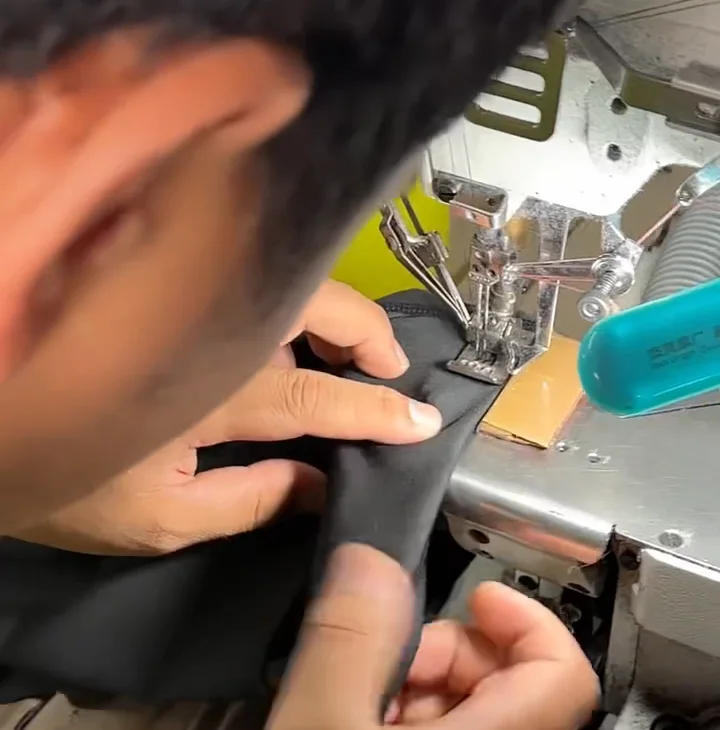
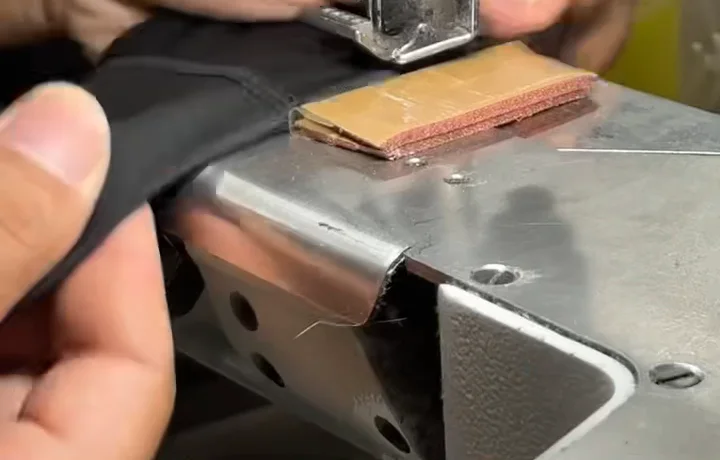
That’s why the hem of a legging, the leg opening of shorts and the sleeve hem of a training top nearly always show three lines. Factories also run a coverstitch over a seam that’s already been sewn, to hold the seam allowance flat and add strength.
What a flatlock does
A flatlock joins panels. The two edges are fed in side by side rather than stacked, and the needles and loopers sew across the join, so the seam ends up barely thicker than the fabric.
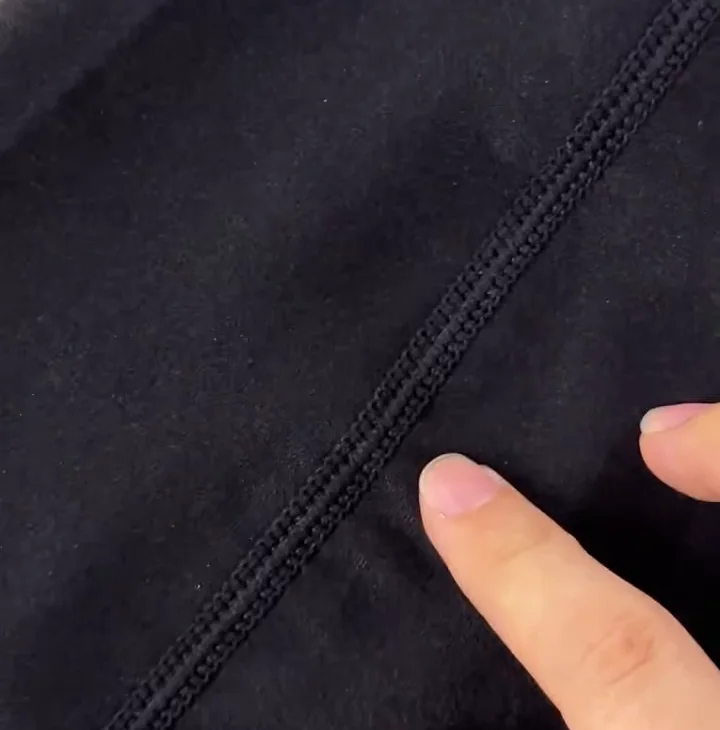
The inside is the reason to pay for it. A seam on leggings or a fitted top is pressed against the skin under stretch for an hour or more. A ridge there can rub during a run or a class, and a flat seam doesn’t.
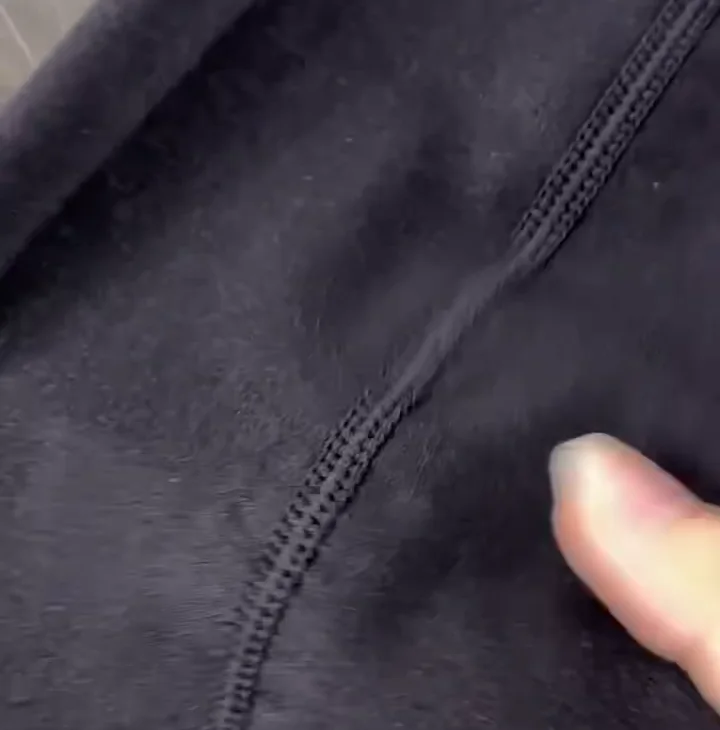
Join with 4/6, finish edges with 3/5
Pick the seam by where it sits on the garment, not by which one costs more.
- Seams that join panels and sit against the skin: 4-needle 6-thread. Leggings side seams and inseams, gusset and panel seams on tights, princess seams on fitted tops, and bra panels.
- Hems, openings and topstitching: 3-needle 5-thread is enough. A flatlock on a hem adds cost without making the garment better.
- Where it shows up in price: a flatseamer costs several times as much as a standard coverstitch machine, and a garment with many panel seams takes more of its time. When one quote for panel-heavy leggings comes in well below another, ask how the panel seams are sewn. Some factories join them with an overlock instead, which leaves a ridge inside. We compare the two in flatlock vs overlock seams.
Waistbands are a special case. A waistband joins the leg, but it’s also folded, often holds elastic, and goes on in more than one pass, so the stitching you see there is often a coverstitch. The options are covered in waistband construction.
What to write on your tech pack and check on samples
Name the seam for each location instead of writing “flatlock seams throughout”:
- Side seams, inseams and panel seams: 4-needle 6-thread flatlock.
- Hems, leg openings and sleeve hems: 3-needle 5-thread coverstitch.
- Waistband: how it’s attached, and which stitch shows on the outside.
When the sample arrives:
- Count the lines on the outside of each seam and match them to your tech pack.
- Turn the garment inside out. A flatlock should lie flat with no ridge.
- Stretch each seam lengthways and across. Stitches shouldn’t pop, and hems shouldn’t ripple or stay stretched out.
- Check the thread color against the fabric, especially on a flatlock, because its wide band is easy to see.
If you’re writing your first tech pack, our tech pack guide shows where seam details go. Finished garments are then checked against the approved sample under AQL 2.5, as in our quality control guide.
Seamless garments are different
Seamless leggings and bras are knitted to shape on circular machines, so most of the seams above disappear. What’s left is usually a few joins and finished edges. If you’re deciding between the two constructions, see seamless vs cut-and-sew.
How this works at YOUMEGA
We’re a private-label activewear manufacturer with two of our own factories, cut-and-sew in Xiamen and seamless in Yiwu, and 1,000+ private-label projects since 2017.
- Both machines on our floor. We sew coverstitch and 4-needle 6-thread flatlock in house, and we’ll tell you which seam goes where on your style.
- Stock styles come as built. On stock styles with your logo, from 100 sets in total mixing styles, colors and sizes, the seams are already set. Browse them in our online catalog.
- Custom is where you choose. On ODM and OEM, from 300–500 pieces per style, per color, you specify the seam for each location. Samples take about 7–10 days for ODM, not counting design preparation, and 10–15 days for OEM.
- The same checks on every order. Finished garments are inspected under AQL 2.5, and we reply within 24 hours on working days.
FAQ
Is a flatlock the same as a coverstitch? No. A coverstitch, usually 3-needle 5-thread, folds and stitches an edge or topstitches over a seam, and shows three lines. A flatlock, usually 4-needle 6-thread, joins two pieces edge to edge, shows four lines in a wider band, and lies flat on the inside.
Why does my legging hem show three lines but the side seam four? Because they do different jobs. The hem is an edge that’s folded and stitched, which is coverstitch work. The side seam joins two panels and sits against your leg, which is where a flatlock earns its cost.
Is 4-needle 6-thread always better? No. It’s better for joining panels that sit against the skin. On hems and topstitching, a coverstitch does the job and costs less. Pick the seam by its position on the garment.
Does a flatlock make activewear more expensive? It can. The machine costs several times as much as a coverstitch machine, and garments with many panel seams spend more time on it. If two quotes for the same style differ a lot, ask how each factory sews the panel seams.
Can I change the seams on a stock style? No. Stock styles are sold as built, which is part of why they’re fast and start from 100 sets with your logo. To choose the seams yourself, develop the style through ODM or OEM.
Not sure which seams your design needs? Send us a sketch or a photo of a garment you like. We reply within 24 hours on working days with the seam for each part and what it means for your quote. Ask about your seams →