Is Recycled Polyester Safe to Wear? What a "Recycled" Label Proves — and What It Doesn't
Short answer: A recycled-polyester claim describes feedstock, not the chemical profile or overall safety of a finished garment. GRS verifies recycled content and chain of custody and restricts chemicals used in processing, but version 5.0 does not address chemicals present in the final product. An OEKO-TEX® STANDARD 100 certificate provides evidence only for the articles and product class in its current scope. For a proposed style, check the actual certificate and relevant test results; neither document alone is an all-purpose "safe" or "non-toxic" guarantee.
What recycled polyester actually is
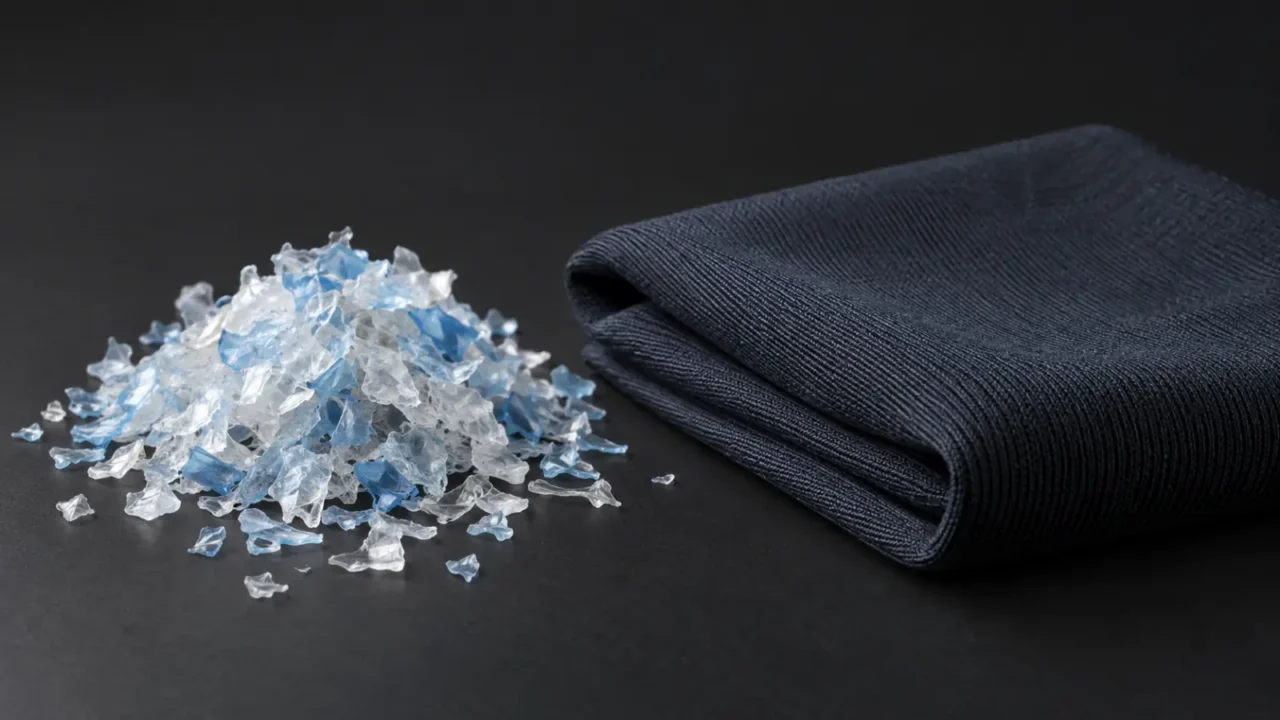
The rPET used in clothing is recycled polyethylene terephthalate, the PET polymer also used in many drinks bottles. It can be collected, cleaned and flaked, then either melted and re-spun (thermomechanical recycling) or broken down to monomers and re-polymerised (chemical recycling). Textile Exchange's Materials Market Report 2025, reporting 2024 data, estimated polyester at 59% of world fibre production and recycled polyester at 12.0% of polyester, roughly 9.3 million tonnes. For that same 2024 dataset, it estimated 98% of recycled polyester came from plastic bottles and textile-to-textile recycling at around 2%; these are dated market estimates, not a description of any proposed fabric.
| Virgin polyester | Recycled polyester (rPET) | |
|---|---|---|
| Polymer | PET | PET — the same polymer |
| Feedstock | Crude oil and natural gas, processed into PTA and MEG | Varies by lot; Textile Exchange estimated bottle feedstock at 98% of recycled polyester in its 2024 global dataset |
| Catalyst residues | Check the proposed material against the applicable restricted-substance requirements | Check the proposed material against the same requirements; feedstock history alone is not a test result |
| Dyes, finishes and prints | Added after the fibre exists | Added the same way, in the same kind of dye house |
| How you specify performance | GSM, stretch, recovery, shrinkage | The same spec sheet; rPET runs on the same knitting machines |
Recycled content and performance are separate specifications: ask for the same test figures you would on a virgin fabric. Our guide to recycled activewear fabrics, rPET and ECONYL covers the material options, and what polyester is covers the fibre itself.
What each certificate actually covers
GRS: recycled content, custody, and the chemicals used in processing
The Global Recycled Standard is run by Textile Exchange. Version 5.0 took effect on 1 July 2026 and becomes mandatory for audits from 31 December 2026, replacing version 4.0. Three points decide what it can prove for you:
- It generally applies to products containing at least 20% recycled material. The claimed material needs a verified chain of custody through the applicable certified organisations, subject to the standard's stated exceptions for some subcontractors and low-volume traders. Consumer-facing labelling requires certification through the last business-to-business seller, and product-specific labelling needs at least 50% recycled content. A mill's scope certificate alone does not turn a finished garment into a GRS product.
- On chemicals, GRS is not silent. Under GRS 5.0 D2.1, chemicals used to make GRS products must not contain substances described by REACH Article 57 and included in Annex XIV; this is not a ban on every REACH Candidate List substance. The standard also restricts specified hazard classifications and requires conformity with the ZDHC Manufacturing Restricted Substances List. Certified sites keep a list of every chemical input and current safety data sheets.
- What it does not do is test the article you will sell. GRS 5.0 says it does not address chemicals present in the final product. Final sellers of GRS products must ensure compliance with their own or nominated restricted-substance list, or with the law in the country of sale; a brand may be that seller.
The two documents you will be offered are compared in GRS scope certificate vs transaction certificate.
OEKO-TEX STANDARD 100: a named article, tested for its product class
STANDARD 100 certifies articles within a defined scope — for example a fibre, yarn, fabric, trim or finished garment — against applicable harmful-substance limit values. Check the product class and the exact scope: class I covers articles for children up to 36 months; class II direct skin contact; class III little skin contact; and class IV decoration material. Do not assume a fabric certificate covers the assembled leggings, sports bra or printed trim. Ask for the current PDF and compare its named article, components, class and validity with the proposed style.
Limits are set per product class and updated by edition. If checking antimony, use the current official limit-value document and distinguish extractable from total antimony. Do not infer a finished article's result, or a health threshold, from a general figure for polyester.
Edition 01.2026 (dated 3 March 2026) adds rules that matter for recycled fabric:
- Describing an article as recycled requires pre- or post-consumer waste only, proof of recycled origin, and at least 20% recycled content in the chief material. Pre-consumer PET bottles are not accepted as a source, recycled articles get their own certificate, and a higher testing frequency can apply depending on where the material came from.
- Articles from post-consumer or post-industrial material of unknown origin can be certified only in classes II to IV. Material from recycled PET bottles and food-grade sources is the exception: it can also be certified in class I.
- For renewals, every manufacturer or commissioner in the chain performing a wet or chemical process must hold a valid certificate covering the product, with a transition period to June 2027.
More detail: OEKO-TEX STANDARD 100 explained.
| Document | What it proves | What it does not prove |
|---|---|---|
| GRS scope certificate | A named site is certified for named products and processes, under recycled-content, custody and processing-chemical rules | What is in the final product; nor does it cover the rest of the chain |
| GRS transaction certificate | A specific shipment moved between certified organisations as GRS material | Anything about harmful substances in that shipment |
| OEKO-TEX STANDARD 100 certificate | Evidence for the named articles and applicable product class within its dated scope; recycled articles may have additional origin and testing requirements | It does not certify an unlisted finished style or establish overall safety for every exposure and market |
The four things people mean by "is it safe to wear"
| The question | Does recycling change the answer? | What answers it |
|---|---|---|
| Catalyst residues | Cannot be inferred from recycled or virgin status alone | A relevant result for the specified article and substance, interpreted against the applicable limit |
| Dyes, finishes and prints | May differ by supplier and process | Testing plus the brand's restricted-substance list (how screening works, PFAS in yoga wear) |
| Substances carried in from earlier use | Depends on feedstock and controls | Traceability and relevant testing for the specified article; check recycled-material requirements in the applicable standard |
| Microfibres released in washing | Cannot be concluded from the recycled label | Compare fabrics and use conditions with a relevant shedding test |
The chemistry behind the headlines is in toxic chemicals in activewear; what a usable lab report contains is in how to read a fabric test report.
Why "recycled" and "safe" get read as the same claim
Sustainability claims and safety claims sit side by side on hangtags, so shoppers read one as implying the other. The standards keep them apart: a recycled-content certificate is not a substitute for a harmful-substance test, and a harmful-substance test says nothing about where the fibre came from.
What we check at the factory
When a recycled fabric is specified, we ask the mill for its current GRS scope certificate and check the named products and processes. The source-mill or dye-house certificate is not YOUMEGA's and does not by itself support a GRS claim for a finished garment; for a proposed rPET style, the applicable chain and transaction documents must be checked order by order. YOUMEGA does hold an OEKO-TEX STANDARD 100 certificate, but we have not reviewed its PDF, product class, validity or coverage for this article here. During supplier vetting, ask for the current PDF and confirm whether the specific fabric, components or finished style are within its scope; request relevant article-level test results where the claim or market requires them. Applicable PDFs can be forwarded within 24 hours during supplier vetting. Agree the brand's restricted-substance list, test panel and evidence before bulk fabric is booked. Our full-custom MOQ is 300–500 pieces per style per colour, depending on the product; in-house finished-goods QC uses AQL 2.5.
FAQ
What is recycled polyester? The rPET discussed here is polyester made from recovered PET, which can be reprocessed into fibre. Textile Exchange's 2024 global dataset estimated 98% of recycled polyester came from bottles and around 2% from textile-to-textile recycling; those figures do not identify the feedstock of a particular lot.
Is recycled polyester toxic? Recycled status alone cannot answer that. Check feedstock controls, dyes, finishes, prints and trims, then request a test panel appropriate to the named article, product class and market. Results for specified substances and limits provide bounded evidence, not an unconditional "non-toxic" conclusion. GRS 5.0 does not address chemicals present in the final product.
Does recycled polyester contain antimony? A recycled label cannot answer for the actual material. Ask for the article's relevant test result and compare extractable antimony with the current applicable product-class limit. Total and extractable concentrations are different measures.
Does a mill's GRS certificate make a garment GRS certified, or non-toxic? No to both. Verify the applicable chain-of-custody and transaction evidence for the specific garment, including any standard exceptions; product-specific consumer labelling also needs at least 50% recycled content. GRS does not address chemicals present in the final product.
Is recycled polyester suitable for babies and children? Recycled content alone does not establish suitability. OEKO-TEX STANDARD 100 product class I addresses harmful-substance requirements for articles intended for babies and children up to 36 months; it does not replace other safety requirements for the finished garment and its market. Under Edition 01.2026, recycled articles of unknown origin can be certified only in classes II to IV; material from recycled PET bottles and food-grade sources may also be certified for class I.
Is recycled polyester better for the environment? It uses recovered PET, but this question needs a defined impact measure and comparable lifecycle data. Textile Exchange estimated for 2024 that 98% of recycled polyester feedstock came from bottles and around 2% from textile-to-textile recycling; this does not describe an individual garment. Its June 2026 polyester life cycle assessment is non-comparative and does not itself rank recycled against virgin.
Can I get recycled polyester with stretch? Yes, a proposed rPET fabric can include elastane. Ask for the composition and documentation identifying exactly which fibre content is recycled, plus the finished fabric's stretch and recovery results. Industry-wide elastane production shares cannot establish the content of a specific order.
Building a recycled line and need the paperwork to match the claim? Send us the fabric and the claim you want to print, and we will tell you which certificates have to exist and who has to hold them.
Sources
- Textile Exchange, Global Recycled Standard 5.0, July 2026
- OEKO-TEX® STANDARD 100, standard document, Edition 01.2026
- OEKO-TEX®, STANDARD 100 overview page
- Textile Exchange, Materials Market Report 2025 (2024 data, published September 2025)
- Textile Exchange, Life Cycle Assessment for Polyester — Summary, June 2026
- Molecules, "Impact of Chemicals and Processing Treatments on Thermo-Mechanical Recycling of Polyester Textiles", 2025